How to Build an Auto Villager Trading Machine in Minecraft (2026)
Filed under Minecraft Economy & Trading · How we create content
Key Takeaways
| Point | Details |
|---|---|
| Auto trading defined | A Redstone contraption that cycles villager trades automatically, producing emeralds or desired items without manual input. |
| Core components | Villagers locked onto workstations, input hoppers for trade materials, a Redstone clock to trigger trades, and an item collection system. |
| Discount stacking | Curing zombie villagers and Hero of the Village can push many trades down to 1 emerald, maximizing profit. |
| Passive income | Even a basic machine running wheat-to-emerald trades can generate over 100 emeralds per hour while you're away. |
| Gaia Legends integration | Use your machine's emeralds to buy from player shops or fuel a job system economy without grinding. |
Table of Contents
- What Is an Auto Villager Trading Machine?
- Why Should You Automate Villager Trading?
- What Materials Do You Need to Build an Auto Trading Machine?
- How to Build an Auto Villager Trading Machine
- How Can You Maximize Emerald Output?
- Best Practices for Redstone Trading Machines
- How to Put This Into Practice on Gaia Legends
- Conclusion
- Frequently Asked Questions
- Recommended
If you’ve ever spent hours clicking through villager trades, you know how tedious it can be. A minecraft auto villager trading machine changes that — it automates the entire process so you can generate emeralds or rare items while you do other things. Whether you’re after a passive emerald farm or a way to stockpile enchanted books, this guide walks you through every component, from villager holding cells to Redstone clocks. By the end, you’ll have a fully functional machine that turns idle time into wealth.
What Is an Auto Villager Trading Machine?
An auto villager trading machine is a Redstone contraption that automatically cycles trades with villagers to produce emeralds or desired items without manual clicking.
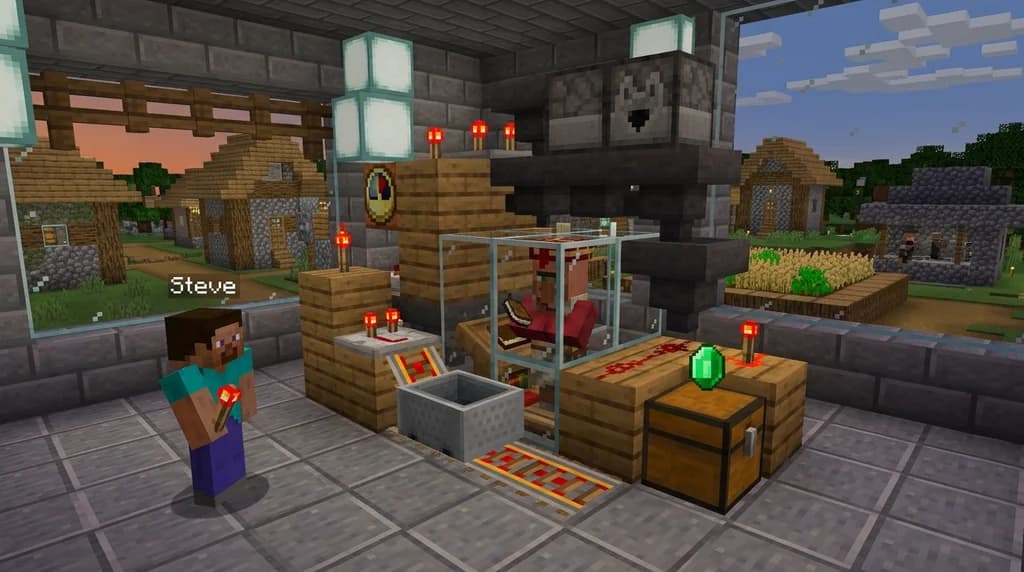
At its core, the machine holds one or more villagers in place, each linked to a specific workstation. Hoppers and minecarts deliver the required trade items (like wheat, paper, or rotten flesh) to the villager, while a Redstone clock triggers the trade interaction. The resulting items — usually emeralds — are collected and stored in chests. Because villagers restock their trades up to two times per Minecraft day, a well-designed machine can run continuously, turning basic farm outputs into a steady emerald stream.
Why Should You Automate Villager Trading?
Automating villager trading eliminates the most repetitive part of Minecraft’s economy, freeing you to focus on building, exploring, or running a player shop.
Manual trading is slow and error-prone. An auto machine lets you scale up without extra effort. On multiplayer servers, emeralds are often the backbone of the economy — they’re used in job systems with quests and rewards or as a standard currency in barter economies. By producing emeralds passively, you can afford high-value items from other players without grinding for hours.
What Materials Do You Need to Build an Auto Trading Machine?
You’ll need villagers, workstations, hoppers, minecarts, rails, Redstone components, and building blocks to create a reliable auto trading machine.
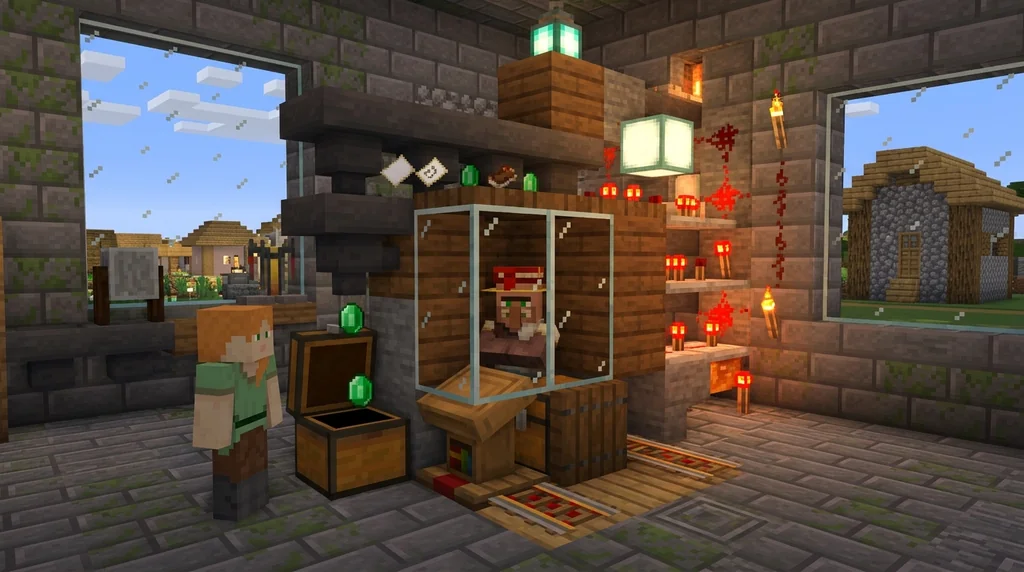
Here’s a basic checklist:
- Villagers: At least one, ideally a farmer (wheat→emerald) or librarian (paper→emerald).
- Workstations: Composter (farmer), lectern (librarian), etc.
- Redstone: 1 comparator, 1 repeater, 2-3 Redstone dust, 1 Redstone torch, 1 sticky piston (optional).
- Hoppers & Minecarts: 3-4 hoppers, 1 minecart with hopper, 2-3 rails, 1 powered rail.
- Input chest for trade items, output chest for emeralds.
- Building blocks: Glass, slabs, and solid blocks for the containment cell.
Note: If you’re using multiple villagers, consider a trading post design to keep them organized and safe from mobs.
How to Build an Auto Villager Trading Machine
Building an auto trading machine requires positioning villagers near their workstations, using hoppers and minecarts to collect items, and a Redstone clock to trigger trades.
Follow these steps to assemble a basic but effective machine.
Step 1: Villager Holding Cell
Place your chosen villager in a 1×1 glass enclosure with a workstation directly in front of them. Make sure the villager can reach the workstation but cannot wander. Trapdoors or slabs above the workstation prevent escape while still allowing trade access. If you cured a zombie villager, the permanent discount will apply to all future trades.
Step 2: Input and Output System
Set up a double chest above the villager’s cell, connected to a hopper that feeds into a minecart with hopper. The minecart should travel on a rail loop that passes directly in front of the villager, depositing the trade item (e.g., wheat) into the villager’s inventory. A second hopper line beneath the cell collects the emeralds the villager drops after each trade.
Pro Tip: Use a sticky piston to push a block in front of the villager’s workstation to pause trading if you need to swap items or transport the villager.
Step 3: Redstone Clock and Trigger
A simple comparator clock or observer-based clock can pulse the minecart every few seconds. Connect the Redstone signal to a powered rail to start and stop the minecart. The clock should be fast enough to cycle trades but slow enough for the villager to restock — about 10–15 seconds per cycle works well.
Step 4: Item Collection and Sorting
Emeralds from the villager drop into a hopper below and are routed into an output chest. If you’re trading multiple items (e.g., from different villagers), add a simple item sorter to separate emeralds from other drops.
Warning: Always chunk-load the area or ensure the machine is in spawn chunks; if the machine unloads, the minecart may stop and break the loop.
How Can You Maximize Emerald Output?
Stacking villager discounts, choosing the most efficient trades, and keeping the machine running 24/7 are the keys to maximizing emerald output.
Curing a zombie villager provides a permanent discount of 1 emerald per trade, stacking with Hero of the Village for massive price reductions (via Minecraft Wiki). A single farmer villager can trade 1 emerald for 20 wheat, making wheat farming a reliable emerald source for automated farms (via Minecraft Wiki). Combine that with an auto wheat farm, and your machine becomes a true emerald printing press.
On the other hand, a librarian has a 2.8% chance of offering a Mending book trade, making it one of the rarest villager trades (via Minecraft Wiki). If you’re after enchanted books, you might want to focus on a librarian trading machine instead, then sell the books for emeralds in a player economy where you’ve learned to price items correctly.
Best Practices for Redstone Trading Machines
Keep designs simple, test in creative first, and always lock your villagers in place to prevent accidents.
Here’s a quick comparison of common machine types:
| Machine Type | Complexity | Emerald Rate | Redstone Knowledge | Best For |
|---|---|---|---|---|
| Single-villager wheat loop | Low | ~100/h | Basic clock | Beginners |
| Multi-villager with sorter | Medium | ~300/h | Comparators, hopper lines | Mid-game servers |
| Fully automatic with farms | High | 600+/h | Observer clocks, minecart logic | End-game wealth |
Villagers restock their trades up to two times per Minecraft day, meaning a fully loaded trading machine can generate emeralds every 10 minutes of play (via Minecraft Wiki). To avoid scams when trading those emeralds with other players, always check the common scams in player markets.
How to Put This Into Practice on Gaia Legends
On Gaia Legends, your auto trading machine isn’t just a novelty — it’s a core part of the player-driven economy. Use the emeralds you generate to buy rare blocks, gear, or even land from other players’ shops. Combine your machine with the server’s job system to earn extra rewards while you trade, or stockpile emeralds to dominate the diamond currency market.
Gaia Legends is free to join, non-pay-to-win, and supports Java + Bedrock crossplay. Whether you’re a Redstone novice or a seasoned engineer, the community is full of builders who can help you refine your machine. Join at gaialegends.pro and start your legend today.
Conclusion
An auto villager trading machine turns one of Minecraft’s most tedious tasks into a passive income stream. Remember the three pillars:
- Simplicity first: Start with a single-villager wheat loop before scaling up.
- Discounts matter: Cure villagers and stack Hero of the Village to push prices to 1 emerald.
- Keep it chunk-loaded: A machine that unloads stops producing.
Build it, tweak it, and watch your emerald count rise while you focus on the fun parts of the game.
Ready to play? Join Gaia Legends today — no pay-to-win, Java + Bedrock crossplay.
- Java:
join.gaialegends.pro - Bedrock:
join.gaialegends.pro— Port19132
Further reading
These references were recorded with the article; specific claims have not been matched to source excerpts.
Frequently Asked Questions
What is a minecraft auto villager trading machine?
It’s a Redstone contraption that automates trading with villagers. It holds a villager in place, delivers trade items via hoppers and minecarts, and triggers trades with a clock, collecting emeralds or other items automatically.
How many emeralds can an auto trading machine produce per hour?
A basic wheat-to-emerald loop with one farmer can produce around 100 emeralds per hour. More advanced multi-villager setups with optimized trades and discounts can exceed 600 emeralds per hour.
Do I need a zombie villager for the machine to work?
No, but curing a zombie villager gives a permanent 1-emerald discount per trade, which stacks with Hero of the Village. This can make many trades cost only 1 emerald, dramatically increasing profit margins.
What is the best villager profession for an auto trading machine?
Farmers are the easiest — they trade wheat, potatoes, or carrots for emeralds. Librarians are great for paper trades and enchanted books, but they require more setup and a reliable paper supply.
How do I keep the machine running when I’m offline?
The machine must stay in loaded chunks. On servers, use a chunk loader or build it in spawn chunks. In singleplayer, you’ll need to stay nearby or use a mod that keeps chunks loaded.
Can I use this machine to get enchanted books automatically?
Yes, but it’s trickier. You’ll need a librarian with the desired book trade, and you must supply the required item (usually emeralds and a book). A sorter can separate the enchanted books from other drops.
Related guides

Piglin Bartering: Mechanics and Rewards
Learn the exact mechanics of piglin bartering in Minecraft Java and Bedrock. Includes cycle times, barter rewards, Soul Speed odds, and tips for efficient trading.
Minecraft Economy 101: How Supply and Demand Work on Player-Driven Servers
Learn how supply and demand shape Minecraft economies, from vanilla villager trading mechanics to player-driven server markets. Includes inflation control...
How to Build a Command Block Currency Exchange for Your Minecraft Server
Build a fully vanilla command block currency exchange for your Minecraft server. No plugins needed—just redstone and command blocks. Step-by-step guide...
How to Cure a Zombie Villager for Insane Trading Discounts in 2026
Master the art of curing zombie villagers for massive, permanent trading discounts in Minecraft 2026. Step-by-step guide, trading hall designs, and...
Have a question or another approach?
Compare notes with other readers. Include your edition and version when discussing mechanics.