How to Price Items on a Minecraft Player Economy Server (2026)
Filed under Minecraft Economy & Trading · How we create content
Key Takeaways
| Point | Details |
|---|---|
| Calculate base cost | Add up the time, tools, and resources required to get one unit—this is your minimum price floor. |
| Watch supply and demand | Price high when stock is low and demand spikes; lower prices when the market is flooded. |
| Pick a model | Fixed-price shops, auction houses, and chest-shop plugins each suit different sales strategies. |
| Adjust weekly | Review your listings regularly to match evolving market conditions and competitor moves. |
| Avoid dumping | Selling too low can crash the economy for everyone; set a healthy minimum. |
| Track your niche | Focus on a few high-demand items you can consistently supply, rather than selling everything. |
Table of Contents
- What Is a Player-Driven Market Economy in Minecraft?
- How Do You Determine an Item’s Base Value?
- Why Supply and Demand Matters on SMP Servers
- Best Pricing Models for Minecraft Server Economies
- How to Adjust Prices Over Time (Market Correction)
- Tips for Avoiding Common Pricing Mistakes
- How to Put This Into Practice on Gaia Legends
- Frequently Asked Questions
- Recommended
Pricing items on a Minecraft player economy server can feel like walking a tightrope. Price too high, and customers walk away; price too low, and you struggle to buy anything else. In a player-driven market, there’s no automatic vendor telling you what a diamond is worth — it’s all up to you. This guide breaks down how to price items on a Minecraft player economy server in 2026, using real strategies that work on SMP (Survival Multiplayer) worlds like Gaia Legends. You’ll learn how to calculate base costs, read supply and demand signals, pick the right pricing model, and adjust over time to keep your shop thriving.
What Is a Player-Driven Market Economy in Minecraft?
A player-driven market economy is a system where the value of all goods is set by players themselves through trade, not by static NPC prices, creating a dynamic, ever-changing bazaar.
A player-driven economy relies on trust and negotiation. Instead of buying from a villager with a fixed price, you set up a shop and either list items for a set amount or barter directly. On many servers, custom currency mods replace emeralds with gold coins or server points. Other servers, like Gaia Legends, run on a diamond-based standard where every item’s worth traces back to how many diamonds it takes to obtain or craft it. The beauty of this system is that prices reflect real scarcity: if a creeper destroys the only sugarcane farm, paper prices will spike until someone replants.
How Do You Determine an Item’s Base Value?
To set a fair price, first calculate the item's acquisition cost: the time and tools needed to obtain one unit, including any crafting steps or mob drops.
The base value represents your minimum acceptable price. For example, mining a diamond ore block with a Fortune III pickaxe yields an average of 2.2 diamonds per block (via Minecraft Wiki). A diamond pickaxe has a durability of 1561 (via Minecraft Wiki). That means you’ll lose a tiny fraction of a pickaxe with each ore mined—so your base price for diamonds should cover tool wear, plus your time. Add a markup for risk if you mined in the deep dark or fought mobs.
For servers that use diamonds as the main currency, this calculation directly determines how many other blocks you can trade for one diamond. If you farm emeralds with villagers, factor in the time to reset trades and cure zombie villagers.
Accounting for Crafting and Enchanting
Netherite upgrades need four netherite scraps and four gold ingots, doubling the base cost. Enchanting adds a layer: a fully enchanted diamond sword costs significantly more because you burn experience levels and lapis lazuli. Always calculate the full production chain before listing an enchanted netherite piece, or you’ll sell yourself short.
Why Supply and Demand Matters on SMP Servers
In a player economy, prices spike when few players sell an item and many want it, but crash when everyone stocks the same block after a common event.
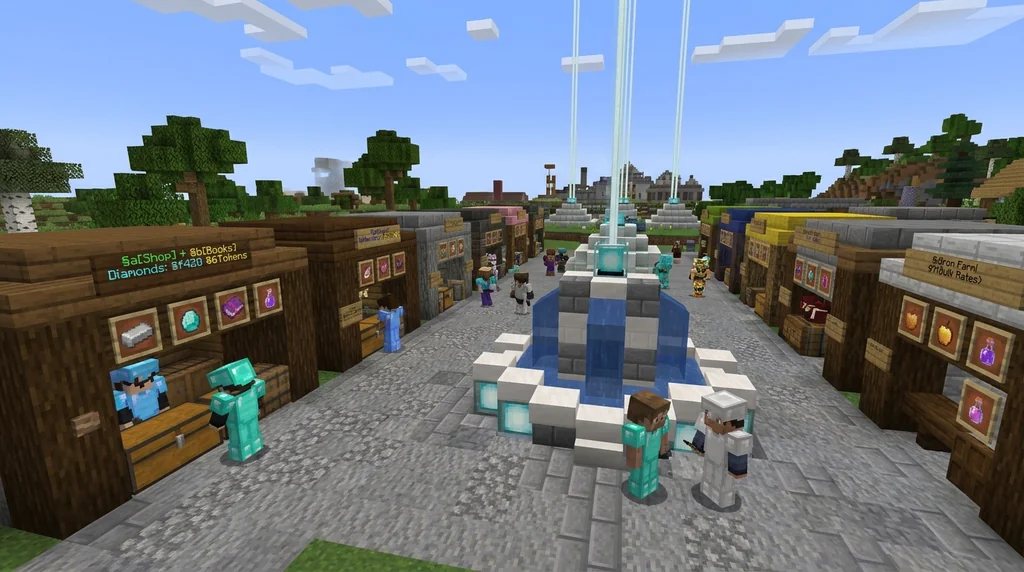
Supply and demand behave like real-world economics. When a new update adds the mace, every PvPer wants one, and the price of heavy cores jumps. Once people build farms, supply increases, and prices fall. Watch what other shops list and what sells. Wither skeletons have a 2.5% chance to drop a wither skull, making them one of the rarest farmable mob drops (via Minecraft Wiki). That scarcity keeps skulls expensive even when farms exist.
When bartering with piglins, a player has a 5.63% chance to receive a blaze powder per gold ingot (via Minecraft Wiki). So blaze rods (and blaze powder) often settle at a moderate price because gold is farmable. You can observe these shifts by checking auction house listings.
Best Pricing Models for Minecraft Server Economies
Minecraft server shops typically use fixed prices, dynamic bidding, or chest-shop plugins that let players set their own price and restock on demand.
Each model fits a different niche. Fixed-price shops (like warp markets) are simple but require manual restocking. Auction houses let the community dictate value but can be volatile. Chest-shop plugins, supported by top economy add-ons, balance control and automation.
| Model | Best For | Risk |
|---|---|---|
| Fixed Price Shop | Starter items, bulk blocks | Underpricing if you ignore costs |
| Auction House | Rare collectibles, one-offs | Low bids during quiet hours |
| Chest Shop Plugin | Ongoing sales, enchantments | Requires constant monitoring |
On many servers, a hybrid approach works best: put common essentials in a fixed shop, auction rare trophies, and use chest shops for mid-range gear.
How to Adjust Prices Over Time (Market Correction)
Regularly scanning competing shops and monitoring what sells quickly keeps your prices competitive; set a calendar reminder to review your listings at least once per real-life week.
Markets evolve. A week after an enderdragon fight, end stone prices may halve. Every major patch can flip item values. Use auction house logs or simple signs to note which items sit unsold. If nobody buys your diamond blocks at 4 diamonds each for a month, lower them to 3. If arrows sell out instantly, raise the price slightly.
Flipping guides often emphasize timing; you can apply the same logic by watching Gaia Legends’ auction house trends.
Tips for Avoiding Common Pricing Mistakes
Avoid overpricing common building materials or massively underpricing rare loot: the biggest error is forgetting to account for your own time when mining or farming.
- Don’t set a price below your base cost. If it takes 5 minutes to get 1 emerald block, charging 1 iron ingot loses you time.
- Don’t ignore seasonal demand. Fire resistance potions sell for more before a nether fortress raid.
- Don’t match the lowest price blindly. Some players dump items at a loss to clear inventory; you can hold out for a better price.
Warning: Selling items below your minimum required cost devalues everyone’s stock and can trigger a server-wide economic crash. Protect your margins.
Curing a zombie villager and triggering the Hero of the Village effect can reduce trade prices by up to 55% (via Minecraft Wiki). That means a player with a trade hall can undercut you on enchanted books if you don’t factor in their discounts. If you can’t beat that price, pivot to items they don’t sell. One smart move is to build a trading post where you can showcase multiple types of wares and create a one-stop shop that attracts more customers.
How to Put This Into Practice on Gaia Legends
On Gaia Legends, our player economy uses a blend of diamonds and the /shop system to create a balanced market. Players can set up chest shops in the spawn mall, list rare items on the auction house, and even flip items for profit. We’ve observed that items like enchanted netherite tools stabilise around 4-6 diamonds each, while bulk stone sells for pennies. Gaia Legends is free to join, non-pay-to-win, and supports Java + Bedrock crossplay. Join at gaialegends.pro and start your legend today.
Conclusion
Pricing on a player-driven server isn’t a static formula—it’s a living game within the game. Remember these three pillars:
- Calculate your base cost so you never operate at a loss.
- Watch supply and demand to ride price waves.
- Adjust your listings regularly to stay competitive.
Whether you’re running a diamond empire or a tiny food stall, fair pricing helps everyone. Log in, open a shop, and see what the market will bear.
Frequently Asked Questions
Recommended
- How to Build a Minecraft Fishing Village in Survival (2026 Guide)
- How to Unlock Minecraft Prestige Rewards and Perks on Servers in 2026
- How to Choose the Best Mod Loader for Vanilla+ Minecraft in 2026
- 7 Common Fixes for Minecraft Multiplayer Not Working (2026)
Ready to play? Join Gaia Legends today — no pay-to-win, Java + Bedrock crossplay.
- Java:
join.gaialegends.pro - Bedrock:
join.gaialegends.pro— Port19132
Further reading
These references were recorded with the article; specific claims have not been matched to source excerpts.
Frequently Asked Questions
How do I price items on a Minecraft player economy server?
Start by determining the item’s base cost—the time and resources required to get one unit. Then research what other players charge for similar items. Finally, adjust based on supply: if many people sell it, lower your price; if rare, increase it. Check the market every few days to stay current.
What is the best currency for a Minecraft server economy?
Diamonds and emeralds remain the most popular physical currencies because they are stackable, universally recognised, and tied to in-game progression. Some servers use custom plugins with virtual coins, which offer more control. The best currency is one your player base trusts and finds convenient.
How do I avoid crashing my server’s economy?
Don’t sell items below their base cost or flood the market with free goods. Keep a healthy minimum price that reflects the effort to obtain the item. Encourage new players to earn rather than receive handouts, which devalues everyone’s work.
Should I use fixed-price shops or auctions?
Use fixed-price shops for everyday items like wood, cobblestone, and food to provide consistent prices. Reserve auctions for rare or one-of-a-kind items (e.g., dragon eggs, named gear) where bidding can drive up the price. A mix of both keeps your economy dynamic.
How often should I change my shop prices?
Check your sales logs at least once a week. If an item sells within minutes of listing, raise the price slightly. If it never sells, lower it. After major server events or updates, re-evaluate everything because new farms or patches can shift values overnight.
Can I make real profit from a Minecraft player economy?
You earn in-game wealth, not real money, but mastering a server’s economy lets you afford the best gear, bases, and prestige on the server. On Gaia Legends, top traders amass stacks of diamond blocks and control key markets, gaining influence and fun gameplay advantages.
Related guides
How to Set Up a Profitable Minecraft Chest Shop: 2026 Guide
Master the Minecraft chest shop guide for 2026. Learn plugin setup, best items to sell, pricing strategy, and layout tips to dominate any SMP economy server.
How to Maximize Piglin Bartering for Maximum Profit in Minecraft 2026
Maximize piglin bartering profit in Minecraft 2026 with this guide covering farm setups, best items to trade, gold-to-emerald strategies, and server...
7 Best Items to Sell in Minecraft Player Chest Shops in 2026
Discover the 7 best items to sell in Minecraft chest shops in 2026. Maximize your SMP economy profits with this data-backed shop profit guide.
7 Best Items to Sell on Minecraft SMP Servers: 2026 Market Guide
Discover the 7 best items to sell on Minecraft servers in 2026. Maximize your SMP economy profits with this player market guide covering top-selling...
Have a question or another approach?
Compare notes with other readers. Include your edition and version when discussing mechanics.