Top 7 Aesthetic Cottagecore Block Palettes for Minecraft 2026
Filed under Minecraft Build Palette & Block Harmony · How we create content
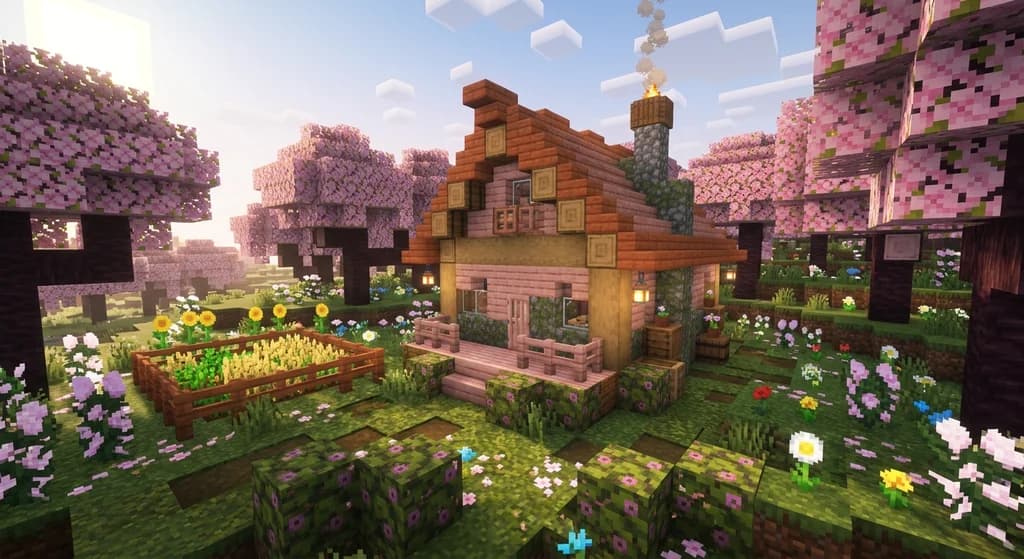
Key Takeaways
| Point | Details |
|---|---|
| 60/30/10 palette rule | Use 60% base blocks, 30% accent blocks, and 10% detail blocks for balanced, professional-looking cottagecore builds. |
| Cherry is the fairycore MVP | Cherry wood planks and cherry leaves together create a natural pink-pastel canopy no other wood type can match. |
| Moss over stone every time | Replacing cobblestone with moss blocks and mossy cobblestone instantly ages a build and adds organic texture. |
| Calcite and diorite for soft walls | These pale, low-saturation stones keep walls light without the harshness of white concrete or quartz. |
| Wildflower detail blocks matter | Oxeye daisies, azure bluets, and pink petals placed in pots or window boxes add fairycore charm at zero build cost. |
| Mix vertical and horizontal textures | Alternating stripped oak logs (horizontal) with oak planks (vertical) breaks up flat walls and reads as intentional craftsmanship. |
Table of Contents
- What Are Aesthetic Cottagecore Building Blocks in Minecraft?
- Why Does Block Palette Ratio Matter for Cozy Builds?
- Top 7 Cottagecore Block Palettes
- How Do You Choose the Right Fairycore Minecraft Block Combinations?
- Tips for Cozy Forest House Blocks and Wildflower Details
- How to Put This Into Practice on Gaia Legends
- Conclusion
- Frequently Asked Questions
- Recommended
Most Minecraft builders obsess over shape and scale — and then wonder why their builds still feel cold. The secret isn't the footprint. It's the blocks. Choosing the right aesthetic cottagecore building blocks transforms a plain wooden box into something that looks like it grew out of the forest floor. This guide gives you seven ready-to-use palettes, a proven ratio system, and the specific block names you need to start building fairy-tale magic today.
What Are Aesthetic Cottagecore Building Blocks in Minecraft?
Aesthetic cottagecore building blocks are warm, organic, low-saturation Minecraft materials — woods, mossy stones, flowering plants, and pale terracottas — that together evoke a handmade, nature-rooted fairy-tale atmosphere.
Cottagecore is a design aesthetic inspired by rural, pastoral life: wildflower meadows, thatched roofs, herb gardens, and candlelit interiors. In Minecraft, you translate that into specific block choices. The palette leans on warm yellows and pinks, soft greens, and weathered stone — never neon concrete or polished metal.
The Minecraft Wiki lists over 800 unique block types available in Java and Bedrock editions as of 1.21 (via Minecraft Wiki). Out of those 800+, roughly 40–60 blocks reliably nail the cottagecore look. Knowing which ones to reach for — and which to avoid — is the entire game.
Core cottagecore block families:
- Wood: Oak, cherry, birch, stripped spruce
- Stone: Mossy cobblestone, calcite, diorite, stone bricks
- Greenery: Moss block, flowering azalea, azalea leaves, fern
- Floral detail: Pink petals, oxeye daisy, azure bluet, lilac
- Earthy accents: Coarse dirt, rooted dirt, mud bricks, hay bales
Note: Avoid smooth quartz, white concrete, and glass panes as primary materials — they read as modern, not cozy, and will undercut your palette instantly.
Why Does Block Palette Ratio Matter for Cozy Builds?
The 60/30/10 palette ratio — 60% dominant base, 30% supporting accent, 10% pop detail — is the single most reliable framework for making cottagecore builds look intentional rather than random.
Interior designers use this ratio for room color schemes, and it maps perfectly onto Minecraft block selection. Your dominant base (oak planks, mossy cobblestone) covers walls and floors. Your supporting accent (stripped birch logs, calcite) frames windows, corners, and rooflines. Your pop detail (pink petals, lanterns, flower pots) catches the eye and gives the build personality.
Breaking this ratio — say, using five different wood types at equal proportions — is the #1 reason cottagecore builds end up looking cluttered instead of cozy. Pick one primary wood, one primary stone, and let everything else serve those two anchors.
For a deeper look at how palette ratios work across all Minecraft build styles, the How to Use a Minecraft Palette Generator for Perfect Builds 2026 guide walks you through digital tools that automate this math.
Top 7 Cottagecore Block Palettes
These seven palettes are tested, named, and ready to copy — each one built around a dominant base, a supporting accent, and a detail layer that locks the aesthetic together.
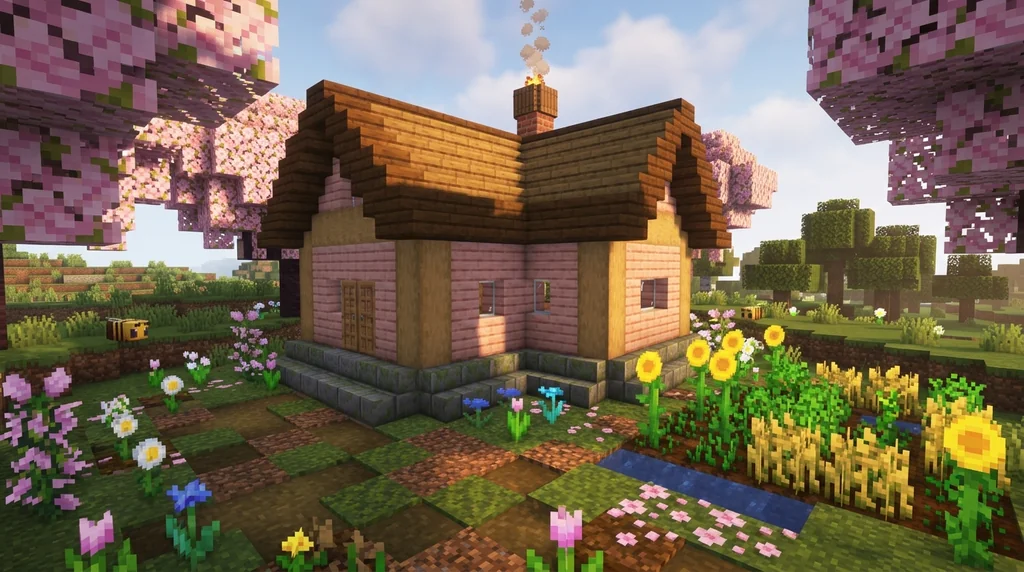
Palette 1: Cherry Blossom Fairycore
| Role | Block |
|---|---|
| Base (60%) | Cherry planks + cherry log |
| Accent (30%) | Calcite + white terracotta |
| Detail (10%) | Pink petals, cherry leaves, pink candles |
This is the most recognizable fairycore palette in 2026. Cherry wood was introduced in Java 1.20 and Bedrock 1.20.0 (via Minecraft Wiki), and its warm rose-pink hue pairs with calcite's cool pale grey to create a pastel contrast that feels delicate without being saccharine. Use cherry leaves as roof overhangs for a natural canopy effect.
Palette 2: Mossy Cottage Classic
| Role | Block |
|---|---|
| Base (60%) | Oak planks + mossy cobblestone |
| Accent (30%) | Stripped oak log + stone bricks |
| Detail (10%) | Moss block, fern, oxeye daisy, lantern |
This is the foundational cottagecore palette — the one that started the trend. Mossy cobblestone reads as aged and weathered, while oak planks stay warm and inviting. The moss block (craftable from moss carpets or found in lush caves) adds a velvety green texture that no other block replicates.
Pro Tip: Place moss blocks on the lower third of exterior walls and let cobblestone take the upper two-thirds. It mimics how real moss grows from the ground up and makes the build feel genuinely old.
Palette 3: Birch & Wildflower Meadow
| Role | Block |
|---|---|
| Base (60%) | Birch planks + birch log |
| Accent (30%) | Diorite + diorite slab |
| Detail (10%) | Azure bluet, lilac, white tulip, flower pot |
Birch's pale cream-yellow pairs beautifully with diorite's cool white-grey — a natural pastel color harmony that requires zero dye or terracotta. This palette suits open meadow builds where you want the structure to feel light and airy. Keep the roof low-pitched with birch slabs to avoid the build feeling too tall and formal.
For players who want to explore how pastel color harmony extends into other build styles, check out the 7 Best Triadic Color Palettes for Vibrant Minecraft Builds 2026 — some triadic combos overlap surprisingly well with cottagecore accents.
Palette 4: Mushroom Forest Witch Cottage
| Role | Block |
|---|---|
| Base (60%) | Spruce planks + stripped spruce log |
| Accent (30%) | Mossy stone bricks + cobblestone |
| Detail (10%) | Brown mushroom, red mushroom, cauldron, hanging roots |
Darker and moodier than the others, this palette leans into the "witch in the woods" end of cottagecore. Stripped spruce has a warm amber tone that reads as aged timber, while mossy stone bricks give the foundation a dungeon-adjacent weight. Add hanging roots from ceilings and cauldrons near the entrance for instant atmosphere.
Warning: Spruce can read as "dark cabin" rather than "cozy cottage" if you over-use it. Keep your window openings large and place at least 3–4 light sources (lanterns, candles) per room to maintain warmth.
Palette 5: Sunflower Prairie Farmhouse
| Role | Block |
|---|---|
| Base (60%) | Oak planks + hay bale |
| Accent (30%) | Coarse dirt + mud bricks |
| Detail (10%) | Sunflower, wheat, barrel, composter |
Hay bales used as wall blocks — especially in a herringbone or stacked pattern — are criminally underused in cottagecore builds. They bring a textural warmth no plank can match. Mud bricks (crafted from packed mud, introduced in Java 1.19) provide an earthy, sun-dried adobe look that grounds the build in a pastoral farming aesthetic (via Minecraft Wiki).
Palette 6: Lush Cave Fairy Grotto
| Role | Block |
|---|---|
| Base (60%) | Moss block + rooted dirt |
| Accent (30%) | Flowering azalea + azalea leaves |
| Detail (10%) | Glow berries, spore blossom, dripleaf |
This palette works best for underground or partially-buried builds — a hobbit hole, a fairy grotto, or a root cellar entrance. The spore blossom (found in lush caves) emits a constant particle effect that reads as magical pollen or fairy dust in screenshots. Glow berries replace torches and keep the lighting organic. Flowering azalea blocks have a unique property: they are the only leaf-type block that produces flowers on their surface, making them ideal for living rooftops (via Minecraft Wiki).
Palette 7: Coastal Herb Garden Cottage
| Role | Block |
|---|---|
| Base (60%) | Birch planks + white terracotta |
| Accent (30%) | Calcite + smooth sandstone |
| Detail (10%) | Potted fern, sea pickle, blue orchid, white glazed terracotta |
This palette bridges cottagecore and coastal aesthetics — perfect for builds near rivers, beaches, or flower forest biomes. White terracotta's warm off-white is softer than white concrete and doesn't look clinical. Sea pickles used as ground-level lighting keep the vibe organic. If you want to push this direction further, the 7 Best Coastal Block Palettes for Minecraft House Builds 2026 has dedicated deep-dives on sandstone and driftwood combinations.
How Do You Choose the Right Fairycore Minecraft Block Combinations?
Choosing the right fairycore Minecraft block combinations comes down to matching color temperature, surface texture, and natural vs. processed material ratios within a single palette.
Start with color temperature. Warm blocks (oak, cherry, hay bale, yellow terracotta) and cool blocks (calcite, diorite, birch, blue orchid) can coexist — but you need one temperature to dominate. Most cottagecore palettes are warm-dominant with cool stone accents. Reversing this makes the build feel cold and clinical.
Next, balance processed vs. natural materials. A good rule: for every two processed blocks (planks, slabs, stairs), include one natural or semi-natural block (moss, rooted dirt, azalea). This prevents the build from looking too "crafted" and maintains that handmade, grown-over-time quality.
The Minecraft Wiki's block color reference confirms that oak planks have an RGB value of approximately (162, 130, 78) — a warm mid-tone yellow-brown that sits harmoniously next to the soft grey of diorite (RGB ~198, 198, 198) (via Minecraft Wiki). Understanding these color relationships lets you predict which blocks will clash before you place a single one.
For players who want to explore contrast-driven palettes beyond the soft cottagecore range, the 7 Best Complementary Block Palettes for Minecraft Builds 2026 covers high-contrast combinations that still maintain visual harmony.
Tips for Cozy Forest House Blocks and Wildflower Details
Cozy forest house blocks succeed when you treat exterior detailing — window boxes, path edging, and climbing plants — as seriously as the main walls and roof.
Window Boxes and Flower Pots
Place flower pots on every windowsill. Use a mix of potted ferns, red mushrooms, and flowering azalea. Flower pots in Minecraft are purely decorative but cost almost nothing to craft — one brick, shaped into a pot (via Minecraft Wiki). A row of three pots under a window transforms a flat wall into something that looks hand-tended.
Path and Garden Edging
Use coarse dirt, rooted dirt, and podzol to create organic garden beds around your build. Edge paths with mossy cobblestone walls (not fences — walls have a lower, more rustic profile). Scatter pink petals, oxeye daisies, and azure bluets directly on the ground around the path for a wildflower meadow feel.
Roof Texture
Avoid single-material roofs. A spruce slab roof with occasional stripped spruce log "rafters" visible at the eaves reads as thatched timber. Add a moss carpet layer over the top ridge for a living-roof effect. This technique is used in almost every top-voted cottagecore build on community showcases.
If you're drawn to how different aesthetic communities approach roofing and structure, it's worth comparing with the Best Gothic Block Combinations for Minecraft Builds in 2026 — the contrast highlights exactly what makes cottagecore rooflines feel soft rather than imposing.
Pro Tip: Use trapdoors as decorative shutters on windows. Oak trapdoors placed flat against the wall beside a glass pane window add depth and a hand-crafted feel that plain planks can't achieve.
For builders who want to branch out from cottagecore into other nature-adjacent styles, the 7 Best Underwater Block Palettes for Minecraft Builds 2026 offers a surprisingly compatible set of organic textures — prismarine and sea lanterns can anchor a fairy grotto pool with ease.
How to Put This Into Practice on Gaia Legends
Ready to build something you're actually proud of? Gaia Legends' survival realms drop you into lush, peaceful biomes — cherry groves, flower forests, and meadow plains — that are practically pre-decorated for cottagecore building. The terrain does half the work before you place a single block.
On Gaia, you'll find several features that make these palettes shine in a multiplayer context. The free-claim land system lets you stake out a flower forest or cherry grove and protect your build from griefing, so you can take your time layering moss and wildflower details without pressure. The community build showcase runs weekly, and players vote on their favorites — cottagecore and fairycore builds consistently dominate the top spots. The server's cross-biome resource access means you can gather calcite from mountain biomes, cherry logs from grove biomes, and azalea from lush caves all within a single survival session.
Gaia Legends is free to join, non-pay-to-win, and supports Java + Bedrock crossplay. Whether you're on a phone, console, or PC, your cozy cottage will look just as magical.
Join at gaialegends.pro and start your legend today.
Conclusion
Building a beautiful cottagecore home comes down to three decisions made before you place a single block:
- Choose your palette anchor: Pick one warm wood and one soft stone, then let every other block serve those two.
- Apply the 60/30/10 ratio: Dominant base, supporting accent, pop detail — this single rule eliminates 90% of "why does this look wrong?" moments.
- Layer in living details: Moss, wildflowers, flower pots, and trapdoor shutters are what separate a good build from one that gets screenshot-shared across the community.
Pick one of the seven palettes above, gather your materials, and start small — a single-room cottage with a garden path is all you need to prove the concept. Once you see how the blocks interact in natural light, you'll never go back to building with a single material again.
Frequently Asked Questions
Recommended
- What is a Minecraft Soulbound Item? How to Keep Your Gear 2026
- How to Master Leading a Successful Minecraft MMO Guild in 2026
- How to Win Every Minecraft Raid: Best Gear and Tactics for 2026
- What is a Minecraft Economy Server? 5 Types of SMP Markets 2026
Ready to play? Join Gaia Legends today — no pay-to-win, Java + Bedrock crossplay.
- Java:
join.gaialegends.pro - Bedrock:
join.gaialegends.pro— Port19132
Further reading
These references were recorded with the article; specific claims have not been matched to source excerpts.
Frequently Asked Questions
What are the best aesthetic cottagecore building blocks in Minecraft?
The best aesthetic cottagecore building blocks are cherry planks, oak planks, mossy cobblestone, calcite, moss block, flowering azalea, and pink petals. Combine a warm wood as your 60% base, a soft stone as your 30% accent, and floral or greenery blocks as your 10% detail layer. This 60/30/10 ratio produces builds that feel cozy and intentional rather than random or cluttered.
What is the difference between cottagecore and fairycore in Minecraft builds?
Cottagecore leans into rustic, farmhouse warmth — oak, hay bales, mossy stone, sunflowers. Fairycore pushes further into magical, pastel territory — cherry blossoms, pink petals, glow berries, spore blossoms, and calcite. Think of fairycore as cottagecore with a sprinkle of enchantment. Both share the same organic, nature-rooted philosophy, but fairycore prioritizes pastel color harmony and magical lighting over earthy textures.
Which Minecraft wood type is best for cozy forest house builds?
Oak is the most versatile cozy forest house wood — its warm yellow-brown tone pairs with nearly every stone and greenery block. Cherry is the best choice for a fairycore or pastel-forward build thanks to its rose-pink hue. Birch works beautifully for light, airy meadow cottages. Avoid dark oak as a primary material; it tends to read as gothic or industrial rather than cozy.
How do I use moss blocks in a Minecraft cottagecore build?
Place moss blocks on the lower third of exterior walls to mimic natural ground-level moss growth. Use moss carpet on rooftops for a living-roof effect. Combine moss blocks with mossy cobblestone and rooted dirt in garden beds for a layered, organic texture. Moss blocks can be grown and spread using bone meal, making them easy to farm once you have a starter supply from a lush cave or shipwreck chest.
Can I build a cottagecore house in Minecraft without mods or resource packs?
Absolutely. Every block in all seven palettes in this guide is available in vanilla Minecraft Java and Bedrock editions with no mods or resource packs required. Cherry wood, calcite, mud bricks, moss blocks, spore blossoms, and pink petals are all obtainable in survival mode. The only tool you need is a good palette ratio — the 60/30/10 rule handles everything else.
What biome is best for a Minecraft wildflower cottagecore build?
The flower forest biome is the single best location for a wildflower cottagecore build — it spawns every overworld flower type naturally, giving you free oxeye daisies, azure bluets, tulips, lilacs, and more. The cherry grove biome is the top pick for fairycore builds, with natural pink petal ground cover and cherry blossom canopy. Meadow biomes are ideal for the sunflower prairie farmhouse palette.
Related guides

7 Best Block Palettes for Minecraft Pixel Art in 2026
Discover the 7 best block palettes for Minecraft pixel art in 2026. Learn how to choose blocks, create color schemes, and build stunning pixel art in...
7 Best Block Palettes for the Minecraft Movie Build Challenge (2026)
Discover 7 best block palettes for the Minecraft Movie Build Challenge 2026. Cinematic combos for sci-fi, fantasy, horror & more. Build like a director on...
7 Best Steampunk Block Palettes for Copper Minecraft Builds 2026
Discover 7 expert steampunk Minecraft block palettes using copper, deepslate, and dark oak. Build vintage machinery and industrial towers with perfect...
7 Best Analogous Block Palettes for Minecraft Treehouses 2026
Discover 7 expert analogous block palettes for Minecraft treehouses in 2026. Master green block harmony, moss-wood combos, and natural building tips for...
Have a question or another approach?
Compare notes with other readers. Include your edition and version when discussing mechanics.