Understanding Minecraft's Vanilla Trading System
Filed under Minecraft Economy & Trading · How we create content
Version scope: Minecraft Java Edition
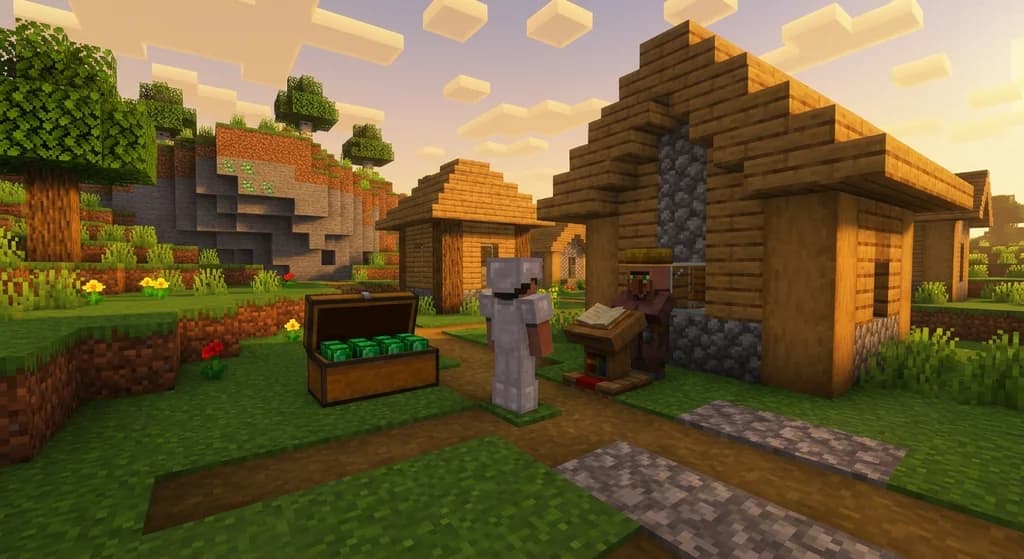
Key Takeaways
| Point | Details |
|---|---|
| Trading was added in | Trading was added in Java Edition 1.3.1, introducing emeralds as the primary currency. |
| Villagers in different biomes | Villagers in different biomes offer trades for a variety of useful items, including enchanted gear. |
| Wandering traders have a | Wandering traders have a chance to buy water buckets for 2 emeralds. |
| Emerald ore generates rarely | Emerald ore generates rarely in extreme hills biomes and can be mined for emeralds. |
| Villager trading remains a | Villager trading remains a core mechanic for mid- to late-game resource acquisition. |
What Is the Vanilla Trading System in Minecraft?
The vanilla trading system lets players exchange resources with villagers for emeralds and other items. It's the primary player-to-villager economy in the game and was introduced in a major update.
According to the Java Edition 1.3.1 article,
1.3.1 is a major update to Java Edition released on August 1, 2012, which added trading, Adventure mode, new generated structures (jungle and desert pyramids), and new blocks/items including emeralds, book and quills, written books, and tripwire.
Emeralds themselves are used as the currency for all villager trades.
Emerald Used to trade with villagers.
How Villager Trading Works in Minecraft Java Edition
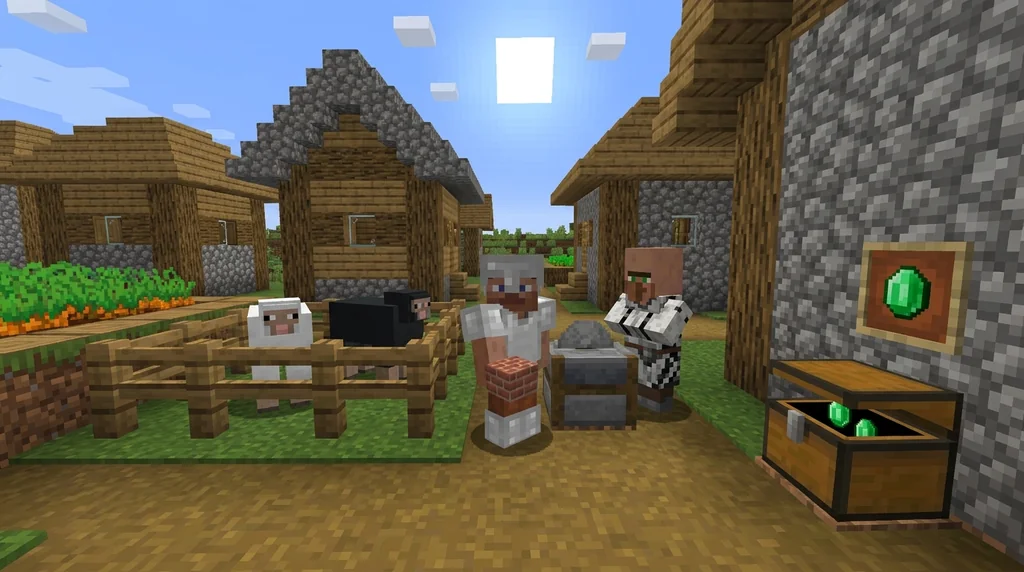
Villages generate naturally in several biomes, and each villager can have a profession that determines what trades it offers.
Villages can be found throughout the world, in plains, sunflower plains[BE only], deserts, savannas, taigas, snowy taigas[BE only], and snowy plains.
Once you find a village, you can interact with a villager and see its trades. Trading with villagers requires emeralds, which you can obtain by mining emerald ore or by trading other items to villagers. The mechanic is straightforward: you give emeralds (and sometimes other items) and receive items in return.
Key Items You Can Get from Trading
Through trading, you can acquire many valuable items.
Here, the player can trade with villagers for emeralds to get useful items, like food, explorer maps, ender pearls and enchanted tools and books.
This includes food for early survival, enchanted books and tools for late-game equipment, and ender pearls for accessing the End. Some trades also yield explorer maps to locate woodland mansions and ocean monuments.
Wandering Trader Trades
In addition to village traders, wandering traders occasionally appear and offer unique trades.
Wandering traders have a 1⁄3 chance of purchasing 1 water bucket for 2 emeralds.
This means you can sell a water bucket to a wandering trader for 2 emeralds, though the trade has only a one in three chance of being offered.
For more depth on maximizing your trades, see our guides on How to Use the Minecraft Trading Wiki to Maximize Villager Deals in 2026 and How to Make Villagers Restock Faster in Minecraft (2026).
Sources
- 1.3.1 is a major update to Java Edition released on August 1, 2012, which added trading, Adventure mode, new generated structures (jungle and desert pyramids), and new blocks/items including emeralds, book and quills, written books, and tripwire. — Java Edition 1.3.1
- Emerald Used to trade with villagers. — Java Edition 1.3.1
- Villages can be found throughout the world, in plains, sunflower plains\[BE only\], deserts, savannas, taigas, snowy taigas\[BE only\], and snowy plains. — Gameplay
- Here, the player can trade with villagers for emeralds to get useful items, like food, explorer maps, ender pearls and enchanted tools and books. — Gameplay
- Wandering traders have a 1⁄3 chance of purchasing 1 water bucket for 2 emeralds. — Water Bucket
Related guides
Minecraft Bedrock Villager Economy: Supply and Demand System
Learn how the supply and demand system works for villager trading in Minecraft Bedrock Edition 1.11.0. Understand price increases, restocking, and...
Minecraft Economy 101: How Supply and Demand Work on Player-Driven Servers
Learn how supply and demand shape Minecraft economies, from vanilla villager trading mechanics to player-driven server markets. Includes inflation control...
How to Avoid Scams in Minecraft Player Markets and Trading (2026)
Learn how to avoid scams in Minecraft player markets and trading in 2026. Discover common scam types, safety tips, and how reputation systems protect your...
How to Make Emeralds Fast with Minecraft Villager Professions in 2026
Learn the fastest ways to farm emeralds using Minecraft villager professions in 2026. Optimize trading halls, cure zombies, and master crop trading for...
Have a question or another approach?
Compare notes with other readers. Include your edition and version when discussing mechanics.