Best Modern Industrial Build Tutorial: 2026 Block Harmony Guide
Filed under Minecraft Build Palette & Block Harmony · How we create content
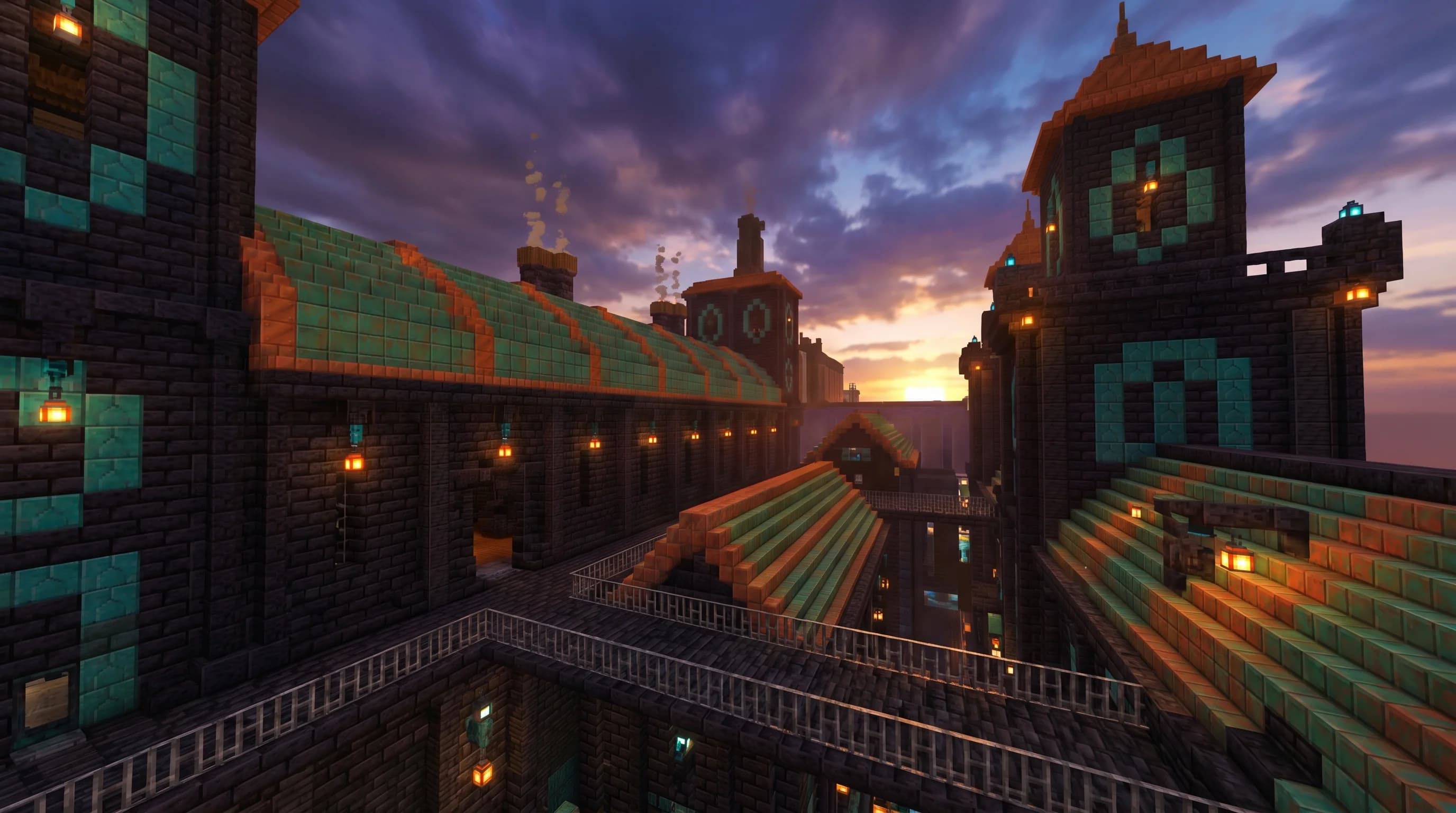
Key Takeaways
- Deepslate bricks and blackstone form the ideal dark neutral base for modern industrial builds, providing gritty texture without overwhelming the palette.
- Oxidized copper's teal-green tone acts as a natural triadic accent against iron grey and warm orange concrete.
- Cyan terracotta bridges warm and cool tones in the palette, preventing the build from feeling monotone or cave-like.
- Trapdoors, chains, lanterns, and exposed iron bars are the go-to detail blocks that sell the industrial aesthetic at close range.
- Block harmony in industrial builds follows the same triadic color theory principles used in medieval and swamp builds — the theory scales across every biome style.
- Limiting your palette to 5–7 block types prevents visual noise and keeps the industrial look clean and intentional.
Most builders who attempt a modern industrial Minecraft build make the same mistake: they go full grey. Everything ends up looking like a cave with windows. A truly great modern industrial build tutorial teaches you that the aesthetic lives or dies on contrast — dark neutrals anchored by oxidized teal and warm iron tones. Get that triadic balance right, and your factory looks like it belongs in a cyberpunk skyline. Get it wrong, and it looks like a parking garage.
This guide breaks down every layer of the modern industrial palette — from foundation blocks to micro-detail accents — so you can build something that actually turns heads.
What Is Block Harmony in Minecraft Builds?
Block harmony is the intentional selection of blocks whose colors, textures, and visual weights work together to create a unified, readable structure. It borrows directly from color theory: you choose a dominant tone, a supporting mid-tone, and one or two accent colors that create contrast without clashing.
For industrial builds specifically, block harmony is what separates a "grey box" from a living, textured factory. The blocks are all available in vanilla Minecraft — the skill is knowing which ones to combine and in what ratio.
If you want to understand the full theory behind this approach, the guide on How to Use Color Harmony for Houses to Build in Minecraft (2026) covers analogous, complementary, and triadic schemes in depth. Industrial builds lean hardest on the triadic model.
The Triadic Model for Industrial Palettes
A triadic palette uses three colors spaced roughly equally around a color wheel. For industrial Minecraft:
- Slate grey (deepslate, blackstone, smooth basalt) — your dominant tone
- Oxidized teal (oxidized copper, cyan terracotta, warped planks) — your cool accent
- Warm iron-orange (raw copper blocks, orange concrete, exposed iron) — your warm accent
This three-way tension is what makes the palette feel alive instead of flat.
Best Blocks for a Modern Industrial Palette
Choosing the right blocks is the first real decision. Here's a quick-reference table of the top performers in each palette role:
| Role | Block Options | Why It Works |
|---|---|---|
| Dark Neutral Base | Deepslate Bricks, Blackstone, Smooth Basalt | Deep grey tones with subtle texture variation |
| Mid-tone Structure | Stone Bricks, Polished Deepslate, Tuff | Lighter grey to break up the dark base |
| Cool Accent | Oxidized Copper, Cyan Terracotta, Warped Planks | Teal-green creates triadic contrast |
| Warm Accent | Raw Copper, Orange Concrete, Cut Copper | Adds warmth and prevents the palette going cold |
| Detail & Grating | Iron Bars, Chains, Trapdoors, Lanterns | Sells the industrial micro-detail at eye level |
| Glazing & Glass | Grey Stained Glass, Tinted Glass | Adds depth to windows without breaking the palette |
Pro Tip: Keep your dark neutral base at roughly 60% of total block usage, your mid-tones at 25%, and your accent blocks at 15% or less. This ratio prevents any single color from dominating and keeps the build readable from a distance.
Why Deepslate Bricks Beat Regular Stone
Deepslate bricks are the single most important block in the modern industrial toolkit. According to the Minecraft Wiki, deepslate has a blast resistance of 6 — identical to stone — but its darker, more granular texture reads as "aged concrete" rather than "generic wall." That visual weight is exactly what industrial builds need.
Deepslate also has natural variation when you mix in cracked deepslate bricks and deepslate tiles. Alternating these three variants across your walls creates the kind of weathered, worn texture that makes a factory feel like it's actually been used.
Copper's Role: Oxidation as a Design Tool
Copper is uniquely powerful in industrial builds because it changes over time. A freshly placed copper block is warm orange-pink. Fully oxidized copper is a muted teal-green. According to the Minecraft Wiki, copper goes through four oxidation stages — copper, exposed, weathered, and oxidized — and you can wax any stage with a honeycomb to lock it permanently.
This means you can deliberately freeze copper at different stages across your build to create a gradient from warm to cool — mimicking the look of a real industrial structure where older sections have weathered more than newer ones.
Note: Copper oxidation is affected by proximity to other copper blocks. Copper blocks oxidize faster when grouped together. If you want to control which blocks oxidize and which stay warm, wax the blocks you want to keep early.
How to Build a Modern Industrial Structure Step by Step
Step 1 — Establish the Footprint and Height
Industrial builds read best when they're wide and tall. A 20×30 footprint with a 12–16 block height gives you enough surface area to layer textures meaningfully. Avoid perfectly square footprints — an L-shape or staggered silhouette immediately looks more architectural.
Start with a smooth basalt foundation layer (2 blocks tall) to visually separate the structure from the ground. This mimics a concrete slab foundation and grounds the build.
Step 2 — Build the Primary Walls
Use deepslate bricks as your main wall material. Every 4–6 blocks horizontally, insert a column of polished deepslate to create vertical rhythm — these act like structural pillars and break the monotony of a flat wall.
At the mid-height point of your walls, add a horizontal band of cut copper or raw copper blocks (waxed at the exposed stage for a warm-but-not-orange tone). This band reads as a structural beam and introduces your warm accent color early.
Step 3 — Add Windows and Grating
Industrial buildings are defined by their window shapes. Use iron bars in a 3-wide, 4-tall grid pattern to create factory windows. Back them with grey stained glass for depth. Frame each window with blackstone to make them pop against the deepslate walls.
For loading dock areas or lower-level openings, trapdoors (spruce or dark oak) mounted on the wall face add incredible texture. They read as ventilation panels, access hatches, or shutters depending on context.
Step 4 — Roof and Silhouette
Flat roofs work for industrial builds, but a slightly angled roof using oxidized copper stairs and slabs elevates the whole structure. The teal-green of fully oxidized copper against the grey walls is your primary triadic contrast moment — make it count.
Add chains hanging from roof overhangs, lanterns at regular intervals, and lightning rods as antenna-style details. These vertical elements break the roofline and add the kind of micro-detail that rewards close inspection.
Step 5 — Interior Detailing
The interior is where most builders give up too early. A few quick wins:
- Blast furnaces and smokers as functional machinery props
- Barrels and chests arranged in storage-bay formations
- Exposed stone or tuff on interior walls (raw, unfinished look)
- Redstone lamps behind iron bars for industrial lighting
- Cauldrons filled with water or lava as chemical vat props
Tips for Mixing Cyan Terracotta Into Your Industrial Palette
Cyan terracotta is an underrated bridge block. Its muted, dusty teal sits between the cool oxidized copper and the warm stone tones — it doesn't shout, but it holds the palette together.
Use cyan terracotta for:
- Interior accent walls (one wall per room, not all four)
- Flooring strips that break up a polished deepslate floor
- Exterior panel sections on lower building levels
- Pipe or conduit representations when placed in vertical columns
For a deeper look at how terracotta and earthy tones interact with other block families, the 7 Best Mangrove and Mud Block Palettes for Swamp Bases (2026) guide explores similar muted-tone harmony principles that translate directly to industrial contexts.
Why Triadic Color Harmony Works Across Every Build Style
The triadic model isn't just an industrial trick. It's the same principle that makes medieval builds feel rich and swamp builds feel atmospheric. If you've already explored the 7 Minecraft Block Palettes for Pro Builders (2026 Guide), you'll recognize the pattern: dominant tone, supporting mid-tone, two controlled accents.
Industrial builds are just the most literal expression of that theory — the blocks themselves are named after industrial materials (iron, copper, stone), so the aesthetic almost builds itself once you understand the color logic.
The key difference from, say, a Best Medieval Minecraft Block Combinations for 2026 Builds approach is that industrial palettes favor cooler mid-tones and harder textures. Medieval builds lean warm and organic. Industrial builds lean cool and geometric. Same theory, opposite temperature.
How to Put This Into Practice on Gaia Legends
Gaia Legends is the perfect proving ground for modern industrial builds, and not just because the community appreciates ambitious architecture. The resource world on Gaia refreshes regularly, giving you unlimited access to deepslate, copper ore, blackstone, and tuff without ever touching your main plot's terrain. You can mine freely and experiment without consequence.
The server's build showcase events give you a real audience for your industrial projects — and the feedback you get from other players is genuinely useful for refining your block choices. The community skews toward experienced builders, so you'll get specific critique, not just "looks cool."
Gaia also supports Java + Bedrock crossplay, so your industrial masterpiece is visible to the full player base regardless of platform. Whether you're building a sprawling factory district or a single industrial tower, the server's plot system gives you the space to scale up.
Gaia Legends is free to join, non-pay-to-win, and supports Java + Bedrock crossplay. Join at gaialegends.pro and start your legend today.
Wrapping Up
Modern industrial Minecraft builds succeed or fail on three decisions:
- Your base block — deepslate bricks give you the texture and darkness the aesthetic needs
- Your triadic accent balance — oxidized copper teal and warm iron-orange working against slate grey
- Your micro-detail layer — chains, trapdoors, iron bars, and lanterns at eye level
Pick those three things right, and the rest of the build practically assembles itself. Start with a 20×30 footprint, get your wall texture layered with pillar breaks and horizontal copper bands, then let the roofline oxidize into that signature teal. The result will look like it belongs in a skyline, not a grey box.
Now go build something worth looking at.
Ready to play? Join Gaia Legends today — no pay-to-win, Java + Bedrock crossplay.
- Java:
join.gaialegends.pro - Bedrock:
join.gaialegends.pro— Port19132
Further reading
These references were recorded with the article; specific claims have not been matched to source excerpts.
Frequently Asked Questions
What is the best modern industrial Minecraft build tutorial approach for beginners?
The best modern industrial Minecraft build tutorial approach for beginners is to start with a triadic palette: deepslate bricks as your dark neutral base (60% of blocks), polished deepslate or stone bricks as mid-tones (25%), and oxidized copper or cyan terracotta as accents (15%). Nail the wall texture first with pillar breaks every 4–6 blocks, then add iron bar windows and chain details before worrying about the roof or interior.
What blocks work best for a modern industrial Minecraft build?
Deepslate bricks, blackstone, and smooth basalt form the ideal dark neutral base. Oxidized copper (waxed at any stage) adds teal accent color, while cyan terracotta bridges warm and cool tones. For detail work, iron bars, chains, trapdoors, and lanterns are essential. Avoid using regular stone as your primary block — it reads as too generic and lacks the visual weight the industrial aesthetic needs.
How does triadic color harmony work in Minecraft industrial builds?
Triadic color harmony in Minecraft means selecting three block color families spaced evenly across the color wheel. For industrial builds, that's slate grey (deepslate, blackstone), oxidized teal (oxidized copper, cyan terracotta), and warm iron-orange (raw copper, orange concrete). Using all three in a roughly 60/25/15 ratio creates visual tension that keeps the build interesting from any angle without looking chaotic.
How do I use copper blocks in a modern industrial Minecraft build?
Use copper at different oxidation stages across your build to create a natural gradient from warm to cool. Wax copper blocks with honeycomb to lock them at your preferred stage — exposed copper for warm tones, weathered for mid-teal, fully oxidized for deep teal. Place oxidized copper on roofing and upper panels, and warmer copper stages at lower levels to simulate realistic weathering patterns.
How many block types should I use in an industrial Minecraft build?
Limit yourself to 5–7 block types for a clean industrial look. More than 7 creates visual noise that makes the build feel chaotic rather than intentional. A good starting set is: deepslate bricks, cracked deepslate bricks, polished deepslate, oxidized copper, cyan terracotta, iron bars, and grey stained glass. Add one warm accent (raw copper or orange concrete) for contrast and stop there.
What interior details make an industrial Minecraft build look realistic?
The most impactful interior details are blast furnaces and smokers as machinery props, barrels arranged in storage-bay formations, redstone lamps behind iron bars for factory lighting, cauldrons filled with lava as chemical vat props, and exposed tuff or stone on interior walls for a raw, unfinished look. Chains hanging from ceilings and trapdoors mounted on walls as ventilation panels complete the aesthetic at eye level.
Related guides
How to Build a Minecraft Bridge with 5 Block Palettes (2026)
Discover 5 stunning block palettes for Minecraft bridges in 2026. From rustic wood to nether luxury, learn how to pick blocks and build a pretty bridge...
How to Use the 60-30-10 Rule for Balanced Minecraft Builds (2026)
Learn how to use the 60-30-10 rule for Minecraft builds with simple layers: 60% dominant, 30% contrast, 10% accent for balanced bases.
7 Best Triadic Block Palettes for Vibrant Minecraft Builds 2026
Discover the 7 best triadic block palettes for Minecraft builds in 2026. Master triadic color harmony with vibrant block combos, pro tips, and build...
7 Best Monochromatic Block Palettes for Minecraft Builds (2026)
Discover the 7 best monochromatic Minecraft block palettes for 2026. Master single-color builds with expert block harmony tips, grayscale combos, and pro...
Have a question or another approach?
Compare notes with other readers. Include your edition and version when discussing mechanics.