How to Use Color Harmony for Houses to Build in Minecraft (2026)
Filed under Minecraft Build Palette & Block Harmony · How we create content
Minecraft version varies by section · Updated 2026-06-14
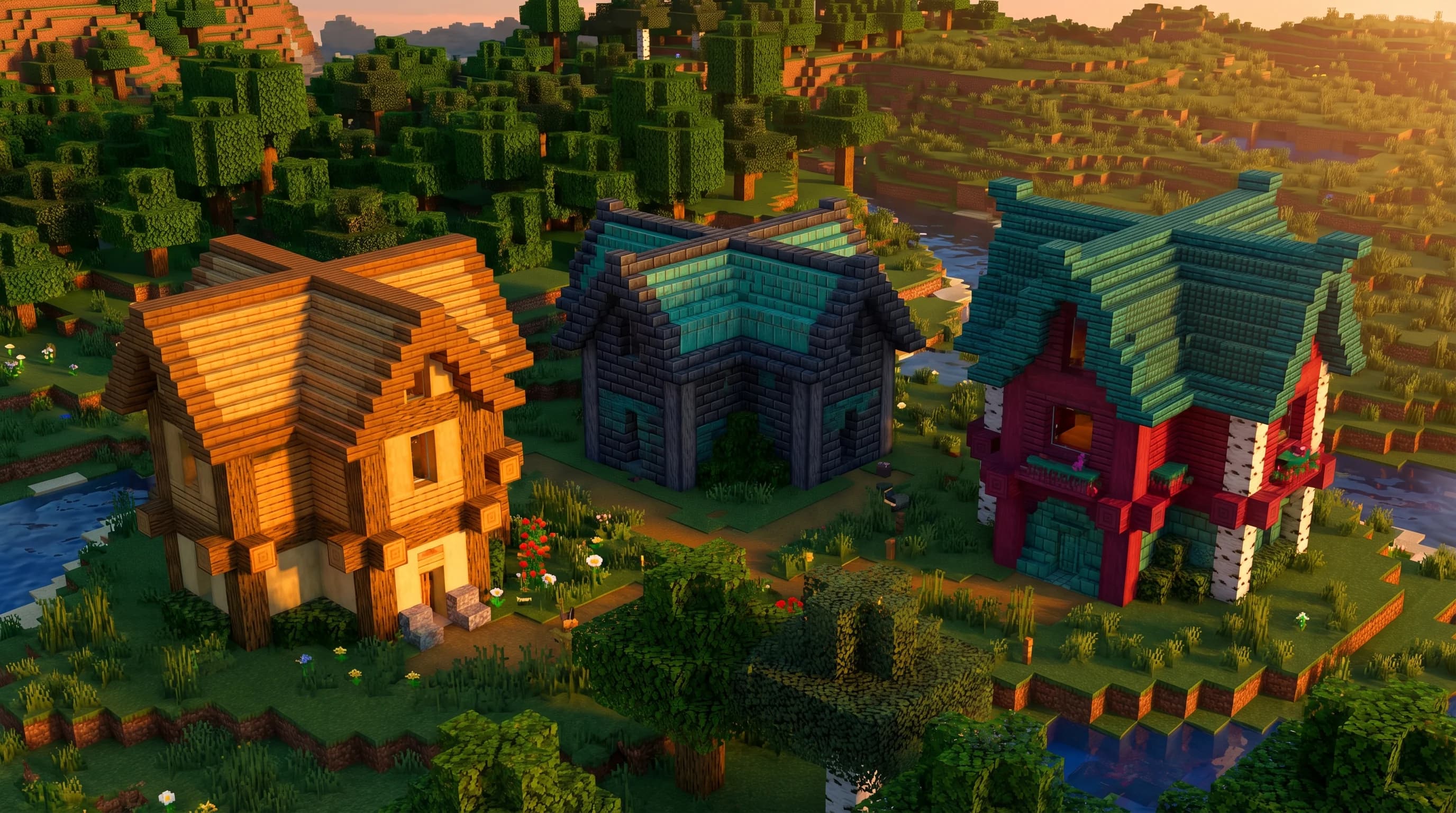
Key Takeaways
- The 60-30-10 rule — dominant, secondary, accent — is the fastest way to make any Minecraft house look polished.
- Analogous palettes (blocks sharing similar hues, like Oak + Birch + Stripped Oak) feel warm and natural.
- Complementary palettes pair opposite-hue blocks — think Deep Slate Blue against Oxidized Copper Green — for high visual contrast.
- Triadic color harmony uses three evenly spaced hues and works best for fantasy or vibrant builds.
- Block texture (smooth vs. rough) is as important as hue — mixing too many textures breaks harmony even when colors match.
- Lighting blocks like Lanterns, Shroomlights, and Copper Bulbs are accent-slot tools that unify a palette at night. Copper Bulbs can even be dimmed with redstone, giving you precise control over the mood of your accent glow.
Most Minecraft houses look unfinished for one reason: random block choices. You grab whatever's in your inventory, slap it together, and wonder why the result feels off. The answer almost always comes back to color. Learning how to apply color harmony to the houses you build in Minecraft is the single fastest upgrade you can make to your building skill — no new blocks required, just smarter choices with what you already have.
What Is Color Harmony in Minecraft Builds?
Color harmony is the principle that colors placed together should share a deliberate relationship — similar hues, opposite hues, or evenly spaced hues — so the eye reads the composition as intentional rather than chaotic. Artists and interior designers use the same rules. Minecraft builders who apply them consistently produce work that gets featured, shared, and replicated.
There are three relationships that matter most for block palettes:
- Analogous — colors sitting next to each other on the color wheel (warm oranges, yellows, tans)
- Complementary — colors sitting directly opposite each other (blue-gray vs. warm orange)
- Triadic — three colors spaced evenly around the wheel (red, yellow, blue)
Every great Minecraft build you've ever seen uses at least one of these, whether the builder knew it or not.
The 60-30-10 Rule: Your New Best Friend
Before picking any palette type, lock in your ratios. The 60-30-10 rule comes from interior design and translates perfectly to Minecraft:
| Role | Percentage | Example Block |
|---|---|---|
| Dominant | 60% | Deepslate Bricks |
| Secondary | 30% | Smooth Basalt |
| Accent | 10% | Oxidized Copper |
The dominant block is your walls and floors. The secondary block is your trim, roof, or framing. The accent is your detail layer — window surrounds, corner pillars, or lighting blocks. Stick to these ratios and your build will feel balanced even before you've chosen a single color relationship.
Pro Tip: Build a small 5×5 test wall before committing to a full house. Swap accent blocks until one makes the dominant and secondary blocks "pop" — you'll feel it immediately.
How to Build an Analogous Palette House
Analogous palettes are the most forgiving and the most popular for survival-style houses. They feel natural because nature itself is mostly analogous — forests are green, brown, and tan; deserts are orange, yellow, and beige.
Best Analogous Block Combinations
Here are three proven analogous palettes for different biome vibes:
Warm Forest Cottage
- Dominant: Stripped Oak Log
- Secondary: Oak Planks
- Accent: Birch Trapdoors + Lanterns
Desert Sandstone Villa
- Dominant: Smooth Sandstone
- Secondary: Cut Sandstone
- Accent: Terracotta (Orange or Yellow) + Torches
Snowy Taiga Cabin
- Dominant: Spruce Planks
- Secondary: Stripped Spruce Log
- Accent: Stone Bricks + Snow Layers
The trick with analogous palettes is value contrast — even if all your blocks share a hue family, you need at least one lighter and one darker option so the build reads in 3D. All-same-value builds look flat, like cardboard boxes. Recently added woods like the pale oak set (from the Pale Garden biome) expand your neutral-light value range dramatically; pale oak planks and stripped logs offer an almost white base that slots beautifully into snowy or modern builds as a secondary value anchor.
Note: Avoid using more than four block types in an analogous palette. Each addition increases the risk of visual noise. Three blocks at the right ratios beats five blocks at random ratios every time.
How to Build a Complementary Palette House
Complementary palettes are higher risk, higher reward. When they work, they're jaw-dropping. When they don't, they look like a clown house. The key is keeping one hue dominant and using its complement sparingly — that's where the 60-30-10 rule saves you.
Deepslate + Copper: The Modern Complementary Classic
The most popular complementary palette in modern Minecraft building right now pairs the blue-gray family (Deepslate, Cobbled Deepslate, Smooth Basalt) against the orange-green family (Copper in its various oxidation stages). New blocks like Resin Bricks — a vivid orange — fit this same complementary slot and give you a brighter alternative to fresh copper when you want maximum contrast.
According to the Minecraft Wiki, copper blocks progress through four oxidation stages — unoxidized (orange), exposed, weathered, and fully oxidized (teal-green) — giving you a built-in gradient of complementary tones from a single material source. This means one copper wall can carry multiple accent tones simultaneously as it ages, which is genuinely useful for large builds where you want organic color variation without placing different block types manually.
Complementary Modern House Palette:
- Dominant (60%): Deepslate Bricks
- Secondary (30%): Smooth Basalt
- Accent (10%): Waxed Oxidized Copper (for permanent teal), unwaxed for living color, or Copper Grates as semi-transparent window accents that preserve the hue while adding texture.
What Is Triadic Color Harmony in Minecraft?
Triadic color harmony is a palette built from three hues spaced approximately 120 degrees apart on the color wheel — for example, red, yellow, and blue. In Minecraft terms, this translates to builds that feel vibrant, fantastical, or deliberately stylized. It's the go-to approach for mushroom kingdoms, magical towers, carnival builds, and anything that should feel otherworldly.
Triadic Palettes That Work
The challenge with triadic palettes is that Minecraft's block palette doesn't map perfectly to a painter's color wheel. You have to find blocks that approximate the right hue relationships:
| Triadic Role | Block Option A | Block Option B |
|---|---|---|
| Hue 1 (Red) | Crimson Planks | Red Nether Bricks |
| Hue 2 (Yellow) | Birch Planks | Yellow Concrete |
| Hue 3 (Blue) | Prismarine Bricks | Blue Glazed Terracotta |
Keep your triadic accent hues in the 10% slot each (so the split is roughly 60-20-20 or 60-15-15-10 with a neutral). A neutral block — Smooth Stone, White Concrete, or Calcite — acts as visual breathing room between the three strong hues.
Pro Tip: Glazed Terracotta is your secret weapon for triadic builds. Its patterns add texture interest without adding a fourth color, and every color variant exists in the game. Use it as a feature wall, not a full exterior.
Why Block Texture Matters as Much as Color
Color harmony fails when texture harmony is ignored. Texture harmony means matching the visual roughness or smoothness of blocks so they don't fight each other. Pairing Smooth Quartz (very smooth, clean lines) with Mossy Cobblestone (rough, organic) creates texture dissonance even if the colors are neutral.
A simple texture framework:
- Smooth + Smooth: Modern, clean, contemporary builds (Quartz, Polished Deepslate, Smooth Sandstone)
- Rough + Rough: Rustic, survival, medieval builds (Cobblestone, Mossy Bricks, Cracked Stone Bricks)
- Smooth + Rough (deliberate contrast): Use rough blocks as foundation/base and smooth blocks as upper floors — this mirrors real-world architecture and reads as intentional
The Minecraft Wiki lists over 90 distinct wood-type blocks across all current tree variants, giving you enormous texture variety within a single hue family — which means you can build a fully analogous warm-wood house that still has rich texture contrast just by alternating stripped logs, planks, and slabs.
How to Put This Into Practice on Gaia Legends
Testing color palettes is one thing in creative mode. It's another thing entirely when you're building in a living, breathing survival world with a community watching. That's where Gaia Legends becomes a real advantage.
Our lag-free Minecraft servers give you the performance headroom to test complex architectural palettes and massive community builds without chunk-loading stutter breaking your concentration mid-build. Specifically:
- Creative plots let you prototype your 60-30-10 palette in a clean sandbox before committing resources in survival
- The community build events expose you to dozens of other builders' palettes — the fastest way to train your eye for what works
- Cross-platform crossplay (Java + Bedrock) means your palette looks the same whether you're building on PC or console, because our server normalizes rendering differences
Gaia Legends is free to join, non-pay-to-win, and supports Java + Bedrock crossplay. Whether you're testing your first analogous cabin or dropping a triadic fantasy tower, the canvas is ready.
Join at gaialegends.pro and start your legend today.
Wrapping Up: Your Color Harmony Checklist
Color harmony transforms good Minecraft houses into great ones. Before you place your next block, run through these three points:
- Lock in your 60-30-10 ratio first. Dominant block, secondary block, accent block — in that order. Don't start building until you know all three.
- Choose one harmony type and commit. Analogous for natural/survival vibes, complementary for modern drama, triadic for fantasy flair. Mixing harmony types without intention is how builds go wrong.
- Match textures, not just colors. A palette where all blocks share similar surface roughness will always look more professional than one where colors match but textures clash.
Pick one palette from this guide, build a test wall, and see how much more intentional your next house feels. The blocks haven't changed — just the way you're thinking about them.
Ready to play? Join Gaia Legends today — no pay-to-win, Java + Bedrock crossplay.
- Java:
join.gaialegends.pro - Bedrock:
join.gaialegends.pro— Port19132
Further reading
These references were recorded with the article; specific claims have not been matched to source excerpts.
Frequently Asked Questions
What are the best block palettes for houses to build in Minecraft?
The best block palettes for houses to build in Minecraft follow the 60-30-10 rule: one dominant block (60% of surfaces), one secondary block (30%), and one accent block (10%). Popular combinations include Deepslate Bricks + Smooth Basalt + Oxidized Copper for modern builds, and Stripped Oak + Oak Planks + Birch Trapdoors for warm cottage aesthetics. Always match block textures as well as colors.
What is triadic color harmony in Minecraft building?
Triadic color harmony in Minecraft means choosing three block hues spaced roughly equally around the color wheel — for example, Crimson Planks (red), Birch Planks (yellow), and Prismarine Bricks (blue). It creates vibrant, fantastical builds. Keep two of the three hues as accents (10-15% each) and one as dominant to avoid visual chaos. A neutral block like Smooth Stone helps balance the composition.
How do I stop my Minecraft house from looking bad?
Most Minecraft houses look off because of random block choices and no ratio discipline. Fix it by: (1) limiting yourself to three block types per build, (2) applying the 60-30-10 dominant-secondary-accent ratio, and (3) matching block textures — don't pair very smooth blocks like Quartz with very rough blocks like Mossy Cobblestone unless it's an intentional contrast between base and upper floors.
What is the 60-30-10 rule in Minecraft building?
The 60-30-10 rule is a color-ratio principle borrowed from interior design. In Minecraft, 60% of your build's visible surfaces use the dominant block (walls, floors), 30% use a secondary block (roof, trim, framing), and 10% use an accent block (details, corners, lighting). This ratio creates visual balance automatically and works with any color harmony type — analogous, complementary, or triadic.
Which Minecraft blocks work best for a complementary color palette?
The most reliable complementary palette in Minecraft pairs the blue-gray family — Deepslate Bricks, Cobbled Deepslate, Smooth Basalt — against the orange-green family of Copper blocks. Copper's four oxidation stages (orange → teal-green) give you a natural gradient of complementary tones from one material. Wax your copper at the 'weathered' stage for a warm mid-green that balances beautifully against deepslate's cool blue-gray.
Does texture matter as much as color in Minecraft builds?
Yes — texture harmony is equally important as color harmony. Pairing blocks with very different surface roughness (like Smooth Quartz with Mossy Cobblestone) creates visual dissonance even when colors are neutral. A good rule: smooth blocks together for modern builds, rough blocks together for rustic builds, and smooth-on-top with rough-on-bottom for a realistic architectural look that mirrors real-world construction styles.
Related guides
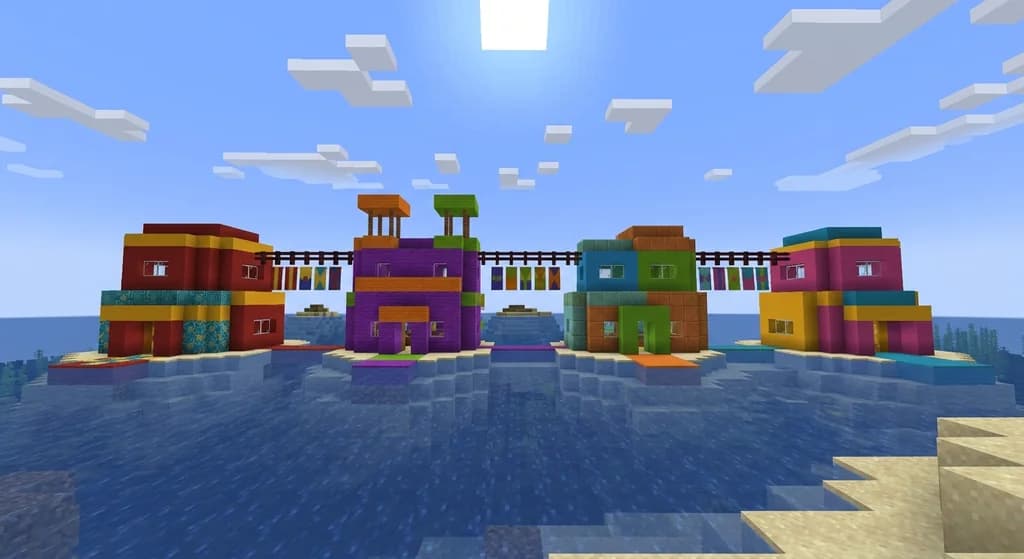
7 Best Triadic Block Palettes for Vibrant Minecraft Builds 2026
Discover the 7 best triadic block palettes for Minecraft builds in 2026. Master triadic color harmony with vibrant block combos, pro tips, and build...
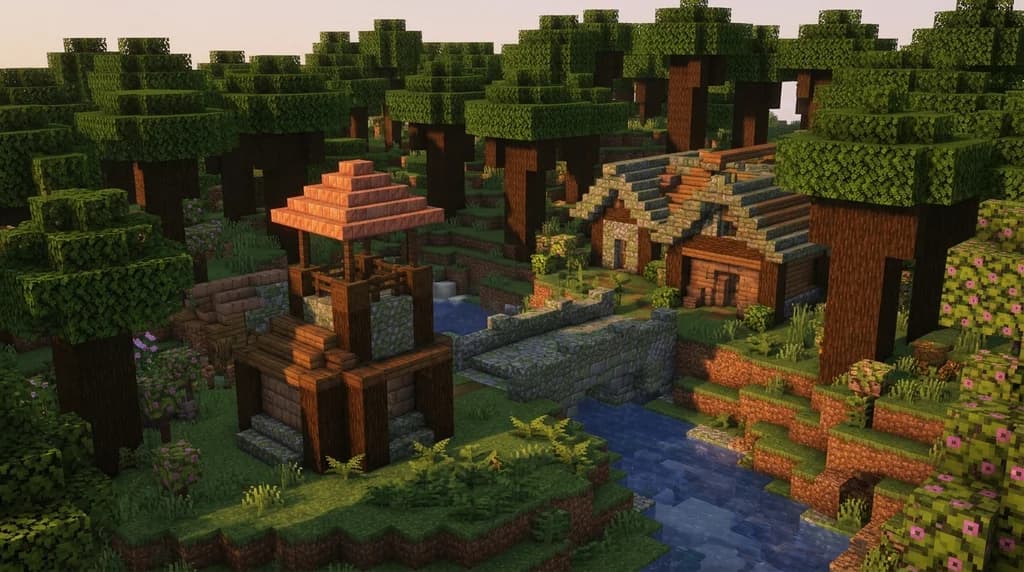
How to Use Natural Palettes: A 2026 Minecraft Build Guide
Master natural Minecraft build palettes in 2026. Learn earthy block combinations, color harmony theory, and pro tips for stunning wilderness retreats.
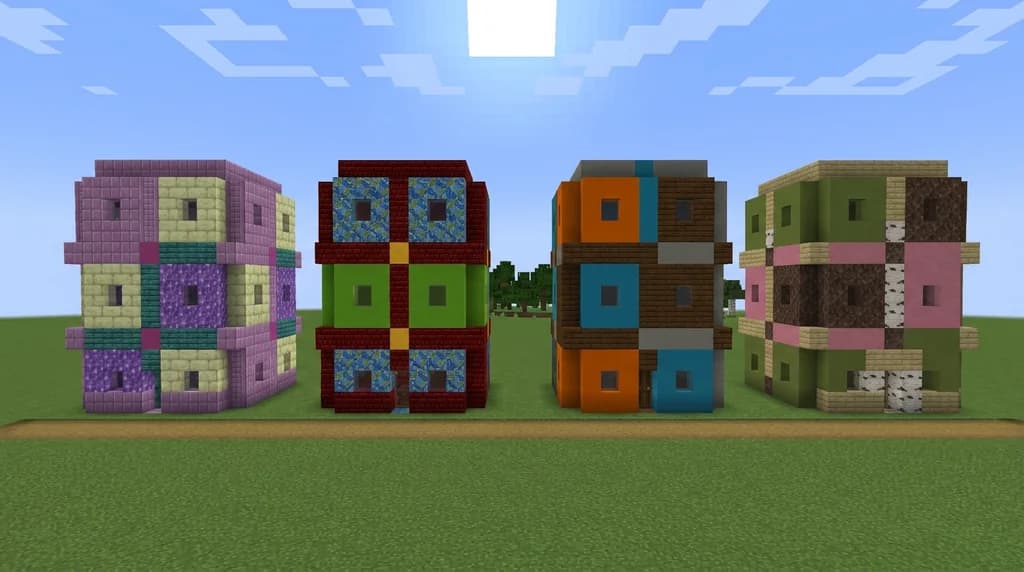
7 Best Triadic Color Palettes for Unique Minecraft Builds (2026)
Discover the 7 best triadic color palettes for Minecraft builds in 2026. Master block harmony with vibrant triadic combos that make your builds unforgettable.
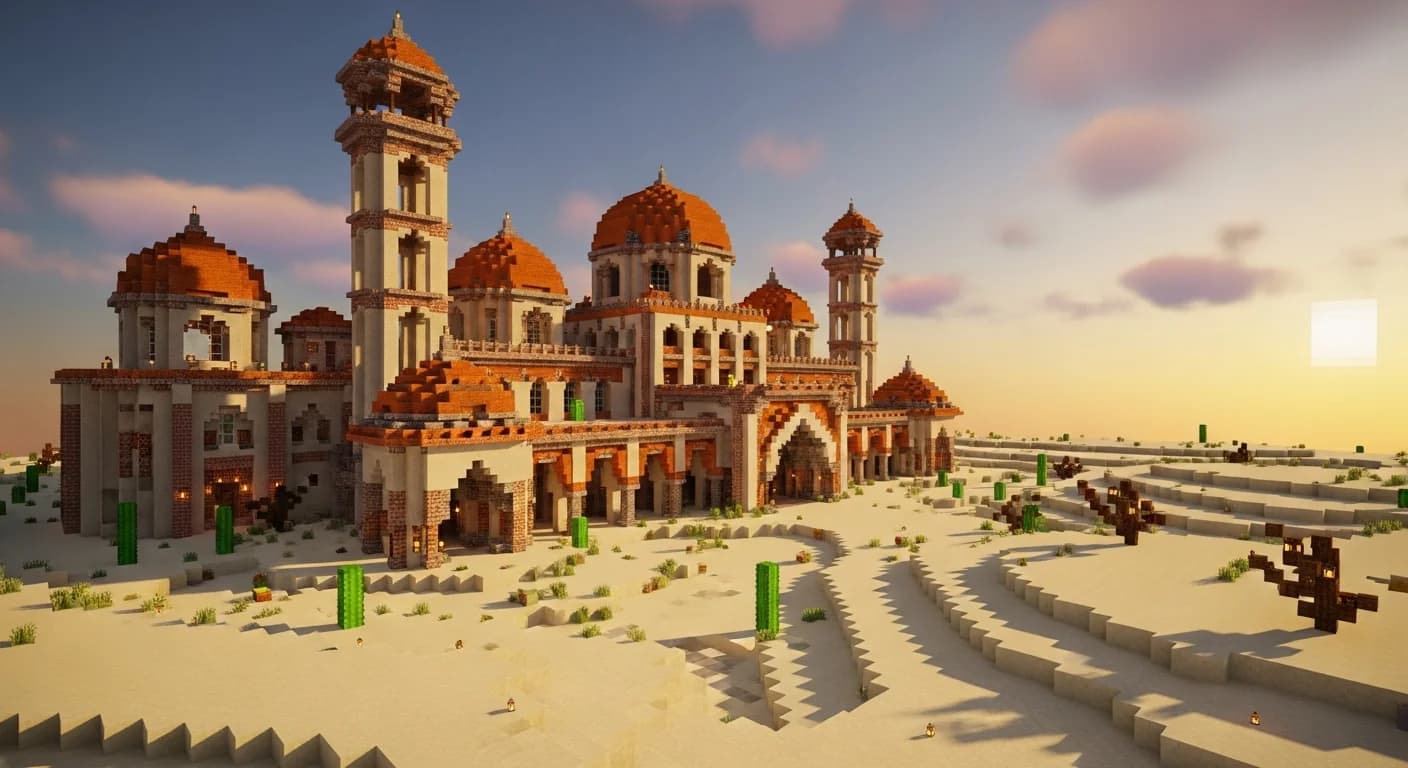
How to Build Desert Masterpieces: 2026 Block Harmony Guide
Master the Minecraft desert build guide for 2026. Discover sandstone block combinations, warm color harmony, and desert palace tips that turn flat sand...
Have a question or another approach?
Compare notes with other readers. Include your edition and version when discussing mechanics.