7 Best Triadic Block Palettes: A Minecraft Build Tutorial (2026)
Filed under Minecraft Build Palette & Block Harmony · How we create content
Key Takeaways
- Triadic color harmony uses three hues equally spaced on the color wheel, giving your build maximum contrast without chaos.
- The golden ratio for triadic palettes is 60% dominant block, 30% secondary block, and 10% accent block.
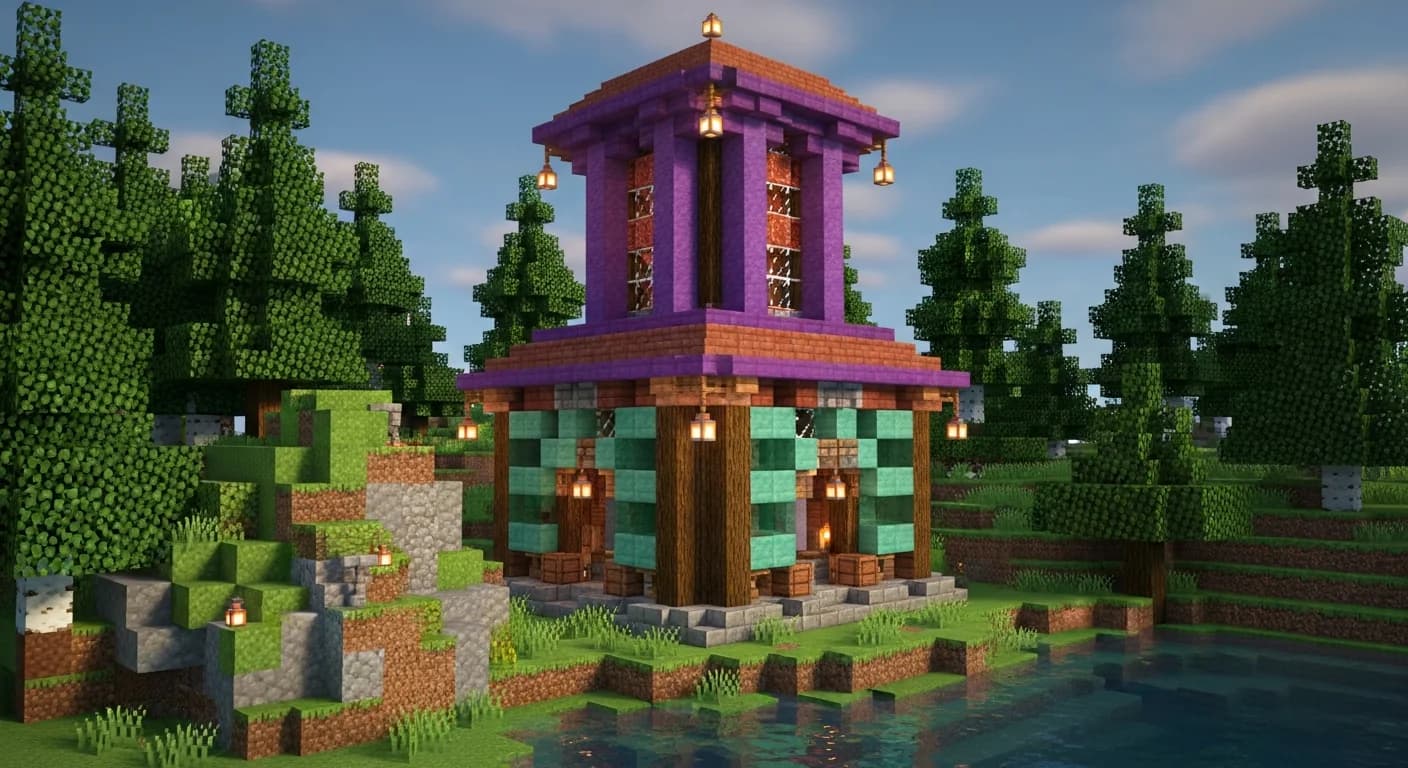
- Purpur + Oxidized Copper + Moss Block is one of the most visually striking triadic combos available in vanilla Minecraft.
- Texture variation matters as much as color — mix smooth, rough, and glowing blocks within each hue family to add depth.
- Biome context shapes palette success: warm-toned triads shine in deserts and savannas, while cool triads thrive in deep ocean or mountain builds.
- Always test your palette in natural lighting and at night — some block combos look great in screenshots but clash under torchlight.
Most builders instinctively reach for blocks they love — and end up with a muddy, same-tone mess that looks flat in every screenshot. The fix isn't better blocks. It's better color theory. This minecraft build tutorial walks you through triadic color harmony: what it is, why it works, and exactly which block combos to use in 2026. By the end, you'll have 7 ready-to-use palettes and a framework you can apply to any build, any biome.
What Is Triadic Color Harmony in Minecraft?
Triadic color harmony is a design principle where three colors equally spaced on the color wheel — roughly 120° apart — are combined to create maximum visual contrast while keeping the composition balanced. Unlike complementary schemes (two opposing colors), triadic palettes feel lively without becoming chaotic because all three hues share the same visual "weight."
In Minecraft terms, this translates directly to block families. Purple, orange, and green are a classic triadic trio. So are teal, red, and yellow. The game's expanding block library makes this easier than ever — Purpur, Copper, and Moss alone give you a full triadic set in vanilla survival.
The 60/30/10 Rule for Block Palettes
Don't use all three colors equally. That's the trap most builders fall into. Instead, follow the 60/30/10 rule:
- 60% — Dominant block (walls, floors, main structure)
- 30% — Secondary block (roofing, framing, large details)
- 10% — Accent block (trim, windows, glowing elements)
This ratio keeps your build readable from a distance while rewarding close inspection with color variety. For a deeper dive into applying this ratio across different architectural styles, check out 7 Minecraft Block Palettes for Pro Builders (2026 Guide).
How to Choose the Right Triadic Palette for Your Build
Before picking blocks, ask yourself three questions:
- What biome is this build in? Warm triads (orange-dominant) blend into deserts and savannas. Cool triads (teal-dominant) pop in ocean monuments and mountain peaks.
- What's the build's mood? Purpur reads as arcane and mysterious. Copper reads as industrial and aged. Moss reads as ancient and overgrown.
- What's your dominant texture? Smooth blocks (polished stone, copper blocks) read as modern. Rough blocks (cobblestone, moss stone) read as organic. Mix textures within a hue family to add depth.
According to the Minecraft Wiki, Copper goes through four oxidation stages — from orange-pink (fresh) to teal-green (fully oxidized) — giving a single block type two completely different color values you can exploit within the same palette.
Pro Tip: Use Wax on Copper at the exact oxidation stage you want. A mix of partially oxidized and fully oxidized Copper panels creates natural color variation without placing a single extra block type.
Best 7 Triadic Block Palettes for 2026 Builds
Here are seven tested, specific palettes — each with a dominant, secondary, and accent block.
Palette Comparison Table
| Palette | Dominant (60%) | Secondary (30%) | Accent (10%) | Best Biome |
|---|---|---|---|---|
| 1. Arcane Forest | Purpur Block | Moss Block | Exposed Copper | Any / Dark Oak Forest |
| 2. Desert Alchemist | Sandstone | Warped Planks | Red Terracotta | Desert / Badlands |
| 3. Deep Ocean Citadel | Prismarine Bricks | Dark Oak Planks | Yellow Glazed Terracotta | Ocean / River |
| 4. Copper Ruins | Oxidized Copper | Deepslate Bricks | Crimson Stem | Mountains / Caves |
| 5. Nether Sage | Crimson Planks | Warped Wood | Gilded Blackstone | Nether / Basalt Delta |
| 6. Savanna Crown | Acacia Planks | Cobbled Deepslate | Cyan Terracotta | Savanna / Mesa |
| 7. Frozen Spire | Packed Ice | Spruce Planks | Magenta Glazed Terracotta | Snowy Peaks / Taiga |
Palette 1: Arcane Forest (Purpur + Moss + Copper)
This is the signature Gaia Legends triadic combo. Purpur Blocks dominate the walls and towers. Moss Blocks and Moss Carpet cover the ground plane and lower walls, softening the purple's sharpness. Exposed Copper trims the windows and archways with a warm orange-pink that completes the triad.
The key to making this work: keep Purpur Pillars as vertical detail elements, not flat walls. Flat Purpur reads as End-dimension generic. Pillar-accented Purpur reads as intentional architecture.
Palette 2: Desert Alchemist (Sandstone + Warped Planks + Red Terracotta)
Sandstone is your warm yellow base. Warped Planks bring a cool teal-green that contrasts hard against the sand. Red Terracotta closes the triad with a muted earthy red. This palette works brilliantly for desert temples, market districts, and alchemist towers.
Use Cut Sandstone for flat walls and Chiseled Sandstone for decorative headers — the texture variation keeps large sandstone surfaces from looking monotonous.
Palette 3: Deep Ocean Citadel (Prismarine + Dark Oak + Yellow Glazed Terracotta)
Prismarine Bricks anchor the cool blue-green dominant. Dark Oak adds a rich brown secondary that grounds the structure. Yellow Glazed Terracotta — used sparingly as floor inlays or window surrounds — pops like lantern light and completes the triad.
Sea Lanterns (crafted from Prismarine Crystals and Shards) double as both a light source and a textural accent within your dominant hue. According to the Minecraft Wiki, Sea Lanterns emit a light level of 15, matching Glowstone — so you get full illumination without breaking your palette.
Palette 4: Copper Ruins (Oxidized Copper + Deepslate Bricks + Crimson Stem)
Let nature do half the work. Build your structure from fresh Copper, then let it oxidize over time — or use commands to fast-forward the process. Deepslate Bricks provide a dark, cracked secondary that reads as ancient. Crimson Stem adds a deep red accent that ties back to the warm end of the triad.
This palette is ideal for builds that are meant to look abandoned or reclaimed by nature. For more on dark-stone-heavy palettes, see Best Modern Industrial Build Tutorial: 2026 Block Harmony Guide.
Palette 5: Nether Sage (Crimson + Warped + Gilded Blackstone)
Both Crimson and Warped wood families exist in the Nether, and they're naturally triadic — red-pink versus teal-blue. Gilded Blackstone adds the third point: a warm gold-flecked dark block that reads as orange-brown under Nether lighting. This palette is purpose-built for Nether bases and portal hubs.
Note: Gilded Blackstone cannot be crafted — it only generates naturally in Bastion Remnants. Plan your resource runs accordingly before committing to this palette at scale.
Palette 6: Savanna Crown (Acacia + Deepslate + Cyan Terracotta)
Acacia's distinctive orange-red grain is one of Minecraft's most polarizing textures — but paired with Cobbled Deepslate (grey-blue) and Cyan Terracotta (muted teal), it becomes a grounded, earthy triad that suits open-world bases beautifully.
Use Acacia Slabs and Stairs for roofing to keep the orange reading as warm highlight rather than overwhelming wall color.
Palette 7: Frozen Spire (Packed Ice + Spruce + Magenta Glazed Terracotta)
Packed Ice gives you a clean, slightly blue-white dominant. Spruce Planks add a warm brown secondary. Magenta Glazed Terracotta is the wildcard accent — its swirling pattern and pink-purple hue completes the triad and adds visual interest to floors and interior walls.
This palette shines in snowy peaks and taiga biomes. The cold-warm contrast between ice and spruce creates natural depth even before the accent color appears.
Tips for Applying Triadic Palettes Like a Pro
Getting the palette right is step one. Here's how to execute it cleanly:
Use Texture Families, Not Just Colors
Within each hue, vary the texture. For your Purpur dominant, mix Purpur Block (smooth), Purpur Pillar (striated), and Purpur Slab (half-height). This creates visual richness without introducing new colors.
Test in Multiple Lighting Conditions
Blocks shift dramatically between noon sunlight, overcast sky, torchlight, and night. Always walk your build at different times of day before committing to a palette. Glazed Terracotta in particular can look stunning in daylight and garish under torches.
Transition Blocks Are Your Secret Weapon
Where two palette sections meet, use a transition block that shares properties with both. Mossy Cobblestone bridges Moss (green) and stone (grey). Mossy Stone Bricks do the same for more formal builds. These transitions prevent hard color lines that make builds look patchy.
For more on how color theory applies to specific architectural styles, How to Use Color Harmony for Houses to Build in Minecraft (2026) covers analogous and complementary schemes alongside triadic ones — great reading once you've mastered these seven palettes.
If you're applying triadic thinking to fantasy castle builds, 7 Best Castle Minecraft Build Palettes for Fantasy Kingdoms (2026) has dedicated palette breakdowns for towers, keeps, and courtyard flooring.
How to Put This Into Practice on Gaia Legends
Gaia Legends is a survival SMP where your base is your identity — and triadic palettes are exactly how top builders make their claims stand out on the map. The server's open-world survival zones give you access to every biome, meaning you can source Purpur from the End, Copper from underground veins, and Moss from lush caves all in a single session.
The Gaia build showcase runs weekly community votes, and triadic builds consistently outperform monochrome ones — players respond to color contrast even if they can't name the theory behind it. Use the /plot system to draft your palette in a creative sandbox before committing resources in survival.
The server also supports Java + Bedrock crossplay, so whether you're building on PC or console, the block palette you see is the one your friends see. No platform-specific color shifts to worry about.
Gaia Legends is free to join, non-pay-to-win, and supports Java + Bedrock crossplay. Join at gaialegends.pro and start your legend today.
Conclusion
Triadic color harmony turns good builders into great ones — not by adding more blocks, but by choosing the right three. Here's what to take away:
- Follow the 60/30/10 rule: one dominant, one secondary, one accent block family.
- Vary texture within each hue: mix smooth, rough, and glowing variants to add depth without breaking your palette.
- Test in multiple lighting conditions: what looks great at noon may clash under torchlight.
Pick one palette from the table above, gather your materials, and build a single wall before committing to a full structure. Seeing the combo in-world for five minutes will teach you more than any screenshot. Now go build something worth citing.
Ready to play? Join Gaia Legends today — no pay-to-win, Java + Bedrock crossplay.
- Java:
join.gaialegends.pro - Bedrock:
join.gaialegends.pro— Port19132
Further reading
These references were recorded with the article; specific claims have not been matched to source excerpts.
Frequently Asked Questions
What is the best triadic block palette for a minecraft build tutorial beginner?
For a first minecraft build tutorial using triadic color harmony, start with Purpur Block (dominant), Moss Block (secondary), and Exposed Copper (accent) in a 60/30/10 ratio. All three blocks are obtainable in vanilla survival — Purpur from the End, Moss from lush caves, and Copper from underground ore veins. This combo is forgiving because each block has a distinct texture that prevents the palette from looking muddy even if your proportions are slightly off.
How do I find triadic colors for Minecraft blocks?
Open a color wheel tool (like Adobe Color or Coolors) and identify your dominant block's hue. Rotate 120° in each direction to find the two complementary triadic hues. Then match those hues to Minecraft block families. For example, Purpur sits near purple-violet; 120° clockwise lands near orange (Copper, Terracotta), and 120° counter-clockwise lands near green (Moss, Slime Blocks, Cactus). The Minecraft Wiki's block pages include color palette swatches that make this matching process faster.
What is the 60/30/10 rule in Minecraft building?
The 60/30/10 rule is a color proportion guideline: use your dominant block for roughly 60% of the build's surface area, your secondary block for 30%, and your accent block for 10%. This prevents any single color from overwhelming the build while ensuring the accent color reads as intentional rather than accidental. It applies to walls, roofing, floors, and trim separately — each surface can follow its own 60/30/10 breakdown.
Can I use triadic palettes in Minecraft survival mode?
Absolutely. Every palette in this guide uses blocks obtainable in vanilla survival. Purpur requires End access, Oxidized Copper forms naturally over in-game time, and Moss Blocks spawn in lush caves and ancient cities. The only palette with a limited resource is the Nether Sage combo, which requires Gilded Blackstone from Bastion Remnants. All other palettes can be farmed or crafted without commands or creative mode.
Why does my Minecraft build look flat even with multiple block types?
Flat builds usually have a texture problem, not a color problem. If all your blocks are smooth (e.g., Polished Granite, Stone Bricks, Concrete), the surface reads as one uniform plane regardless of color variation. Fix this by mixing smooth, rough, and striated textures within your dominant hue family — for example, pairing Purpur Block with Purpur Pillar and Purpur Slab. The texture contrast creates shadow and visual depth that photographs and renders dramatically better.
What Minecraft blocks work best as triadic accent colors?
The best accent blocks are visually distinct, relatively rare in large quantities, and ideally emit light or have a unique texture. Top choices include: Gilded Blackstone (gold flecks), Sea Lanterns (light-emitting teal-white), Magenta or Yellow Glazed Terracotta (patterned), Amethyst Blocks (purple-violet with sparkle), and Shroomlight (warm orange glow). Use these sparingly — at 10% or less — as window surrounds, floor inlays, or trim details to maximize visual impact without overwhelming the palette.
Related guides
7 Best Triadic Block Palettes for Vibrant Minecraft Builds 2026
Discover the 7 best triadic block palettes for Minecraft builds in 2026. Master triadic color harmony with vibrant block combos, pro tips, and build...
How to Build a Minecraft Bridge with 5 Block Palettes (2026)
Discover 5 stunning block palettes for Minecraft bridges in 2026. From rustic wood to nether luxury, learn how to pick blocks and build a pretty bridge...
How to Create Your Own Block Palettes in Minecraft (2026)
Learn how to create your own Minecraft block palettes in 2026. This step-by-step guide covers color theory, block combinations, and testing techniques for...
7 Best Tetradic Block Palettes for Minecraft Builds (2026)
Discover 7 tetradic Minecraft block palettes for 2026 builds. Learn color theory, block combos, and how to use four-color harmony for stunning structures.
Have a question or another approach?
Compare notes with other readers. Include your edition and version when discussing mechanics.