Minecraft pathfinding explained: master navigation and mobs
Filed under Minecraft Tips & Tricks · How we create content
TL;DR:
- Minecraft's AI pathfinding guides mobs and villagers, significantly impacting gameplay efficiency and security.
- Pathfinding success depends on environment factors like block types, obstacles, and entity-specific rules.
- Understanding and manipulating pathfinding mechanics enables better farm designs, puzzles, and mob control.
Have you ever watched a villager walk in confusing circles, completely ignoring the bed that's sitting three blocks away? You're not imagining things. Minecraft's pathfinding system, the invisible AI logic that guides every mob, villager, and animal across your world, is far more complex than most players realize. It affects trading efficiency, farm productivity, base security, and even how dangerous hostile mobs feel in combat. Once you understand how pathfinding works under the hood, you stop fighting the AI and start working with it. That shift alone can make your builds smarter, your farms more reliable, and your defenses actually hold up when it counts.
Table of Contents
- What is pathfinding in Minecraft?
- How does pathfinding work for different Minecraft mobs and villagers?
- What factors influence pathfinding success and failures?
- Practical uses: Leveraging pathfinding for survival, builds, and entertainment
- Troubleshooting and expert tips for mastering pathfinding
- Why mastering pathfinding is an underrated Minecraft skill
- Level up your Minecraft pathfinding skills with Gaia Legends
- Frequently asked questions
Key Takeaways
| Point | Details |
|---|---|
| Pathfinding basics | Entities use invisible rules to move around obstacles and reach targets in your Minecraft world. |
| Villager strategy | Understanding villager pathfinding helps you design efficient trading halls, farms, and communities. |
| Obstacle awareness | Solid blocks and complicated layouts can break pathfinding, so smart building can prevent AI issues. |
| Advanced applications | Mastering pathfinding unlocks creative games, unbeatable defenses, and technical automation builds. |
What is pathfinding in Minecraft?
Pathfinding is the AI system Minecraft uses to help entities, including mobs, villagers, and animals, figure out a route from one point to another. Think of it like an invisible GPS running in the background for every living thing in your world. The game calculates a walkable route using a grid of nodes, which are positions in the world where an entity can legally stand or move through.
Each entity has a goal. A creeper wants to reach you. A villager wants to find its bed before nightfall. A cow wanders toward grass or follows wheat you're holding. The pathfinding AI evaluates available nodes and picks the most efficient route, factoring in obstacles like walls, water, and height differences.
Here's what makes it tricky: the system isn't perfect. Entities can and do fail to find paths, especially when environments get complex. That's why you sometimes see a villager spinning in place near a workstation or a zombie getting stuck on a fence corner.
"Villagers pathfind to beds, workstations, and players with emeralds, influenced by transparent blocks."
A key detail that many players miss is the role of transparent blocks. Glass, slabs, trapdoors, and carpets are processed differently by the pathfinding engine than solid blocks. This is why villager navigation basics matter so much when you're setting up a trading hall, since the wrong block type can silently break the entire system.
Common pathfinding terms worth knowing:
- Nodes: grid positions the AI evaluates for movement
- Line-of-sight: whether an entity can "see" its target without solid blocks in the way
- Obstacle: any block or entity that forces the AI to reroute or give up
- Goal: the target location or behavior the entity is trying to satisfy
Understanding these basics puts you ahead of most players who just see the symptoms without knowing the cause.
How does pathfinding work for different Minecraft mobs and villagers?
Not all entities pathfind the same way. The rules shift depending on whether you're dealing with a villager trying to sleep, a zombie chasing you through a forest, or a sheep wandering a pasture.
Villagers are the most interesting case. Their pathfinding is layered with specific search behaviors. They look for beds within a 48-block radius and search for workstations within 16 blocks in Bedrock Edition. They also respond to players holding emeralds by moving toward them, which is useful for repositioning them in tight builds. Transparent blocks like glass panes or open trapdoors can confuse their pathing, causing them to ignore valid routes right in front of them.
Hostile mobs like zombies, skeletons, and creepers pathfind aggressively toward players. They can navigate around simple obstacles, climb ladders, and even open doors in some editions. However, they struggle with more complex traps, tight corners, and certain block configurations. Spiders are a unique case: they can climb walls, which completely bypasses standard ground-based pathfinding logic. Knowing these limits is central to mob targeting strategies when you want traps or arenas to actually work.

Passive animals like cows, sheep, and chickens use much simpler pathfinding. They wander randomly unless attracted by a specific food item, and their movement rarely gets blocked by complex terrain. They're largely reactive rather than goal-driven.
Here's a quick comparison between Java and Bedrock editions:
| Feature | Java Edition | Bedrock Edition |
|---|---|---|
| Villager bed search range | 48 blocks | 48 blocks |
| Workstation search range | 48 blocks | 16 blocks |
| Door interaction (zombies) | Yes (Hard mode) | Yes |
| Transparent block impact | Moderate | High |
| Spider wall-climbing pathfinding | Standard | Standard |
| Entity stuck frequency | Lower | Higher |
Pro Tip: In Bedrock Edition, keep workstations within 16 blocks of where your villagers sleep. Because their search range is more limited, placing a lectern or smoker too far away is one of the most common reasons villagers lose their profession unexpectedly.
What factors influence pathfinding success and failures?
Once you understand who is pathfinding, it's time to look at what helps or hinders their movement. The environment plays a huge role, and even small block choices can break an entire mob farm or trading hall.
Block types are the biggest factor. Solid blocks create hard walls the AI must route around. Transparent blocks, like glass, slabs placed at half height, or open trapdoors, can either help or hurt depending on context. In Bedrock Edition specifically, line-of-sight broken by non-transparent blocks is a direct cause of pathfinding failure, meaning the entity simply stops trying to reach its target.
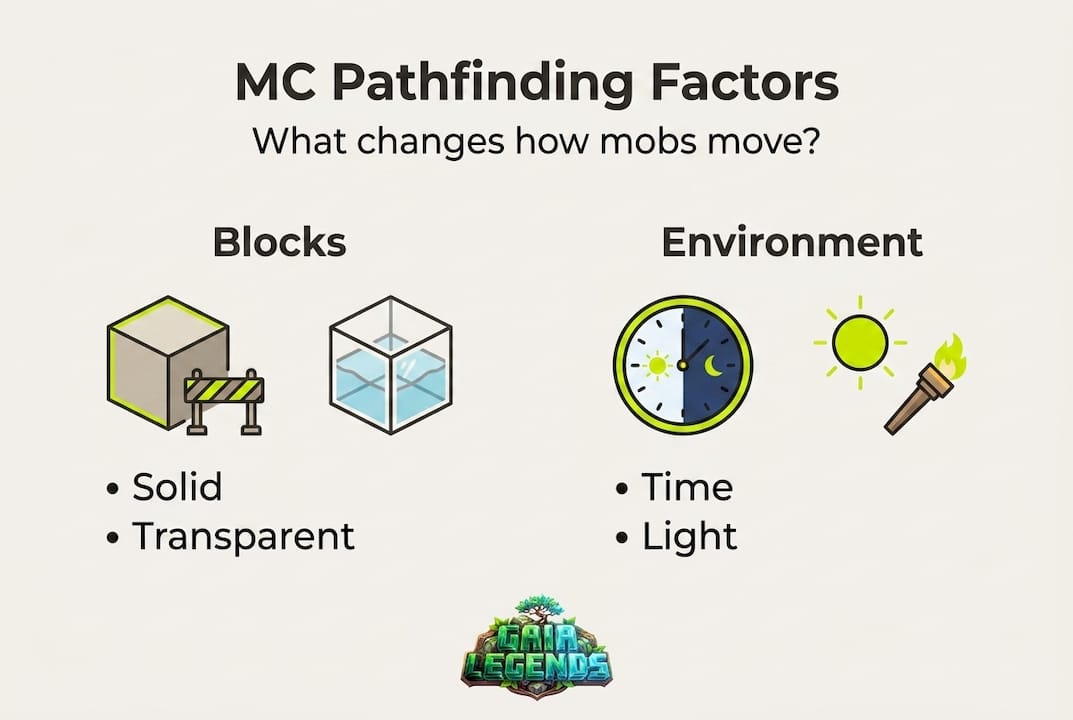
Here's how common blocks affect pathfinding:
| Block type | Pathfinding effect |
|---|---|
| Solid blocks (stone, wood) | Hard obstacle, forces rerouting |
| Transparent blocks (glass, slabs) | Can disrupt line-of-sight checks |
| Fences and walls | Impassable for most mobs unless jumping |
| Doors | Passable for villagers, openable by zombies on Hard |
| Water | Slows movement, disrupts land pathfinding |
| Carpet | Walkable, treated as part of the floor |
| Trapdoors (open) | Often ignored as obstacles, useful for routing |
The day and night cycle adds another layer. Villagers prioritize finding their beds at dusk, which overrides other behaviors. If their path is obstructed at that moment, they may panic, spin, or end up sleeping somewhere unexpected. Hostile mobs, on the other hand, activate their aggressive pathfinding at night or in low-light conditions.
Player behavior matters too. Holding emeralds near villagers actively pulls them toward you, letting you redirect them. This is one of the most underused tricks for optimizing trading hall layouts without needing to push or boat villagers into position.
Steps to troubleshoot a failing path:
- Check for non-transparent blocks between the entity and its goal
- Confirm the path has no gaps or 2-block-tall ceilings that block tall mobs
- Look for water sources near the route that might stall movement
- Remove or reposition fences and doors that could be acting as one-way barriers
- In Bedrock, shrink the distance between workstations and beds
Pro Tip: Open trapdoors placed flat on the floor can act as a surprisingly effective routing guide for villagers. They walk over them without issue while most hostile mobs hesitate or refuse to step on them, giving you a subtle layer of mob defense without walls.
Practical uses: Leveraging pathfinding for survival, builds, and entertainment
With key factors covered, here's how you can turn knowledge of pathfinding into a real advantage in your world.
Players can use pathfinding knowledge to improve everything from trading systems to puzzle maps. This isn't just theory. It's a practical toolkit.
Improving villager trading and farming setups
Designing a trading hall becomes much more reliable once you know how villagers search for workstations and beds. Keep paths clear, use solid flooring without gaps, and avoid glass walls near pathways. Check out survival pathfinding techniques for setups that apply these ideas directly to early and mid-game survival scenarios.
Building mob-proof bases
Hostile mobs follow specific pathfinding rules. They won't jump across a one-block gap if the ledge is too high, and they struggle to navigate around certain block shapes. Designing your base with these limitations in mind is more effective than piling up walls randomly. Think about where mobs would naturally route and place obstacles there.
Creating AI-driven puzzles
Pathfinding makes it possible to build puzzle maps where mob behavior is part of the challenge. Pressure plates that trigger doors, corridors designed to confuse mob movement, or chases that rely on timed pathing all become possible when you know the rules. Innovative puzzles and RPG maps often use exactly this kind of mechanic to create memorable gameplay.
Multiplayer minigames and mapmaking
In competitive or adventure maps, pathfinding awareness lets you control where mobs go and when. You can funnel zombies down specific corridors, prevent them from reaching safe zones, or design arenas where AI behavior adds tension without becoming chaotic.
Here's a quick list of specific pathfinding tricks worth experimenting with:
- Use carpet to guide villager paths without building full walls
- Place trapdoors at entry points to create mob-resistant thresholds
- Use water currents to move mobs through farms without relying on their own pathing
- Light up dead-end corridors to prevent mobs from spawning inside designed routes
- Use boats or minecarts to transport villagers when their own pathing fails completely
- Leverage creative build techniques to integrate pathfinding logic into aesthetically appealing structures
Troubleshooting and expert tips for mastering pathfinding
Even with all the theory down, real-world pathfinding problems show up constantly. Here's what to do when things go sideways.
The most common symptoms of broken pathfinding are: villagers spinning in place, mobs ignoring players through walls, animals refusing to move through a gate, and entities getting permanently stuck in corners. These aren't random glitches. They're symptoms of a diagnosable problem.
Understanding block types and pathfinding logic is your first line of defense against these issues. Before assuming the game is bugged, work through a checklist.
Step-by-step diagnostic process:
- Stand where the entity is stuck and look in the direction it's trying to go. Is there a block at foot, knee, or head level it can't pass?
- Check if doors or trapdoors are in the wrong open or closed state for the entity you're working with
- Remove any transparent blocks along the main route temporarily and test again
- If it's a villager, verify the workstation or bed is unclaimed and within range
- Test the path at night vs. day to see if time of day changes behavior
- Reload the chunk by moving far away and returning, which sometimes resets stuck entity behavior
- If you've recently updated your game version, reconsider any top survival tips that reference block behavior, since AI updates between versions can change expected outcomes
When to rebuild vs. adjust: If a villager consistently fails to path to a workstation, it's faster to rebuild the station placement than spend 20 minutes debugging. But if a mob farm stops working after an update, the issue is usually a block behavior change that only needs a small fix, like replacing a slab with a full block.
Pro Tip: After every major Minecraft update, test your mob farms and trading halls before committing to large production runs. Mojang regularly adjusts AI behavior in patches, and what worked in one version may break silently in the next. Set up a quick test run with a single entity before scaling up.
Why mastering pathfinding is an underrated Minecraft skill
Here's something most guides won't tell you: pathfinding knowledge is one of the highest-leverage skills in Minecraft, and almost nobody treats it seriously. Casual players see a broken trading hall and blame bad luck. Technical players see a pathfinding issue and fix it in two minutes.
We've managed a 200-player SMP server, and the farms that break most often aren't the complicated redstone circuits. They're the ones where someone placed a glass block in the wrong spot and the villager quietly stopped linking to its workstation weeks earlier. By the time anyone notices, the whole trading setup has silently failed.
Mastering pathfinding changes how you design everything. Your mob farms become more predictable. Your villager halls become more reliable. Your puzzle maps become genuinely clever instead of accidentally broken. It even affects how you fight bosses, since understanding how hostile mobs target and reroute helps you dodge and trap them more effectively, something we cover in our advanced survival progression content.
The players who dominate technical Minecraft treat AI rules as core meta knowledge. They're not memorizing trivia. They're using it to build farms that produce thousands of items per hour and defenses that hold up against wave attacks with zero maintenance. Pathfinding is invisible, but so is oxygen. That doesn't make it unimportant.
If you're serious about improving your game, start here. It costs nothing to learn and pays off in every part of your world.
Level up your Minecraft pathfinding skills with Gaia Legends
Understanding pathfinding is just one piece of the Minecraft mastery puzzle. The deeper you go into mechanics like AI behavior, entity routing, and block interactions, the more every other system in the game starts to make sense. That's exactly what we focus on at Gaia Legends.

Whether you want to build advanced trading halls that never break, design mob farms that run without constant babysitting, or explore creative builds that use AI mechanics as a feature rather than a frustration, we've got you covered. Our full library of Minecraft tips and guides is built from real server experience across hundreds of players, covering everything from beginner survival to advanced technical builds. Come dig into the content, and join a community of players who are genuinely passionate about getting better at this game.
Frequently asked questions
Why do Minecraft villagers get stuck or fail to reach their beds?
Villagers may get stuck if non-transparent blocks disrupt their line-of-sight, or if the route is too complex for their pathfinding AI to process, especially in Bedrock Edition where AI range limits are stricter.
How can I use emeralds to influence villager pathfinding?
Holding emeralds causes villagers to pathfind toward players holding them, which is a useful trick for manually guiding their position inside a trading hall or farm without physically pushing them.
What blocks break pathfinding for mobs in Minecraft?
Blocks like fences, doors, water, and non-transparent obstacles can prevent mobs from finding valid paths, causing them to wander, give up, or get permanently stuck in corners.
How is pathfinding different in Minecraft Java and Bedrock editions?
Bedrock villagers have a much shorter workstation search radius of just 16 blocks compared to Java, and Bedrock entities are generally more sensitive to transparent blocks breaking their pathfinding calculations.
Recommended
Related guides
How to Find Buried Treasure in Minecraft 2026: Maps & Tips
Master how to find buried treasure in Minecraft with our 2026 guide. Find treasure maps in shipwrecks & ruins, follow the X, and collect rare loot like...
Minecraft Combat Tips That Win Every Fight in 2026
Master Minecraft combat tips to dominate every fight in 2026! Learn essential strategies for weapons, timing, and terrain to become unbeatable.
Minecraft Event Hosting Guide for Every Server Size
Master your next event with our Minecraft event hosting guide! Learn how to engage players, handle lag, and foster community growth.

Minecraft SMP dynamics: master multiplayer server play
Unlock the secrets of Minecraft SMP dynamics! Master multiplayer gameplay, navigate social strategies, and thrive in any server environment.
Have a question or another approach?
Compare notes with other readers. Include your edition and version when discussing mechanics.