How to Build a Pro Minecraft Trading Hall (2026 Layouts)
Filed under Minecraft Economy & Trading · How we create content
Minecraft version varies by section · Updated 2026-06-21
Key Takeaways
- Curing a zombified villager gives permanent trade discounts — prices can drop to as low as 1 emerald per enchanted book.
- Each villager profession is tied to a specific job site block — remove it to reset trades and reroll for better ones.
- A compact 1-wide cell design lets you pack 10–20 villagers into a small footprint without them escaping or pathfinding away.
- Zombie curing is the single highest-ROI activity in Minecraft's economy — one cured librarian can save hundreds of emeralds over a playthrough.
- Sorting your hall by profession (librarians, farmers, clerics, etc.) turns it into a one-stop shop for every resource you need.
- On economy servers, a stocked trading hall is the fastest legal path to unlimited shop inventory.
Most players never build a trading hall. They wander their village, spam-click a librarian, and hope for the best. That's leaving enormous value on the table. A proper Minecraft trading hall transforms villagers from a passive feature into your most powerful economic engine — one that produces infinite enchanted books, emeralds, and rare gear on demand.
This guide covers everything: cell design, job site block assignment, zombie curing for maximum discounts, and the best profession layouts for 2026 survival and economy play.
What Is a Minecraft Trading Hall?
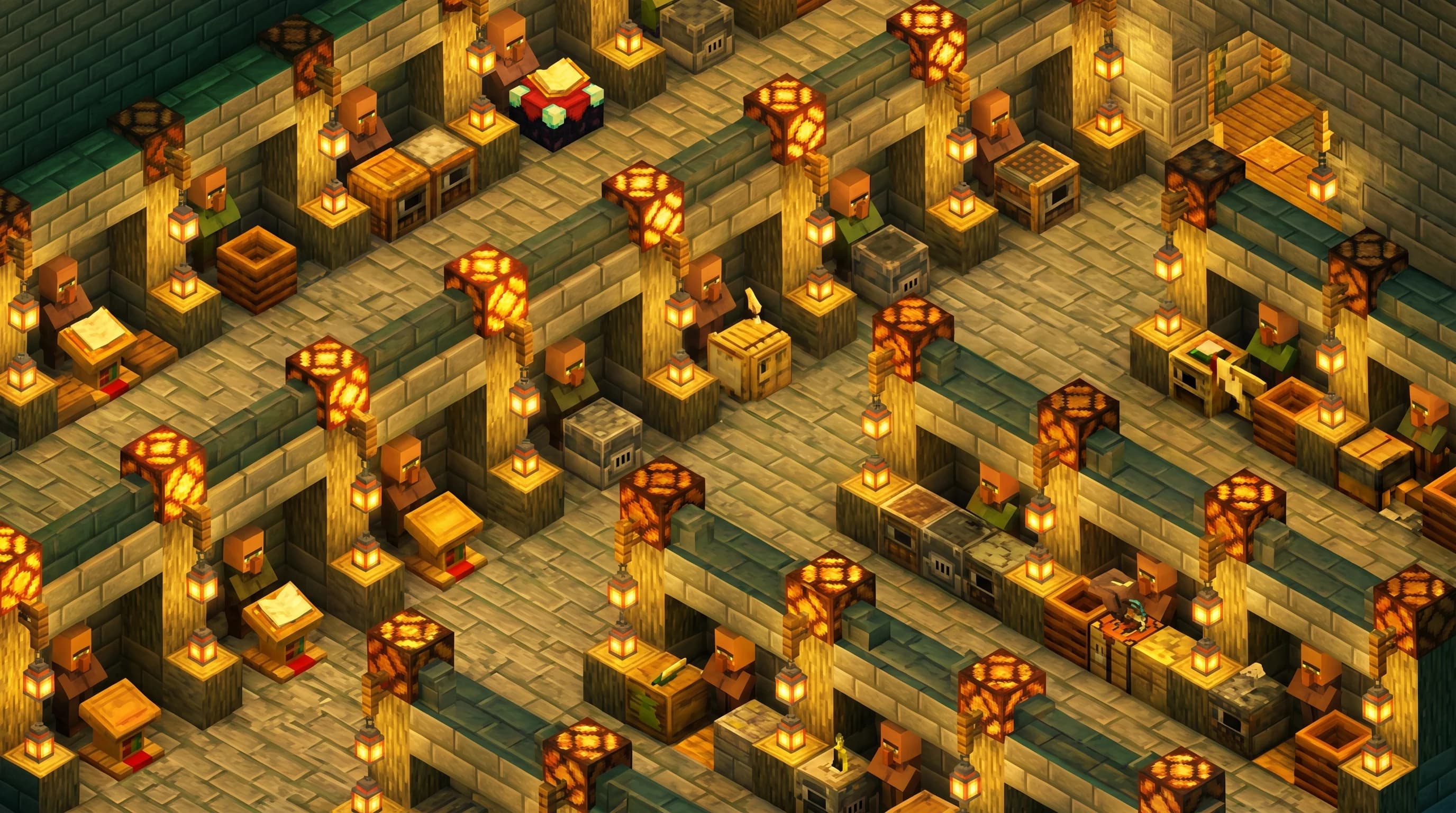
A Minecraft trading hall is a player-built structure that houses multiple villagers in individual, controlled cells, each locked to a specific profession and trade set. Unlike a natural village, a trading hall gives you full control over which trades are available, prevents villagers from wandering off, and lets you cure them for permanent price discounts.
The core loop is simple:
- Capture or breed villagers
- Assign each one a job site block
- Reroll trades by removing and replacing the job site block until you get the trade you want
- Cure them to lock in discounts
- Profit — indefinitely
Why a Trading Hall Beats a Regular Village
Natural villages are messy. Villagers wander, get killed by zombies, and share job site blocks in ways you can't control. A trading hall solves all of that. Every villager is locked in place, every profession is intentional, and every trade is optimized.
Note: Villagers can only claim a job site block if they are unemployed and within a valid pathfinding range. Keep cells small to prevent them from wandering to unintended blocks. On Bedrock Edition, villagers require at least one bed in the vicinity to claim a job site block and restock trades, so always include beds in your hall design even if they appear unnecessary on Java.
How to Design Your Trading Hall Layout
Good layout design is the difference between a hall you actually use and one you abandon after a week. Here are the three most popular cell formats.
The 1-Wide Compact Cell
This is the gold standard for space efficiency. Each cell is 1 block wide, 2 blocks deep, and 3 blocks tall. You place the villager inside, put the job site block in front of them (accessible from outside the cell), and use a trapdoor or slab to prevent them from jumping out.
Materials per cell:
- 2 walls (any solid block)
- 1 job site block (varies by profession)
- 1 bed (placed nearby or inside)
- 1 trapdoor or slab (to seal the top)
A row of 10 cells in this format fits in a 10×4 footprint — extremely compact.
The 2-Wide Observation Cell
If you want to see villager trade menus at a glance, build 2-wide cells with a glass pane on the front wall. This costs more materials but makes it easy to quickly open trades without accidentally clicking the wrong villager.
The Underground Bunker Layout
Pro Tip: Light every cell to at least light level 8 to prevent zombie spawns inside your hall. Lanterns and sea lanterns are the cleanest options aesthetically. For an extra layer of safety, place a lightning rod on the surface above your underground hall to redirect lightning strikes away from any surface-level villager holding cells or entryways.
Best Villager Trades in 2026
Not all villager professions are created equal. Here's a ranked breakdown of the most valuable trades to lock in.
| Profession | Job Site Block | Best Trade | Priority |
|---|---|---|---|
| Librarian | Lectern | Enchanted Books (any) | ⭐⭐⭐⭐⭐ |
| Cleric | Brewing Stand | Bottle o' Enchanting / Nether Wart | ⭐⭐⭐⭐ |
| Farmer | Composter | Emeralds for crops | ⭐⭐⭐⭐ |
| Toolsmith | Smithing Table | Diamond tools | ⭐⭐⭐ |
| Armorer | Blast Furnace | Diamond armor | ⭐⭐⭐ |
| Fletcher | Fletching Table | Arrows / Tipped Arrows | ⭐⭐⭐ |
| Cartographer | Cartography Table | Explorer Maps | ⭐⭐ |
Librarians are the undisputed priority. A single librarian can offer any enchanted book in the game — Mending, Silk Touch, Fortune III, you name it. Reroll their trades by breaking and replacing the lectern until you get the enchantment you want.
How to Get the Enchanted Book You Want
- Place an unemployed villager in a cell with no job site block nearby
- Place a Lectern adjacent to the cell
- Open the villager's trade menu — if the first trade isn't the enchantment you want, break the lectern and replace it
- Repeat until you get your target enchantment
- Trade with the villager once to lock the trade permanently
This process can take anywhere from 1 to 30+ attempts depending on the enchantment pool size. Mending is notoriously rare — budget time for it.
Pro Tip: Keep a stack of lecterns in your inventory while rerolling. Craft them from bookshelves (3 planks + 1 bookshelf) for fast cycling. If you're hunting for a specific treasure enchantment like Mending or Swift Sneak, note that some enchantments are biome-dependent for librarian trades — you may need to reroll a villager in a swamp or jungle biome to access the full enchantment pool.
How to Cure Zombified Villagers for Maximum Discounts
This is the single most impactful thing you can do for your trading hall economy. According to the Minecraft Wiki, curing a zombie villager gives it a permanent "Hero of the Village"-style discount that stacks with each additional cure, meaning prices can drop to as low as 1 emerald per trade on repeat cures.
The zombie curing process:
- Find or lure a zombie villager (they spawn naturally or convert when a zombie kills a villager on Normal/Hard difficulty)
- Throw a Splash Potion of Weakness at the zombie villager
- Feed it a Golden Apple (not enchanted — the regular crafted one works)
- Wait 2–5 minutes while it shakes and converts back to a villager
- The villager retains its profession and trades, but at a steep discount
According to the Minecraft Wiki, each time you cure a villager, it gains a persistent discount on all its trades. Curing the same villager twice (convert to zombie, re-cure) stacks the discount further, and repeated curing can reduce trade costs to a minimum of 1 emerald.
Note: On Hard difficulty, zombies that kill villagers always convert them to zombie villagers. This makes Hard mode the most efficient difficulty for farming zombie villagers to cure.
What You Need to Cure a Zombie Villager
- 1 Splash Potion of Weakness (brewed with a fermented spider eye + water bottle, or found in witch drops)
- 1 Golden Apple (8 gold ingots + 1 apple)
- A safe enclosed space so the zombie villager doesn't burn in sunlight or wander off
The golden apple is the main cost. Gold farms help here — even a basic nether portal gold farm produces enough gold ingots to cure dozens of villagers per hour.
Tips for Organizing a High-Efficiency Trading Hall
A hall with 20 random villagers is chaos. A hall with 20 intentionally organized villagers is a resource factory. Here's how to keep things manageable:
- Label cells with item frames — place an item frame on the outside of each cell with the job site block item inside so you know at a glance what each villager offers
- Group by profession — put all librarians together, all farmers together, etc. Makes it faster to find the trade you need
- Keep a spare bed supply — villagers need beds to restock trades. Make sure every villager has a bed assigned within the hall
- Build a restock area — a small platform where you can wait out a day/night cycle to trigger trade restocks without leaving the hall
- Use name tags on your best villagers — a Mending librarian or a cured armorer with diamond armor is irreplaceable. Name-tag them so they never despawn
How to Put This Into Practice on Gaia Legends
Gaia Legends runs a full player-driven economy where chest shops let you buy and sell items with other players using in-game currency. A well-built trading hall is the backbone of any serious shop owner's operation.
Here's how it connects:
- Librarians give you enchanted books to sell directly in your chest shop — Mending books are consistently the highest-demand item on the server
- Farmers and clerics generate emerald income that you can convert into shop stock or use to buy materials from other players
- Armorer and toolsmith villagers let you produce enchanted diamond (and netherite) gear at scale to list in the player market
Gaia Legends also supports Java + Bedrock crossplay, so whether you're building your trading hall on Java or Bedrock, your shop inventory works the same way. The server's non-pay-to-win economy means the players with the best resource infrastructure — like a maxed-out trading hall — are genuinely the most powerful traders on the server.
Gaia Legends is free to join, non-pay-to-win, and supports Java + Bedrock crossplay. Join at gaialegends.pro and start your legend today.
Wrap-Up: Your Trading Hall Action Plan
Building a great Minecraft trading hall doesn't require a massive base or hours of prep. Start small, optimize fast, and scale up as your hall proves its value.
The three things that matter most:
- Cure your villagers — even one cured librarian with Mending trades will change your entire playthrough
- Reroll trades intentionally — don't settle for bad trades; breaking and replacing a lectern costs almost nothing
- Build underground with full lighting — protect your investment from raids and zombie conversions
Start with three cells: one librarian, one farmer, one cleric. Cure all three. Within a single play session, you'll have more emeralds and enchanted books than you know what to do with. Then expand from there.
Ready to play? Join Gaia Legends today — no pay-to-win, Java + Bedrock crossplay.
- Java:
join.gaialegends.pro - Bedrock:
join.gaialegends.pro— Port19132
Further reading
These references were recorded with the article; specific claims have not been matched to source excerpts.
Frequently Asked Questions
What is the best layout for a Minecraft trading hall?
The best Minecraft trading hall layout uses 1-wide compact cells (1 block wide, 2 deep, 3 tall) arranged in rows underground with full lighting. Place the job site block accessible from outside the cell, assign a bed to each villager, and group cells by profession. Underground placement protects villagers from raids and zombie conversions, making it the most reliable long-term design.
How do I cure a zombie villager in Minecraft?
Throw a Splash Potion of Weakness at a zombie villager, then feed it a regular Golden Apple (not enchanted). The villager will shake and convert back over 2–5 minutes, retaining its profession and trades but at a permanent discount. Curing the same villager multiple times stacks the discount further, potentially reducing trade costs to as low as 1 emerald.
What are the best villager trades to get in 2026?
Librarians are the top priority — they can offer any enchanted book including Mending, Silk Touch, and Fortune III. Clerics are second for Bottles o' Enchanting and Nether Wart. Farmers are excellent for converting crop surpluses into emeralds. Armorers and toolsmiths round out the hall with diamond gear. Reroll trades by breaking and replacing job site blocks until you get what you want.
How do I reroll villager trades in Minecraft?
Place an unemployed villager near a job site block to assign it a profession. If the trades aren't what you want, break the job site block and replace it — the villager's trades will reset. Repeat until you get your target trade. Once you trade with the villager even once, its profession and trades lock permanently, so don't trade until you're happy with what's offered.
How many villagers should a trading hall have?
A starter hall needs at least 3–5 villagers covering the core professions: librarian, farmer, and cleric. A mid-game hall of 10–15 villagers covers all major professions. Endgame halls often reach 20–30 villagers with multiple librarians rerolled for specific enchantments. Start small, cure every villager you add, and expand only once your existing cells are fully optimized.
Do trading hall designs work on Minecraft Bedrock Edition?
Yes, trading halls work on Bedrock Edition with a few differences. Bedrock villagers pathfind slightly differently, so tighter cell designs (using trapdoors and slabs to restrict movement) are even more important. Trade rerolling works the same way — break and replace the job site block. Zombie curing discounts also apply on Bedrock, making the curing strategy equally valuable across both editions.
Related guides
How to Use a Minecraft Villager Trading Chart for Max Profit 2026
Master the Minecraft villager trading chart in 2026. Learn trade prices, zombie curing discounts, piglin bartering, and how to flip items for max profit.
How to Build the Most Efficient Minecraft Trading Hall in 2026
Learn how to build the most efficient Minecraft trading hall in 2026 — layouts, zombie curing, best villager professions, and emerald farming tips.
Minecraft Economy 101: How Supply and Demand Work on Player-Driven Servers
Learn how supply and demand shape Minecraft economies, from vanilla villager trading mechanics to player-driven server markets. Includes inflation control...
How to Profit from Minecraft Wandering Trader Deals in 2026
Learn how to profit from Minecraft wandering trader deals in 2026. Discover the best trades, trapping techniques, and server economy strategies to earn...
Have a question or another approach?
Compare notes with other readers. Include your edition and version when discussing mechanics.