How to Build a Japanese Pagoda in Minecraft 2026: Block Palette Guide
Filed under Minecraft Build Palette & Block Harmony · How we create content
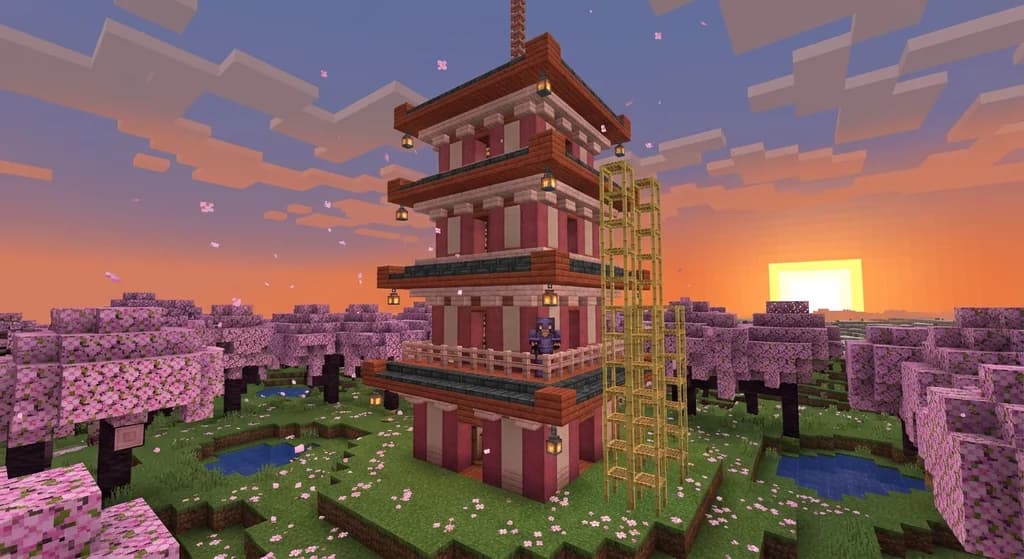
Key Takeaways
| Point | Details |
|---|---|
| Palette triad | A dark roof (deepslate), light walls (stripped cherry wood), and an accent (pink wool) create a classic Japanese pagoda look. |
| Biome matters | Match your palette to nearby biomes—cherry groves for pink tones, bamboo forests for green accents. |
| Scaffolding is essential | Use scaffolding up to 256 blocks to safely build tall tiers without flight. |
| Survival planning | Pre-build in creative and gather at least 6 stacks of wood and 4 stacks of deepslate before starting. |
| Generator first | A palette generator saves hours of trial and error by previewing block interactions. |
Table of Contents
- What Is a Japanese Pagoda in Minecraft?
- Why Does Block Palette Matter for Japanese Builds?
- Best Block Combinations for a Japanese Pagoda
- How to Build a Survival-Friendly Pagoda Step by Step
- Tips for Scaling Your Pagoda and Adding Details
- How to Put This Into Practice on Gaia Legends
- Conclusion
Building a Japanese pagoda in Minecraft is one of the most rewarding architectural challenges you can take on, but many players struggle to find a block palette that looks authentic without feeling monotonous. In fact, over-using dark oak or relying solely on default stone can make your temple feel heavy and uninspired. This guide breaks down the exact block combinations—tested in both creative and survival—that produce a convincing multi-tiered pagoda for your 2026 builds. You'll learn which wood types, accent blocks, and stone variants work together to capture the elegant, curved-roof aesthetic that makes Japanese architecture so iconic. Whether you're placing your pagoda in a cherry blossom grove or a bamboo forest, the right palette ensures every tier reads clearly and feels immersive. We'll also show you how to adapt these palettes for survival mode, where block availability and resource gathering shape your design choices.
What Is a Japanese Pagoda in Minecraft?
A Japanese pagoda in Minecraft is a multi-tiered tower with sweeping, upward-curving roofs that draws from real-world Buddhist and Shinto architectural traditions.
Japanese pagodas are characterized by their stacked floors, each with a wide, flared roof. In Minecraft, builders replicate this look using a combination of stripped woods, stone slabs, fences, and stair blocks to create the illusion of curved eaves. The key is balancing three visual weights: the dark roof, the light walls, and the subtle trim. Unlike a standard tower, a pagoda’s roofs dominate the profile, so your block choices must make each tier distinct while keeping the whole structure cohesive. For example, using cherry wood walls with deepslate roofs creates a high-contrast silhouette that reads clearly even from a distance. According to the Minecraft Wiki, cherry grove biomes—the ideal setting for a Japanese pagoda—have a temperature of 0.7, placing them among the mildest forest biomes for vibrant leaf colors (via Minecraft Wiki). For builders looking to integrate a pagoda into a cherry grove, our cherry blossom palette guide offers complementary pink and white combos.
Why Does Block Palette Matter for Japanese Builds?
Block palette matters for Japanese builds because the right color and texture contrast can make a pagoda feel ancient, polished, and deeply rooted in its environment, while a mismatched palette breaks immersion.
Japanese architecture in Minecraft relies on subtle contrasts: dark roofs against light walls, wooden textures next to smooth stone. If you use blocks that are too similar—like all dark oak—the roof melts into the walls and you lose the signature silhouette. Conversely, clashing colors like birch and spruce can make your build look cartoonish rather than elegant. The goal is to choose a primary wood, a roof block, and an accent material that form a harmonious triad. This triad is often sourced from the surrounding biome to keep the build placeable in survival. For instance, a bamboo forest provides bamboo, dark oak, and stone variants, while a cherry grove offers cherry wood, pink tones, and deepslate. Deepslate tiles, with a hardness of 3.5, offer more than double the protection of oak planks (hardness 2) for a pagoda's structural core (via Minecraft Wiki). The interplay of these blocks creates depth, and using a palette generator can help you avoid muddy combinations before you place a single block.
Best Block Combinations for a Japanese Pagoda
The best block combinations for a Japanese pagoda use a dark roof material like deepslate or dark prismarine, a pale wall wood like stripped oak or birch, and an accent like bamboo or pink wool to pull the palette together.
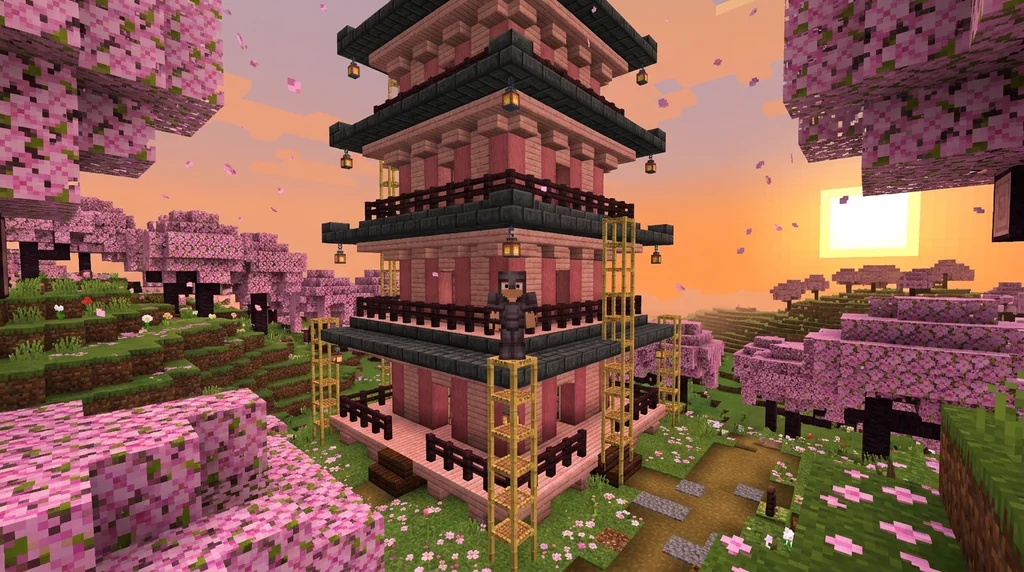
Here’s a quick-reference table of biome-specific palettes that work:
| Biome | Primary Wood | Roof Block | Accent Block | Notes |
|---|---|---|---|---|
| Cherry Grove | Stripped Cherry Wood | Deepslate Tiles | Pink Wool | Classic sakura feel |
| Bamboo Forest | Stripped Oak or Dark Oak | Spruce Slabs | Bamboo Mosaic | Natural green contrast |
| Birch Forest Hills | Stripped Birch Logs | Smooth Sandstone | Prismarine Bricks | Bright, airy look |
| Dark Forest | Stripped Dark Oak | Nether Bricks | Gold Blocks (sparingly) | Dramatic and mysterious |
These four palettes cover most survival-friendly scenarios. For autumn-themed pagodas, the warm-tone palettes for spruce cabins provide earthy accent ideas that blend reds and oranges. For more high-contrast pairing ideas, check out our complementary block palettes guide.
Pro Tip: When in doubt, limit your palette to three core blocks. Adding a fourth is fine for small trims, but never exceed five distinct blocks per tier—over-texturing hides the pagoda’s clean lines.
Scaffolding can reach up to 256 blocks high from its base, making it indispensable when building tall pagoda frames without flying (via Minecraft Wiki). Combined with a bamboo farm for scaffolding, you can work efficiently on that fifth tier.
How to Build a Survival-Friendly Pagoda Step by Step
Building a survival-friendly pagoda starts with laying a 9×9 base and stacking identical tiers with incremental roof expansions, using scaffolding to reach the upper levels safely.
Follow these steps for a solid 5-tier pagoda:
- Gather materials in advance. For a cherry-dark palette, you’ll need at least 6 stacks of stripped cherry logs, 4 stacks of deepslate tiles, 2 stacks of pink wool, and plenty of fences, trapdoors, and lanterns.
- Build the central spine. Start with a 9×9 square of deepslate tiles for the floor, then erect a 4-block central pillar of polished deepslate. This spine will be your load-bearing core.
- Frame the first tier walls. Surround the pillar with stripped cherry log walls, leaving 1-block gaps for windows. At y=4, extend the wall by 2 blocks outward using stairs to begin the roof curve.
- Construct the roof. Use deepslate tile stairs and slabs to create the sweeping eaves. The trick is to slope forward then upward: place stairs for the initial curve, then switch to full blocks and top with slabs for a pointed finial.
- Repeat for upper tiers. Each tier shrinks by 2 blocks in width. The second tier starts at 7×7, third at 5×5, fourth at 3×3, and the top can be a single 1×1 spire.
- Add details. Fence railings on each balcony, trapdoor shutters, and lanterns hanging from chains complete the look.
Warning: Building in survival without scaffolding can get frustrating—the fall risk increases with each tier. Even with Feather Falling IV boots, a drop from 30 blocks deals fatal damage.
Dark oak saplings drop at a 5% rate from leaves without Fortune, so planting a 2×2 tree farm early is wise if you’re using dark oak accents (via Minecraft Wiki). Before committing your resources, use a palette generator tool to visualize the final look and avoid wasted mining trips.
Tips for Scaling Your Pagoda and Adding Details
Scaling a pagoda correctly involves reducing each tier’s width by 2–4 blocks while maintaining roof overhang, then adding fences, trapdoors, and lanterns for ornamental flair.
Even a small pagoda benefits from exaggerated roofs: make the eaves extend at least 3 blocks beyond the walls to create that iconic silhouette. For larger scales, you can use half-block offsets and corner stairs to smooth the curve.
Note: Smooth sandstone can be crafted from 4 sandstones in a 2×2 grid, yielding 4 smooth sandstone—a perfect match for pagoda trim detailing when building in deserts or birch forests (via Minecraft Wiki).
If your pagoda feels too blocky, replace some roof full blocks with slabs and add fence posts along the ridges to simulate traditional ornamental spines. The coastal block palettes guide features sandstone combos that work wonders for pagodas near warm oceans.
Bamboo grows an average of one block every 68 seconds at default random tick speed in Java Edition, so a small bamboo farm next to your pagoda can supply scaffolding and decoration (via Minecraft Wiki). For landscaping, the aesthetic cottagecore block palettes can inspire your surrounding gardens with flowers and mossy cobble paths.
How to Put This Into Practice on Gaia Legends
On Gaia Legends, you can jump into our creative plot world to test each palette before you gather a single resource in survival. Simply claim a plot and build a miniature pagoda using any of the combinations above—no grinding required. Once you’re happy, switch to our survival world where the economy and player shops make bulk block acquisition easy. This is especially helpful if you’re trying a complex palette like the dark forest Nether brick combo, which requires a trip to the Nether. Our community loves sharing palette snapshots in the #build-chat Discord channel, and the server’s built-in palette generator (accessible via the website) lets you preview how different blocks interact with the server’s custom terrain. Gaia Legends is free to join, non-pay-to-win, and supports Java + Bedrock crossplay. Join at gaialegends.pro and start your legend today.
Conclusion
A well-planned block palette turns a simple tower into an authentic Japanese pagoda, and experimenting in creative mode lets you refine that palette before surviving your masterpiece.
Remember these three rules: stick to a dark roof, light walls, and a single accent block; use scaffolding liberally to avoid falls; and quarry local materials so your build feels connected to its biome. Start small—a 3-tier pagoda gives you the confidence to scale up—and soon you’ll have a temple that dominates the skyline. Try it on Gaia Legends’ creative plots and share your results with the community.
Ready to play? Join Gaia Legends today — no pay-to-win, Java + Bedrock crossplay.
- Java:
join.gaialegends.pro - Bedrock:
join.gaialegends.pro— Port19132
Further reading
These references were recorded with the article; specific claims have not been matched to source excerpts.
Frequently Asked Questions
What is the best block palette for a japanese pagoda minecraft build?
A tried-and-true palette pairs stripped cherry wood walls with deepslate tile roofs and pink wool accents. For a more neutral look, use stripped oak, spruce slabs, and bamboo mosaic. Limit yourself to three core blocks to maintain a clean, authentic silhouette.
Can I build a pagoda in survival mode without creative testing?
Yes, but plan your palette first using a generator or by placing a few sample blocks. Gather at least 6 stacks of your primary wood and 4 stacks of roof material before starting, and build scaffolding for safety.
How many tiers should a pagoda have?
Five tiers is traditional, but three is easier for smaller builds. Each tier reduces in width by 2 blocks for a balanced look. Odd numbers work best visually.
What blocks work for the roof curve?
Stairs and slabs of deepslate, dark prismarine, or nether bricks create the signature upturned eaves. Use a combination of upside-down stairs for the base and regular stairs for the tip.
Why does my pagoda look blocky and not smooth?
Expand the roof overhang to at least 3 blocks past the walls, and use half-slab layers to create a gradual slope. Fences along the roof edges can soften the silhouette.
Can I use bamboo blocks in the structure?
Absolutely. Bamboo mosaic blocks make excellent accent walls or flooring, and bamboo scaffolding is perfect for temporary construction. Just avoid using bamboo for roofs—it lacks the dark contrast needed.
Related guides
How to Create Your Own Block Palettes in Minecraft (2026)
Learn how to create your own Minecraft block palettes in 2026. This step-by-step guide covers color theory, block combinations, and testing techniques for...
Best Minecraft Block Palette for a Wizard Tower in 2026
Discover the best Minecraft wizard tower block palette for 2026. Learn how to combine deepslate, amethyst, copper, and crying obsidian for a magical...
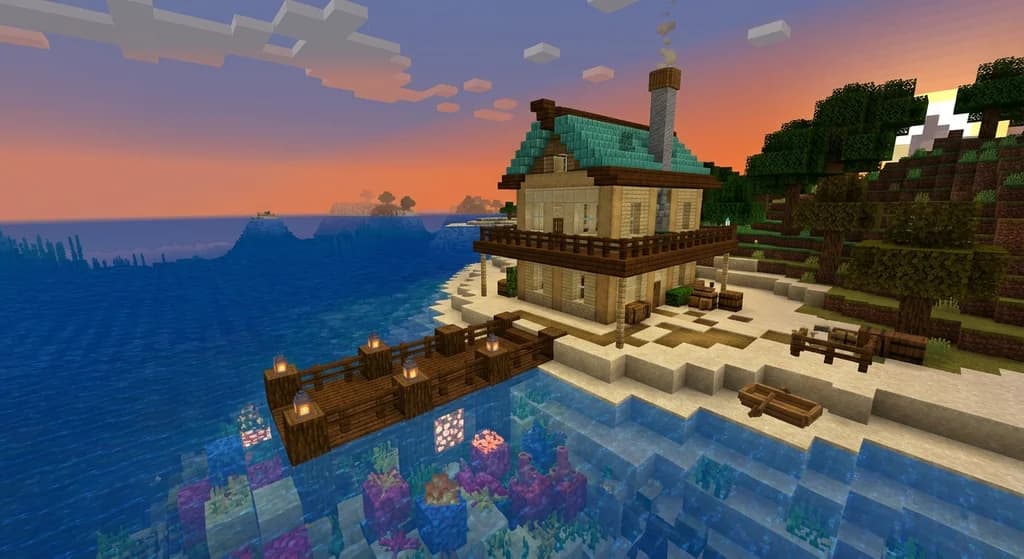
7 Best Coastal Block Palettes for Minecraft House Builds 2026
Discover the 7 best coastal block palettes for Minecraft house builds in 2026. Expert sandstone combos, beach house ideas, and seaside palette tips.
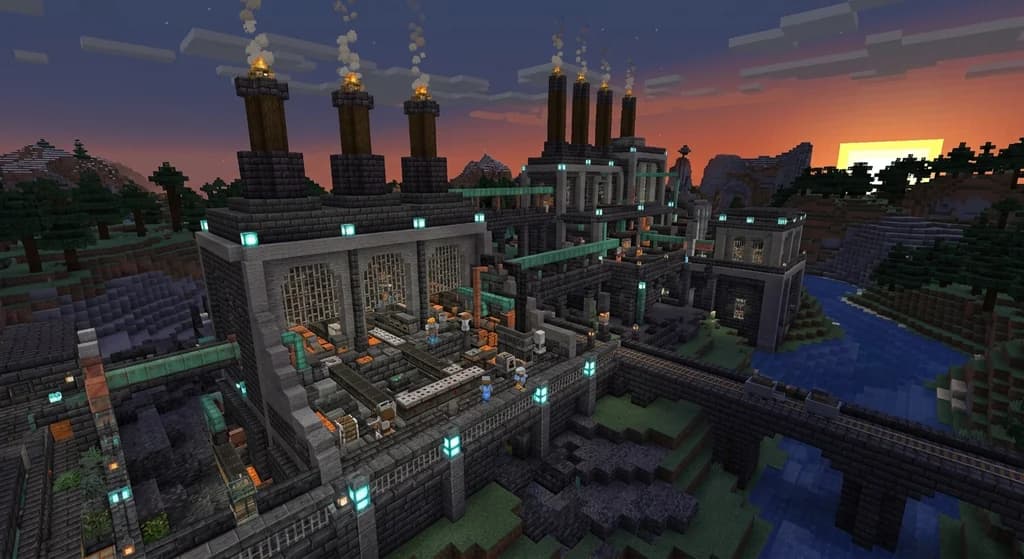
Top 7 Industrial Color Schemes for Minecraft Factory Builds 2026
Discover the top 7 industrial color schemes for Minecraft factory builds in 2026. Master modern factory palettes, steampunk materials, and block harmony tips.
Have a question or another approach?
Compare notes with other readers. Include your edition and version when discussing mechanics.