How to Master Minecraft Villager Trading: 7 Expert Tips for 2026
Filed under Minecraft Tips & Tricks · How we create content
Key Takeaways
| Point | Details |
|---|---|
| Profession blocks are everything | Each villager profession is tied to a specific job site block — place the right one to unlock the trades you need. |
| Cure for permanent discounts | Curing a zombie villager with a golden apple and weakness potion reduces that villager's prices permanently, often to 1 emerald. |
| Level up fast | Trading with a villager increases their experience and unlocks better tiers — reach Master level to access the most powerful trades. |
| Trading halls scale your economy | A dedicated trading hall with multiple profession specialists lets you cycle trades efficiently and never run out of resources. |
| Protect your investment | Villagers who die reset all progress — keep them safe behind walls and away from raids, zombies, and lightning. |
| Reputation matters | Your in-game reputation with a village affects prices globally — defend villagers during raids to earn Hero of the Village and dramatic discounts. |
Table of Contents
- What Is Minecraft Villager Trading?
- How to Assign and Lock Villager Professions
- Best Villager Trades to Prioritize in 2026
- How to Lower Villager Prices Permanently
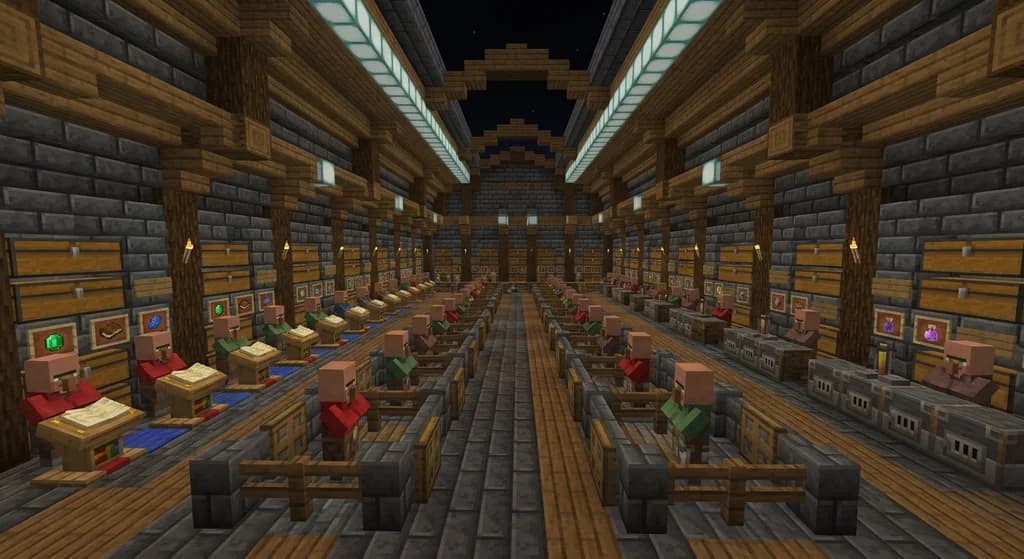
- How to Build a Minecraft Trading Hall
- Tips for Leveling Villagers Quickly
- Why Your Village Reputation Changes Everything
- How to Put This Into Practice on Gaia Legends
- Conclusion
- Frequently Asked Questions
- Recommended
Most players stumble through their first few villages, accidentally break a lectern, and wonder why the librarian suddenly became a nitwit. Sound familiar? A solid Minecraft villager trading guide can be the difference between scraping for resources and having a fully stocked armory by Day 30. Villager trading is arguably the most powerful economic system in vanilla Minecraft — and most players only scratch the surface of it. These seven expert tips will change how you play.
What Is Minecraft Villager Trading?
Villager trading is the in-game system that lets you exchange items — most often emeralds — with profession-assigned villagers in return for goods like enchanted books, tools, food, and rare materials. Each villager has a profession determined by their job site block, and each profession unlocks a unique set of trade tiers that improve as you trade with them.
There are 13 tradeable professions in Java and Bedrock Edition, ranging from Librarian (enchanted books) to Armorer (armor pieces) to Cleric (ender pearls and redstone). Unemployed and Nitwit villagers cannot trade at all — so your first job is always to assign a profession.
Note: Villager trades are randomized at the time they claim a job site block. If you don't like the trades offered, you can break and replace the job site block before the villager sleeps to reroll their trade list — but only while they're still at Novice level and haven't traded with you yet.
How to Assign and Lock Villager Professions
Getting the right villager for the job is step one of any serious trading operation.
Step-by-Step: Assigning a Profession
- Find or breed an unemployed villager (they wear plain robes with no badge).
- Place the desired job site block within 48 blocks of the villager — they'll pathfind to it during the day.
- Wait for the villager to "claim" the block. You'll see green sparkles when it happens.
- Check their trade menu. If you don't like the trades, break the job site block and replace it to reroll — repeat until you get the trade you want.
- Make your first trade with them. This locks their profession permanently, even if the job site block is later removed.
Warning: Once you've traded with a villager even once, their trades are locked forever. Don't make a throwaway trade just to test — wait until you've confirmed the trade list you want.
Job Site Block Quick Reference
| Profession | Job Site Block | Best Trade |
|---|---|---|
| Librarian | Lectern | Enchanted Books (any enchant) |
| Armorer | Blast Furnace | Diamond Armor pieces |
| Cleric | Brewing Stand | Ender Pearls, Bottles o' Enchanting |
| Toolsmith | Smithing Table | Diamond Tools |
| Weaponsmith | Grindstone | Diamond Sword/Axe |
| Farmer | Composter | Bread, Apples, Golden Carrots |
| Fletcher | Fletching Table | Arrows, Bows, Crossbows |
Best Villager Trades to Prioritize in 2026
Not all trades are created equal. Some villagers are worth building an entire hall around; others are situational at best.
Top Tier: Librarian
The Librarian is the single most valuable villager in the game. They can offer any enchanted book in the game — including Mending, which is otherwise only found in treasure chests. According to the Minecraft Wiki, the Librarian's enchanted book trade is randomized from the full enchantment pool, meaning with enough rerolling you can source every enchantment you need from a single profession type.
Pro Tip: Build a dedicated "Librarian farm" with a row of lecterns. Reroll each one until you get the specific enchanted book you need — Mending, Silk Touch, Fortune III. It takes patience, but it's faster than any dungeon run.
High Value: Cleric and Fletcher
Clerics sell Ender Pearls at Master level — critical for End access without hunting Endermen. Fletchers are your best source of arrows and can buy sticks for emeralds, making them an easy emerald income source if you have a tree farm.
Underrated: Farmer
A Farmer villager buys crops like wheat, carrots, potatoes, and beetroot for emeralds. Pair one with an automated crop farm and you have a near-infinite emerald generator that requires almost zero effort to maintain.
If you're still learning the ropes of survival efficiency, the guide on 15 Essential Minecraft Tips and Tricks for New Players in 2026 covers the fundamentals that make trading setups like this possible.
How to Lower Villager Prices Permanently
This is the mechanic that separates casual traders from true Minecraft economists.
The Zombie Cure Method
Curing a zombie villager is the most powerful price-reduction mechanic in the game. Here's how it works:
- Find or create a zombie villager (let a zombie attack a villager at night, or find one spawned naturally).
- Throw a Splash Potion of Weakness at the zombie villager.
- Feed them a Golden Apple while they're weakened.
- Wait 2–5 minutes for the curing process to complete.
- The cured villager will have dramatically reduced prices — often dropping to just 1 emerald per trade.
According to the Minecraft Wiki, each time a villager is cured, they receive a permanent discount modifier that stacks with other discounts. Curing the same villager multiple times can reduce prices to the minimum possible value.
Hero of the Village Discounts
Winning a raid (triggered by entering a village with the Bad Omen effect) grants you the "Hero of the Village" status effect. This provides a temporary discount with all villagers proportional to the raid difficulty level — a powerful short-term boost for bulk trading sessions.
How to Build a Minecraft Trading Hall
A trading hall is a dedicated structure that houses multiple villagers, each locked to a specific profession, in a compact and accessible layout. It's the backbone of any serious Minecraft economy.
Trading Hall Design Essentials
- Separate cells for each villager — prevents them from stealing each other's job site blocks.
- Beds nearby — villagers must have access to a bed or they won't restock trades.
- Two restocks per day — villagers restock their trades twice per in-game day when they can reach their job site block. Keep the path clear.
- Lighting — prevent mob spawns inside the hall. Use sea lanterns or glowstone for style and function.
- Name tags — name each villager so they can't despawn. Label them by their best trade (e.g., "Mending" or "Fortune III").
Pro Tip: Build your trading hall near a bell — it acts as a village center and helps villagers pathfind back to their beds reliably, which is critical for the twice-daily restock cycle.
For inspiration on layouts and block palettes that make your trading hall look as good as it functions, check out 25 Inspiring Minecraft Builds for Every Skill Level.
Tips for Leveling Villagers Quickly
Higher-level villagers unlock better trades. Here's how to push them to Master fast.
Leveling Tiers at a Glance
| Level | Name | Trades Unlocked |
|---|---|---|
| 1 | Novice | 2 trades |
| 2 | Apprentice | 2 more trades |
| 3 | Journeyman | 2 more trades |
| 4 | Expert | 2 more trades |
| 5 | Master | Final 2 trades |
Each trade you complete gives the villager experience. The cheapest available trade is usually the fastest way to level them — buy low-cost items repeatedly to push them through tiers quickly, then access the high-value Master-level trades.
Note: Villagers have a limited supply of each trade per restock cycle. Once a trade is greyed out, wait for the next restock — usually within 20 minutes of real time during an active game session.
Understanding mob behavior is key to keeping your villagers safe and restocking reliably. The post on why mobs despawn in Minecraft explains the mechanics behind mob persistence that apply directly to keeping your villager investments alive.
Why Your Village Reputation Changes Everything
Village reputation is a hidden numerical score that tracks how you've treated a village's inhabitants. It starts at zero and goes up when you trade, cure zombie villagers, or defeat raids — and drops when you attack villagers or iron golems.
A higher reputation means lower prices across the entire village. A low reputation triggers iron golems to attack you on sight. Managing your reputation is especially important on multiplayer servers, where multiple players interact with the same villages.
- Trade regularly with villagers to slowly build reputation.
- Cure zombie villagers for a large reputation boost.
- Never hit a villager — even accidentally — near an iron golem.
- Complete raids for the biggest single reputation jump available.
For a deeper look at how to move efficiently between villages and trading outposts, the guide on how to travel faster in Minecraft covers ice roads, nether highways, and elytra routes that make managing multiple trading halls far less painful.
And if combat is part of your playstyle — especially on servers where raids happen frequently — brushing up on Minecraft combat mastery strategies for survival and PvP will help you clear raids faster and earn Hero of the Village more reliably.
How to Put This Into Practice on Gaia Legends
Everything above becomes even more powerful on a server with a real player-driven economy. Gaia Legends runs a living marketplace where the goods you produce through villager trading — enchanted books, diamond gear, rare materials — have genuine in-game value that other players will pay for.
Here's how the mechanics translate directly to Gaia gameplay:
- Mending books from Librarians are among the most traded items on the server. A cured Librarian selling Mending for 1 emerald is essentially a money printer.
- Farmer villagers paired with our server's crop systems let you convert bulk harvests into emeralds, then emeralds into gear — a full economic loop.
- Trading halls on Gaia function as player-run shops. The better your villager setup, the more competitive your prices and the faster you grow your in-game wealth.
Gaia Legends is free to join, non-pay-to-win, and supports Java + Bedrock crossplay — so your trading hall is accessible no matter how you play. Join at gaialegends.pro and start your legend today.
Conclusion
Villager trading is one of Minecraft's deepest and most rewarding systems — and most players never fully unlock it. Here are the three things to walk away with:
- Cure zombie villagers as early as possible. The permanent price discount is the single highest-value action you can take in the entire trading system.
- Build a proper trading hall with separate cells, beds, and name tags. A well-designed hall pays dividends for the rest of your playthrough.
- Manage your village reputation — trade often, defend raids, and never attack villagers. Prices across your entire hall depend on it.
Set up even one cured Librarian this week and you'll wonder how you ever played without one.
Ready to play? Join Gaia Legends today — no pay-to-win, Java + Bedrock crossplay.
- Java:
join.gaialegends.pro - Bedrock:
join.gaialegends.pro— Port19132
Further reading
These references were recorded with the article; specific claims have not been matched to source excerpts.
Frequently Asked Questions
What is the best Minecraft villager trading strategy for beginners?
The best Minecraft villager trading strategy for beginners is to start with a Librarian and a Farmer. Librarians can sell any enchanted book including Mending, while Farmers buy cheap crops for emeralds. Assign them by placing a Lectern and Composter respectively, reroll trades until you get what you want, then make your first trade to lock the profession permanently.
How do I lower villager prices in Minecraft?
The most effective way to lower villager prices is to cure a zombie villager using a Splash Potion of Weakness and a Golden Apple. This gives the cured villager a permanent discount that often drops prices to just 1 emerald. You can also earn Hero of the Village by defeating raids, which gives a temporary discount with all villagers in the area.
What is the best villager trade in Minecraft?
The Librarian's enchanted book trade is widely considered the best in the game because it can offer any enchantment, including Mending — one of the rarest and most powerful enchantments. Combined with zombie curing, you can buy Mending books for as little as 1 emerald each, making the Librarian an essential part of any trading hall.
How do I build a Minecraft trading hall?
Build a trading hall by creating individual cells for each villager — one bed and one job site block per cell. Ensure each cell is well-lit to prevent mob spawns, and name each villager with a name tag to prevent despawning. Keep pathways clear between beds and job site blocks so villagers can restock trades twice per day.
Why won't my villager restock their trades?
Villagers only restock trades when they can physically reach their job site block. If the path is blocked, they can't restock. Also check that they have access to a bed — villagers need to sleep to reset their daily schedule. Ensure nothing is obstructing their movement inside your trading hall, and that the job site block hasn't been claimed by another villager.
How does village reputation affect villager prices?
Village reputation is a hidden score that affects prices across all villagers in a village. Trading regularly, curing zombie villagers, and completing raids all raise your reputation and lower prices. Attacking villagers or iron golems drops your reputation and raises prices. On multiplayer servers, multiple players can affect the same village's reputation simultaneously.
Related guides
Minecraft Food Mechanics: Eating, Hunger, and Saturation
Learn how eating, hunger, and saturation work in Minecraft. This quick reference covers consumption time, health regeneration, sprinting limits, and starvation damage.
How to Use Beacons in Minecraft: Complete Beacon Guide 2026
Learn how to use a beacon in Minecraft with our 2026 guide. Covers crafting, building, effects, activation, pyramids, and tips. Includes interactive range...

Best Minecraft Enchanting Table Setup for Max Levels (2026)
Learn the best Minecraft enchanting table setup to reach level 30 enchants. Bookshelf layout, placement rules, and pro tips for 2026 survival worlds.
How to Get and Use Nether Wart Blocks in Minecraft: Quick Reference
Learn how to get and use Nether Wart Blocks in Minecraft. This quick reference covers mining, crafting, composting, and mob spawning prevention in the Nether.
Have a question or another approach?
Compare notes with other readers. Include your edition and version when discussing mechanics.