How to Build a Flash-Sync Copper Trumpet Rhythm Trial 2026
Filed under Minecraft Gameplay Remix · How we create content
TL;DR
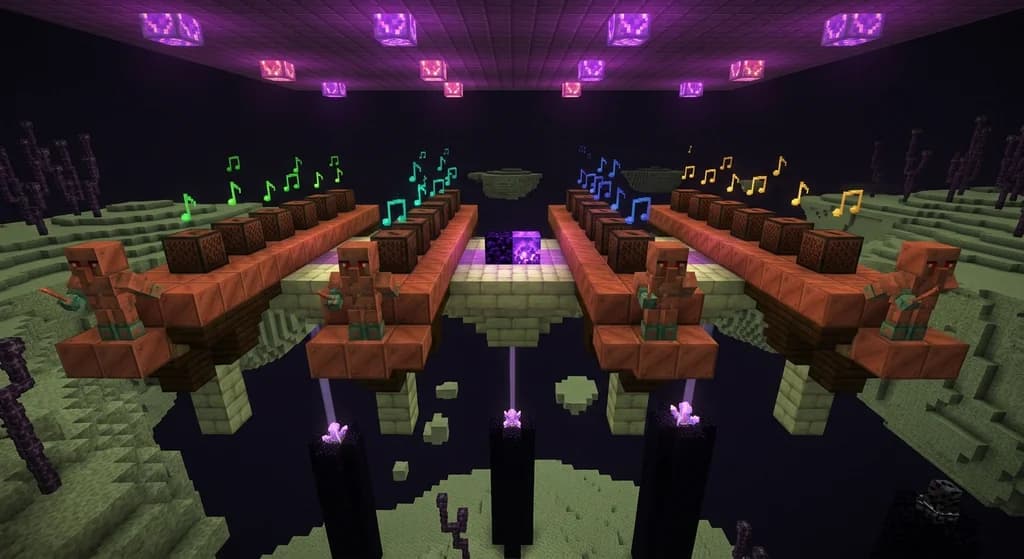
Bored in Minecraft? Build a Flash-Sync Copper Trumpet Rhythm Trial — a redstone rhythm arena that uses the four oxidation pitches of the copper trumpet note block and the natural light-pulse timing of The End's flashing skylight to create a synced, playable rhythm game. After reading this guide, you'll have a full multi-lane circuit, scoring rules, and the knowledge to run it with friends.
Table of Contents
- What Is the Flash-Sync Copper Trumpet Rhythm Trial?
- How to Set Up Your Rhythm Trial Arena
- Best Strategies for the Flash-Sync Rhythm Trial
- Why This Concept Works
- How to Put This Into Practice on Gaia Legends
- Conclusion
- FAQ
- Recommended
What Is the Flash-Sync Copper Trumpet Rhythm Trial?
You know that feeling. You've beaten the Ender Dragon twice, your base is enormous, and you're standing in a field wondering what to do next. The usual Minecraft challenges feel stale. You need something that uses the game's newest mechanics in a way nobody has tried yet.
The Flash-Sync Copper Trumpet Rhythm Trial is exactly that reset.
The Flash-Sync Copper Trumpet Rhythm Trial is a player-designed redstone rhythm challenge in which four lanes of copper trumpet note blocks — each placed on a copper block at a different oxidation stage — are wired to fire in sequence, synchronized to the natural light-flash pulses of The End's flashing skylight. Players stand at a control panel, watch for the flash cue, and hit the correct lane button in time. Miss the beat, lose a point. Chain five perfect hits, unlock a bonus round.
It's part rhythm game, part redstone engineering puzzle, part competitive sport — and it's built entirely from vanilla mechanics introduced in the Java Edition 1.21.9 Copper Age drop and the 26.1 Tiny Takeover update.
The Core Mechanic Combination
Three mechanics lock together to make this possible:
- Copper Trumpet Note Blocks (added in 26.1): A note block placed on a copper block produces a trumpet sound. Critically, the pitch of that trumpet changes based on the oxidation level of the copper block beneath it — giving you four distinct tones: fresh copper, exposed copper, weathered copper, and oxidized copper.
- The End Flashing Skylight (added in 1.21.9): The End dimension now features periodic light flashes across its skylight. These flashes are not purely cosmetic — they produce detectable light-level changes that a daylight sensor can read, giving you a free, ambient clock signal.
- Copper Golem Automation (added in 1.21.9): Copper Golems can be positioned at note block stations. With the right redstone logic, they become automated "ghost players" that can fill empty lanes or trigger notes on a timer, making solo play viable and multiplayer chaos controllable.
Together, these three mechanics create a rhythm engine that the game practically hands you — you just have to build the stage.
Note: The four oxidation levels of copper (fresh → exposed → weathered → oxidized) each produce a noticeably different trumpet pitch on a note block. This is confirmed in the 26.1 changelog: "The sound is different based on the oxidation level of the Copper Block." This pitch ladder is the musical backbone of the entire trial.
How to Set Up Your Rhythm Trial Arena
Materials Checklist
Before you start laying blocks, gather everything. Nothing kills momentum like a mid-build supply run.
Copper Blocks (all four oxidation stages):
- 8× Fresh Copper Blocks
- 8× Exposed Copper Blocks
- 8× Weathered Copper Blocks
- 8× Oxidized Copper Blocks
Redstone Components:
- 32× Note Blocks
- 16× Redstone Comparators
- 24× Redstone Repeaters
- 64× Redstone Dust
- 4× Daylight Sensors (set to "inverted" mode for flash detection)
- 4× Observers (optional, for flash-edge detection)
- 8× Pistons (for lane-lock gates)
- 4× Pressure Plates or Buttons (player input stations)
Structure Blocks:
- 128× Smooth Stone or Deepslate (arena floor)
- 32× Glass (viewing panels)
- 4× Copper Golem Statue Blocks (to spawn your Golem conductors)
- Scaffolding for construction
World Requirement: You must build the arena inside The End dimension to access the flashing skylight signal. Alternatively, build in the Overworld and pipe in a simulated clock — but the authentic End flash is the soul of this challenge.
Step-by-Step Arena Construction
-
Claim your End island platform. Find a flat secondary island at least 30×20 blocks. If none exists, bridge out and build a stone platform. The Dragon should already be defeated.
-
Lay the four-lane floor. Mark four parallel lanes, each 2 blocks wide and 12 blocks long, running north-to-south. Leave a 1-block gap between each lane. This gives you a 11-block-wide arena floor.
-
Place the copper blocks at the far end of each lane. Lane 1 gets a Fresh Copper Block, Lane 2 gets Exposed Copper, Lane 3 gets Weathered Copper, Lane 4 gets Oxidized Copper. These are your tone anchors.
-
Stack a Note Block on each copper block. Right-click each note block to tune it. You don't need to tune manually — the copper beneath determines the trumpet timbre. But you can right-click to shift the base pitch up or down within the trumpet register for fine-tuning. Set all four to the same note value (F# works beautifully) so the oxidation difference is purely timbral, not tonal.
-
Wire the daylight sensor flash-detector. Place an inverted daylight sensor at the open-sky edge of the arena. Run a comparator from it into a 4-tick repeater chain. This creates a brief redstone pulse every time The End's skylight flashes. That pulse is your master beat signal.
-
Build the player input stations. At the near end of each lane (opposite the note blocks), place a button or pressure plate connected by redstone to the note block at the far end. Each button fires that lane's trumpet note when pressed.
-
Install the lane-lock gates. Between the button and the note block, insert a piston gate controlled by the daylight sensor pulse. The gate opens for exactly 4 redstone ticks after each flash — that's your input window. Press the button outside that window and nothing fires. This is the core rhythm mechanic.
-
Spawn your Copper Golem conductors. Place a Copper Golem Statue Block at the side of each lane and power it to activate. Your Golems will wander the lane, and with the Flash-Link logic (more on this in the Gaia section), they can be configured to auto-fire notes on missed beats.
-
Build the scoring board. Use a simple counter circuit — a hopper clock feeding into a comparator chain — to track consecutive successful hits. Display the count on a row of note block lamps (note blocks that light up on activation) above the arena entrance.
-
Test the full loop. Stand at a button station. Wait for the End sky to flash. The gate opens. Hit your button. Hear the trumpet ring. That's a perfect hit. Now build the habit.
Pro Tip: Oxidize your copper blocks at different rates by leaving some exposed to rain (bring them to the Overworld briefly) and waxing others at the stage you want. You can lock any oxidation stage permanently with a honeycomb — wax your tone blocks once they reach the target stage so the pitches never drift during a trial.
Best Strategies for the Flash-Sync Rhythm Trial
Difficulty Tiers
The beauty of this build is how cleanly it scales. Here's a reference table for running trials at different skill levels:
| Tier | Input Window | Lanes Active | Golem Fill | Scoring Rule |
|---|---|---|---|---|
| Casual | 8 ticks | 2 (Fresh + Oxidized) | All missed lanes auto-filled | 1 pt per hit |
| Standard | 4 ticks | 3 (Fresh + Weathered + Oxidized) | No auto-fill | 2 pts per hit, -1 per miss |
| Hardcore | 2 ticks | All 4 lanes | Golems play competing notes | 3 pts per hit, -2 per miss, run ends at -5 |
| Insane | 1 tick | All 4 + random lane scramble | Golems randomize lane order every 10 flashes | Survival scoring — last player standing |
Note: "Ticks" here refers to redstone ticks (0.1 seconds each). A 2-tick window is genuinely hard — it's a 0.2-second reaction gap. Train on Casual before touching Hardcore.
The "Oxidation Ladder" Solo Challenge
This is the most replayable single-player variant. The rules:
- Start with only Lane 1 (Fresh Copper) active.
- Hit 5 consecutive perfect beats to unlock Lane 2 (Exposed).
- Hit 5 more to unlock Lane 3 (Weathered).
- Hit 5 more to unlock Lane 4 (Oxidized).
- Once all four lanes are live, survive 20 consecutive multi-lane flashes without a miss.
The trumpet timbres shift from bright and brassy (fresh copper) to a darker, mellower tone (oxidized copper) as you climb the ladder. Experienced players say the tonal shift actually helps you internalize which lane you're targeting — your ears do half the work.
Multiplayer "Trumpet Duel" Mode
Assign one lane per player. Each player owns their lane's note block button. The flash fires — everyone hits simultaneously. The goal isn't just to hit on time; it's to hit together, creating a chord. A comparator circuit checks whether all four buttons fired within the same 2-tick window. If yes: Chord Bonus — double points for the round.
This turns the trial into a cooperative rhythm game. Four players, four oxidation tones, one End skylight. When you nail a four-part trumpet chord in The End, it sounds genuinely spectacular.
Advanced: The "Scramble Flash" Variant
Every 10 flashes, a random redstone signal (driven by a hopper-clock randomizer) reassigns which button controls which lane. Players must re-learn the layout on the fly. This variant tests adaptability over muscle memory — a completely different skill set.
Why This Concept Works
The Mechanical Harmony
These mechanics weren't designed to work together — but they slot together like they were. The End flashing skylight gives you a free, irregular-but-predictable clock that no player controls. The four oxidation pitches of the copper trumpet give you a natural four-lane musical scale. The Copper Golem's autonomous behavior gives you an NPC performer that can fill, compete, or conduct.
The result is a rhythm game with a living clock — one that the dimension itself generates. You're not fighting a metronome. You're syncing to a world event.
What Makes It Replayable
Three things drive replayability in any game: escalating difficulty, social competition, and sonic reward. This trial has all three.
- Escalating difficulty comes from the oxidation ladder and the shrinking input window.
- Social competition comes from the Trumpet Duel and Scramble Flash modes.
- Sonic reward is immediate and satisfying — hitting a perfect beat fires a real trumpet note that rings across the End void. It feels good in a way that most redstone contraptions don't.
How Recent Updates Make It Possible
This build is only possible because of two specific 2025–2026 updates:
- Java 1.21.9 (Copper Age, September 2025) introduced the Copper Golem, the End flashing skylight, and the copper block family.
- Java 26.1 (Tiny Takeover, March 2026) added the trumpet instrument for note blocks placed on copper — the single mechanic that turns this from a light-show into a music game.
Without 26.1's trumpet note block, you have an interesting light-sync puzzle. With it, you have a rhythm trial. That one changelog line — "Added a trumpet instrument for when using a Note Block that is placed on a Copper Block" — is the difference between a cool build and a legendary one.
Pro Tip: The End's flash interval is not perfectly regular — it has slight variance, like a human drummer. Lean into this. Don't try to predict the exact tick; watch for the visual flash and react. Players who watch the sky outperform players who count ticks every time.
How to Put This Into Practice on Gaia Legends
Everything above works in vanilla Minecraft — but Gaia Legends takes the Flash-Sync Copper Trumpet Rhythm Trial to a level you simply can't reach in a solo world.
Gaia's custom Flash-Link plugin allows Copper Golems to register as active listeners for End-skylight flash events. In practice, this means your Golem conductors don't just wander — they respond. A Flash-Link Golem will strike its assigned note block within 1 redstone tick of a skylight flash, with zero player input required. This creates a true automated rhythm section: your Golems hold the beat while you improvise over them.
Gaia's End dimension also features pre-built Flash-Sync Trial arenas in the competitive zone, so you can jump into a scored trial the moment you arrive, without spending hours on construction. Perfect for players who want to play the concept before committing to building their own.
If you want to push the build further, Gaia's custom oxidation control lets server operators lock and unlock oxidation stages on demand — meaning you can run a Scramble Flash variant where the pitches themselves change mid-trial, not just the lane assignments.
Gaia Legends is free to join, non-pay-to-win, and supports Java + Bedrock crossplay.
Join at gaialegends.pro and remix your Minecraft experience today.
Conclusion
The Flash-Sync Copper Trumpet Rhythm Trial is one of the most complete gameplay remixes you can build right now in Minecraft. It combines a world-generated clock, a four-tier musical instrument, and autonomous NPC performers into something that feels less like a redstone contraption and more like a designed game.
Three takeaways to carry with you:
- The End's flashing skylight is a free clock signal — use daylight sensors in inverted mode to capture it as a redstone pulse.
- The four oxidation levels of the copper trumpet note block give you four distinct tones, a natural lane system, and an escalating difficulty ladder all in one mechanic.
- Copper Golems are your automation layer — they turn a two-player concept into a solo experience and a four-player concept into a full ensemble.
Try the Flash-Sync Copper Trumpet Rhythm Trial tonight. Build the arena, wire the gates, stand at Lane 1, and wait for the sky to flash. Then share your high score — we want to see it.
FAQ
What are the best minecraft redstone challenges 2026 for experienced players?
The best minecraft redstone challenges 2026 for experienced players combine multiple new mechanics from the Copper Age (1.21.9) and Tiny Takeover (26.1) updates. The Flash-Sync Copper Trumpet Rhythm Trial is a top-tier pick because it layers daylight-sensor flash detection, four-pitch copper trumpet note blocks, and Copper Golem automation into a challenge that requires both redstone engineering skill and real-time reaction speed.
What should I do when I'm bored in Minecraft and want something genuinely new?
When you're bored in Minecraft, the fastest cure is a self-imposed challenge with clear rules and a scoring system. The Flash-Sync Rhythm Trial works perfectly here — it gives you a build goal (the arena), a skill goal (perfect-hit chains), and a social goal (Trumpet Duel with friends). It transforms "I don't know what to do" into "I need five more perfect hits to unlock Lane 3."
Do copper trumpet note blocks actually produce different pitches at each oxidation level?
Yes. As confirmed in the Java 26.1 changelog, note blocks placed on copper blocks produce a trumpet sound, and "the sound is different based on the oxidation level of the Copper Block." Fresh copper gives the brightest, most piercing trumpet tone. Oxidized copper produces a darker, mellower timbre. The four stages — fresh, exposed, weathered, oxidized — form the four-lane pitch ladder at the heart of this trial.
Can I build the Flash-Sync Rhythm Trial without going to The End?
You can build a functional version in the Overworld by replacing the End skylight flash detector with a hopper clock or comparator clock of your own design. However, you lose the authentic ambient timing variance that makes the End flash feel alive. For the full experience — especially the visual drama of playing a rhythm game in the void — The End is strongly recommended. Defeat the Dragon first, then claim a secondary island.
How do Copper Golems automate the rhythm trial?
Copper Golems, added in Java 1.21.9, are autonomous mobs that interact with copper blocks and their environment. In the rhythm trial, they're positioned at note block stations and wired into the flash-detection circuit. When the gate opens on a flash pulse, a Golem in "fill" mode will trigger the note block if no player input is detected within the window — keeping the beat alive. On Gaia Legends, the Flash-Link plugin gives Golems precise 1-tick response timing for true rhythm automation.
What's the minimum redstone knowledge needed to build this?
You need a working understanding of redstone repeaters (for timing delays), comparators (for signal strength reading from daylight sensors), pistons (for the lane-lock gates), and basic wire routing. If you've built a door lock or a simple clock circuit before, you have enough foundation. The trickiest part is calibrating the input-window gate to exactly 4 ticks (or 2 ticks for Hardcore mode) — use a repeater set to 2 ticks feeding a monostable circuit for clean results.
Recommended
Frequently Asked Questions
What are the best minecraft redstone challenges 2026 for experienced players?
The best minecraft redstone challenges 2026 for experienced players combine multiple new mechanics from the Copper Age (1.21.9) and Tiny Takeover (26.1) updates. The Flash-Sync Copper Trumpet Rhythm Trial is a top-tier pick because it layers daylight-sensor flash detection, four-pitch copper trumpet note blocks, and Copper Golem automation into a challenge that requires both redstone engineering skill and real-time reaction speed.
What should I do when I'm bored in Minecraft and want something genuinely new?
When you're bored in Minecraft, the fastest cure is a self-imposed challenge with clear rules and a scoring system. The Flash-Sync Rhythm Trial works perfectly here — it gives you a build goal (the arena), a skill goal (perfect-hit chains), and a social goal (Trumpet Duel with friends). It transforms 'I don't know what to do' into 'I need five more perfect hits to unlock Lane 3.'
Do copper trumpet note blocks actually produce different pitches at each oxidation level?
Yes. As confirmed in the Java 26.1 changelog, note blocks placed on copper blocks produce a trumpet sound, and the sound is different based on the oxidation level of the Copper Block. Fresh copper gives the brightest, most piercing trumpet tone. Oxidized copper produces a darker, mellower timbre. The four stages — fresh, exposed, weathered, oxidized — form the four-lane pitch ladder at the heart of this trial.
Can I build the Flash-Sync Rhythm Trial without going to The End?
You can build a functional version in the Overworld by replacing the End skylight flash detector with a hopper clock or comparator clock of your own design. However, you lose the authentic ambient timing variance that makes the End flash feel alive. For the full experience — especially the visual drama of playing a rhythm game in the void — The End is strongly recommended. Defeat the Dragon first, then claim a secondary island.
How do Copper Golems automate the rhythm trial?
Copper Golems, added in Java 1.21.9, are autonomous mobs that interact with copper blocks and their environment. In the rhythm trial, they're positioned at note block stations and wired into the flash-detection circuit. When the gate opens on a flash pulse, a Golem in fill mode will trigger the note block if no player input is detected within the window — keeping the beat alive. On Gaia Legends, the Flash-Link plugin gives Golems precise 1-tick response timing for true rhythm automation.
What's the minimum redstone knowledge needed to build this?
You need a working understanding of redstone repeaters (for timing delays), comparators (for signal strength reading from daylight sensors), pistons (for the lane-lock gates), and basic wire routing. If you've built a door lock or a simple clock circuit before, you have enough foundation. The trickiest part is calibrating the input-window gate to exactly 4 ticks — use a repeater set to 2 ticks feeding a monostable circuit for clean results.
Related guides
How to Build a Rhythmic Copper Golem Tiny Mob Dungeon 2026
Discover unique Minecraft game ideas 2026: build a Rhythmic Copper Golem Tiny Mob Dungeon using trumpet pitch oxidation, Golden Dandelion stasis, and End flashing skylight cues.
How to Build a Perpetual Baby Mob Zoo: 2026 Innovation Guide
Bored in Minecraft in 2026? Build a perpetual baby mob zoo using Golden Dandelions, Copper Golem automation, and Trumpet Note Blocks for a fresh, replayable challenge.
How to Build an Automated Copper Symphony in Minecraft 2026
Master the minecraft copper golem music guide for 2026: automate a full symphony hall using oxidized copper trumpets, copper golems, and golden dandelion baby mob performers.
How to Build a Copper Golem Flash-Stealth Trial in Minecraft 2026
Bored in Minecraft? Build a Copper Golem Flash-Stealth Trial using The End's flashing skylight, Golden Dandelion obstacles, and randomized redstone traps. Fresh 2026 gameplay ideas inside.
Have a question or another approach?
Compare notes with other readers. Include your edition and version when discussing mechanics.