Why breed animals in Minecraft: survival and resources
Filed under Minecraft Tips & Tricks · How we create content

TL;DR:
- Animal breeding is a vital survival mechanic that provides food, materials, and resource management benefits.
- Proper enclosure design and correct food are essential for successful and efficient breeding.
- Smaller, well-managed farms prevent lag and promote long-term success over massive, inefficient operations.
Most players discover animal breeding by accident, usually after accidentally feeding a cow some wheat and watching two of them produce a calf. It feels like a cute bonus feature. Here's the truth: animal breeding is one of the most powerful survival mechanics in the entire game, and treating it as optional is one of the biggest mistakes new and intermediate players make. Whether you're managing a solo survival world or running operations on a multiplayer server, a well-organized breeding system is the difference between scraping by and building a true empire. This guide covers the core mechanics, the survival value, management strategies, and the advanced edge cases that most players never think about.
Table of Contents
- Understanding the mechanics of animal breeding
- Why breeding animals is essential for survival
- Strategies for efficient animal management
- Advanced breeding: Special animals and edge cases
- A fresh perspective on animal breeding in Minecraft
- Want to master every aspect of Minecraft farming?
- Frequently asked questions
Key Takeaways
| Point | Details |
|---|---|
| Critical for survival | Breeding keeps your food and material supplies stable throughout Minecraft gameplay. |
| Strategy matters | Efficient breeding and population management reduce lag and maximize farm productivity. |
| Species-specific mechanics | Certain animals require taming and unique foods, so understanding the details speeds up your progress. |
| Renewable resources | Consistent breeding provides materials for crafting, trading, and automation beyond what hunting allows. |
Understanding the mechanics of animal breeding
Now that you understand the importance of animal breeding, let's break down how the actual mechanics work in detail.
At its core, breeding in Minecraft follows a simple loop: find two adults of the same species, feed them the right food, and watch love mode activate. During love mode, both animals display red hearts and move toward each other. After roughly three seconds, a baby animal spawns between them. That's the entire trigger sequence, and it's beautifully straightforward once you know the rules.
The most common reason breeding fails isn't a game bug. It's the wrong food. Every species has its own specific item that triggers love mode. According to breeding mechanics guidance, you need to feed two adult animals of the same species their specific food, which means wheat for cows and sheep, seeds for chickens, and carrots for pigs, to trigger love mode. Feeding a pig wheat does nothing. That's a detail that trips up players constantly.
Here's a quick breakdown of which foods work for common animals:
- Cows and mooshrooms: Wheat
- Sheep: Wheat
- Pigs: Carrots, potatoes, or beetroot
- Chickens: Seeds (any type)
- Rabbits: Dandelions, golden carrots, or carrots
- Turtles: Seagrass
- Pandas: Bamboo (requires 8 bamboo blocks nearby)
Proximity matters too. Both animals need to be within a short range of each other when you feed them. If one wanders too far, love mode cancels and you've wasted your food. A properly built enclosure solves this entirely, which is why pen design matters more than most players realize. Check out our Minecraft breeding basics if you want a solid foundation before diving deeper into optimization.
One thing that surprises a lot of players: light level has zero effect on breeding. Unlike crops, which need light to grow, animals breed just fine in total darkness. This opens up some interesting options for underground or enclosed farm designs without windows.
After a successful breed, each animal enters a cooldown period of five minutes before it can breed again. Baby animals take 20 minutes to reach adulthood. You can speed up growth slightly by feeding baby animals their breeding food, each piece shaving a small amount off the timer. Planning your breeding cycles around these timers is what separates reactive breeders from efficient ones.
Pro Tip: Label your food chests near each pen clearly. When you're running multiple animal enclosures, grabbing the wrong item and wasting a trip happens more than you'd think. A simple sign above each chest saves real time.
Why breeding animals is essential for survival
Once you're clear on the mechanics, the next logical step is to explore why breeding is arguably a linchpin of survival strategies.
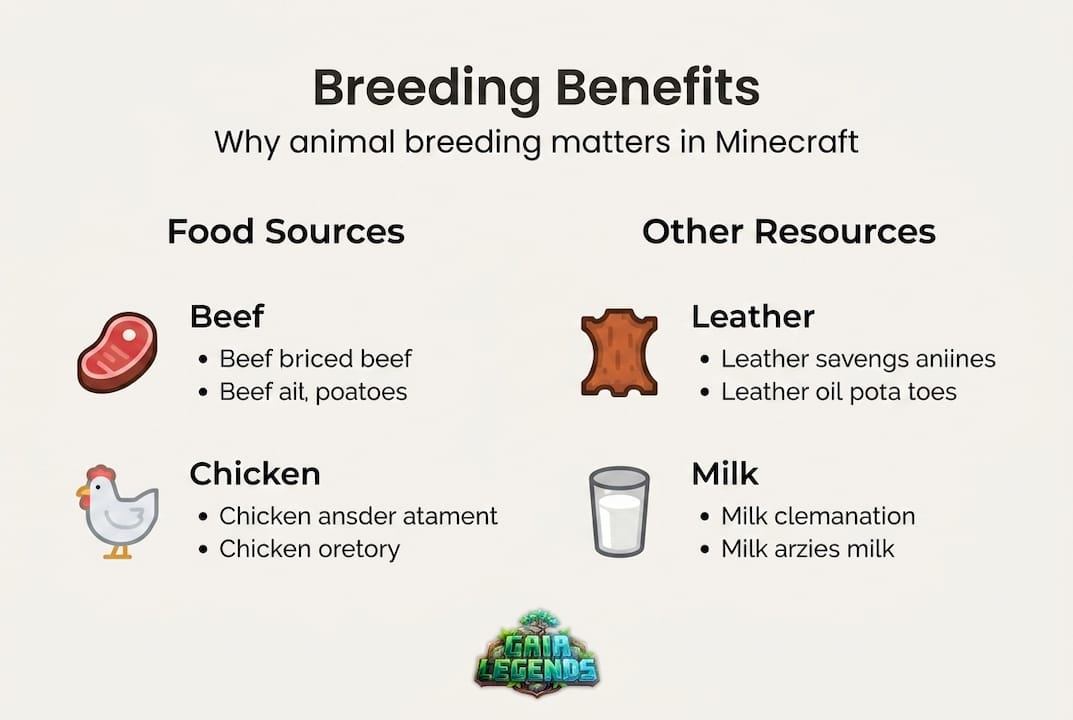
The most obvious benefit is food. Cooked beef, pork chops, chicken, and mutton are all high-saturation foods that keep your hunger bar full through long mining sessions, combat encounters, and building projects. A reliable animal farm means you're never scrambling for food at a critical moment. That reliability compounds as your world progresses.
But food is just the beginning. As the breeding and resource use data makes clear, breeding drives survival and resource management across multiple categories. Here's how the resource value stacks up:
| Animal | Primary resource | Secondary resource | Bonus use |
|---|---|---|---|
| Cow | Beef | Leather | Milk for potions |
| Sheep | Mutton | Wool | Dye farming |
| Pig | Pork chop | None | Saddle riding |
| Chicken | Chicken meat | Feathers | Eggs (auto-farm) |
| Bee | Honey | Honeycombs | Wax for copper |
Leather is worth calling out specifically. In early game, leather armor is one of your first defensive layers. Later, books, bookshelves, and item frames all require leather. If you want a high-efficiency trading hall, librarian villagers need lecterns, and those need books, which need leather. The chain from cow breeding to enchanting is more direct than most players realize.
Wool from sheep powers the entire bed economy. Sleeping through the night skips phantom spawns, which makes nighttime exploration and afk sessions far safer. Dyed wool also drives map art and build design, so colorful sheep farms have both functional and creative value.
Here's how to think about building your breeding operation for long-term survival:
- Start with cows first. Beef plus leather gives you two critical resources from one animal type.
- Add chickens early. Their eggs provide a passive food source even before you cook the meat.
- Build sheep pens once you have a bed. Then dye sheep different colors for future build projects.
- Expand to pigs and rabbits once your food supply is stable.
- Add bees last for honey and wax, which become relevant in mid to late game.
"A well-planned breeding operation isn't just a food source. It's a crafting materials engine, a trading economy booster, and a long-term survival insurance policy." This is the mindset shift that separates struggling survivors from established players.
For more foundational tactics, our guides on tips for Minecraft survival and staying safe and thriving complement this breeding strategy well.
Strategies for efficient animal management
Having established the necessity of breeding for survival, let's focus on how you can maximize efficiency and prevent common pitfalls in animal management.
The foundation of any good animal operation is a smart enclosure. A basic fenced pen with a gate works fine for two or three animals, but once you scale up, you need more structure. According to animal population control guidance, the best practice is to build fenced pens, use leads for transport, separate baby animals from adults, and cull excess animals to keep everything efficient.

Here's a comparison of enclosure types to help you choose the right setup:
| Enclosure type | Best for | Pros | Cons |
|---|---|---|---|
| Simple pen | Early game, 2 to 4 animals | Fast to build, minimal materials | Gets crowded fast |
| Tiered pen | Mid game scaling | Separates babies from adults | Requires more planning |
| Automated farm | Late game | Hands-free resource collection | Complex build, lag risk |
| Sorting pen | Rare animals | Keeps valuable animals isolated | High upfront investment |
Transporting animals is one of the bigger headaches in early game. Leads let you walk animals directly to your pen, which works well for short distances. For longer journeys, boats are surprisingly effective for aquatic-friendly animals, and minecarts with rails work great for moving animals underground or across hilly terrain. The key is building your pens near your spawn or base before you start collecting animals, so you're not wandering far with a reluctant pig on a lead.
- Use name tags on breeding pairs you want to keep. Named animals don't despawn, which protects your breeding stock.
- Double-fence your perimeter. Animals can occasionally clip through single fence layers, especially near gates.
- Keep a chest of breeding food near each pen. Wasting inventory space on wheat mid-farm run is inefficient.
- Mark babies with colored carpet on the ground to identify new additions quickly.
Pro Tip: On multiplayer servers, large animal farms are a leading cause of server lag. Keep your active population below 20 animals per pen when possible. Our guide on efficient farm building covers layout principles that apply directly to animal farms too.
Population control is often overlooked. Once you have a sustainable breeding pair, extra adults are just resource consumers and lag generators. Regular culling, processing excess animals into food and materials, keeps your farm lean and your server healthy. Think of it less like harm and more like harvesting a crop you planted.
Advanced breeding: Special animals and edge cases
With strategies for everyday animals in place, mastering breeding edge cases gives you a critical advantage in advanced setup.
Not every animal breeds the same way. Some require additional steps before you can even attempt breeding. As the special breeding cases guide explains, some animals require taming first, specific foods work for breeding, and light level doesn't affect the process at all.
Here's the taming requirement breakdown:
- Wolves must be tamed with bones before they can breed. Two tamed wolves bred with any meat produce a puppy.
- Cats must be tamed with raw fish. Breed two tamed cats with raw fish or raw salmon for a kitten.
- Horses and donkeys require taming by repeated riding until hearts appear. Then use golden apples or golden carrots to trigger love mode.
- Llamas are tamed by repeated riding but cannot be bred with food. You trigger love mode by having two tamed llamas in hay bale proximity.
Special foods open up additional breeding opportunities that many players skip entirely:
- Golden carrots are the primary horse breeding item and one of the best overall. Craft them from a regular carrot surrounded by gold nuggets.
- Flowers (any type) trigger love mode in bees. Place two bees near flowers and they'll breed naturally without you feeding them directly.
- Seagrass is the only item that works for turtles. Bred turtles lay eggs on their home beach, and those eggs hatch into baby turtles that drop scutes, which are critical for the turtle helmet.
- Bamboo works for pandas, but you need eight bamboo blocks within a five block radius or the pandas simply won't enter love mode regardless of how much bamboo you feed them.
For creative animal pen inspiration, think about theming your pens to match your base style. If you're working in a colder region, our guide on designing pens in snowy biomes has some genuinely striking layout ideas.
Bees deserve extra attention because of their unique role in both resource production and farm enhancement. Bees pollinate nearby crops as they travel between flowers and hives, accelerating crop growth. A bee farm next to a wheat field isn't just producing honey. It's also speeding up your wheat supply, which feeds your other breeding operations. That kind of cross-system efficiency is what advanced players build toward.
Turtle farms are another underutilized setup. Scutes from baby turtles combine to craft a turtle helmet, which grants the water breathing effect, a massive quality-of-life upgrade for underwater exploration and ocean monument raids. Building a small turtle breeding area on a warm beach is a relatively low-effort investment for a high-value payoff.
A fresh perspective on animal breeding in Minecraft
Having covered the mechanics, reasons, and edge cases, let's step back and examine what really separates effective breeders from players who are just getting by.
The smarter approach is tight, intentional design. A breeding pair of cows plus a handful of extras for culling is almost always enough. All sources agree that breeding is essential for survival and resource management, but the strategy variations that matter most are about restraint, not scale. The best players we've worked with treat their farms like a well-run logistics operation, not a collection.
Another overlooked mistake is breeding without intention. Running animals through love mode repeatedly without processing the results wastes food, time, and server resources. Every breeding cycle should produce animals that either replace culled adults or get harvested shortly after maturity. That rhythm, breed, grow, harvest, repeat, is what keeps resources flowing without the farm becoming a burden.
For more actionable strategies that layer well with what we've covered here, our Minecraft tips and tricks guide covers the broader survival picture that breeding slots into perfectly.
Want to master every aspect of Minecraft farming?
Ready to put your breeding knowledge to work? Here's how to deepen your Minecraft mastery.

Whether you want to design your first efficient animal farm, optimize an existing setup for a multiplayer server, or push into advanced automation, our Minecraft farming guides have you covered. Every guide is written with the same goal: give you practical, accurate strategies you can apply immediately. Bookmark the site, explore the archive, and keep leveling up your survival game. The more systems you connect, the stronger your world becomes.
Frequently asked questions
What food do I need to breed each animal in Minecraft?
Each animal needs its specific food: wheat for cows and sheep, carrots for pigs, seeds for chickens, and golden carrots for horses. Using the wrong food simply won't trigger love mode, so always match the item to the species.
Does animal breeding in Minecraft require light?
No light is required for breeding, unlike crops that need adequate lighting to grow. Animals breed at any light level, which means underground or fully enclosed farms are completely viable.
How do I prevent lag from large animal farms?
Separate babies from adults, cap population per pen at around 20 animals, and cull excess regularly to keep entity counts low. Smaller, well-managed pens run far more smoothly than oversized compounds on any server.
Which animals require taming before breeding?
Wolves, cats, and horses must all be tamed before you can breed them. Attempting to breed wild versions of these animals won't work, no matter how much food you use.
Why should I breed animals instead of just hunting?
Breeding ensures a renewable resource supply for both food and crafting materials, while hunting depletes local populations and becomes increasingly unreliable as your world ages. A stable breeding operation is simply a more dependable long-term strategy.
Recommended
Related guides
How to Obtain Mending in Minecraft
Learn how to get Mending in Minecraft. Discover the best methods: trading with librarian villagers, fishing, and looting chests. Includes mechanics and...

How to Use the Trident in Minecraft: Riptide, Channeling & Impaling
Learn how to use the trident in Minecraft with our quick reference guide. Covers Riptide, Channeling, Impaling enchantments, throwing mechanics, and...

How to Find Buried Treasure in Minecraft 2026: Maps & Tips
Master how to find buried treasure in Minecraft with our 2026 guide. Find treasure maps in shipwrecks & ruins, follow the X, and collect rare loot like...

Minecraft Combat Tips That Win Every Fight in 2026
Master Minecraft combat tips to dominate every fight in 2026! Learn essential strategies for weapons, timing, and terrain to become unbeatable.
Have a question or another approach?
Compare notes with other readers. Include your edition and version when discussing mechanics.