Understanding Minecraft Economy Plugin Tax Systems
Filed under Minecraft Economy & Trading · How we create content
Version scope: Java Edition (plugin-based servers)
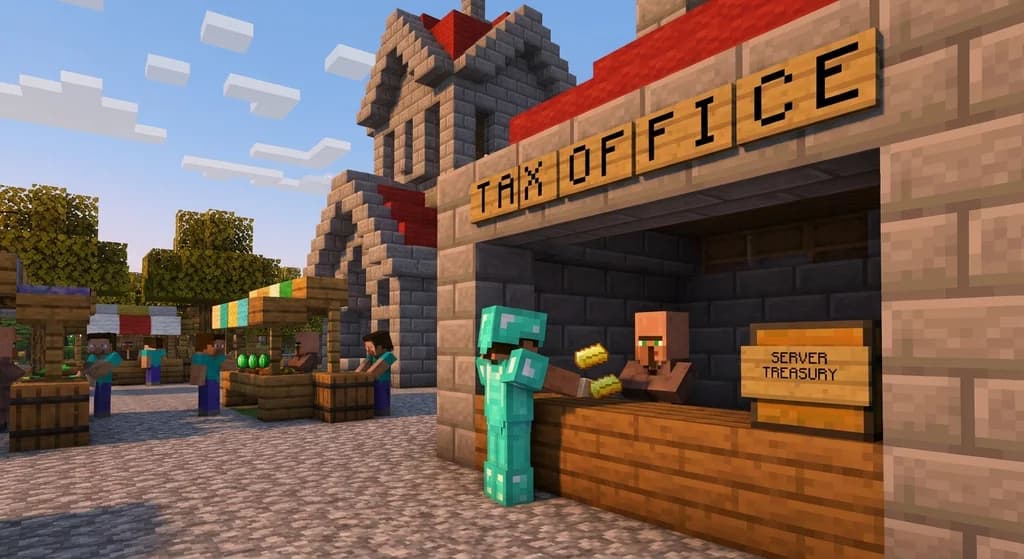
Key Takeaways
| Point | Details |
|---|---|
| Economy plugin taxes function | Economy plugin taxes function as money sinks to counteract inflation from farms, mob grinders, and admin payouts. |
| Transaction taxes (percentage fees | Transaction taxes (percentage fees on trades) are the most common and easiest to configure. |
| Land taxes periodically remove | Land taxes periodically remove currency from players who hold large plots, encouraging active trading. |
| Salary taxes reduce net | Salary taxes reduce net income from automatic payouts, helping balance server economies. |
| Server owners should start | Server owners should start with low tax rates (1-3%) and adjust based on observed inflation and player feedback. |
If you've run a Minecraft server with an economy plugin for more than a few weeks, you've probably noticed something strange: money starts piling up. Players who built early farms or mob grinders accumulate thousands, then millions. Newer players can't catch up. Prices in player shops climb. Soon, the whole economy feels broken.
That's where tax systems come in. Economy plugin taxes aren't about roleplaying a government—they're a practical tool to keep your server's economy healthy. Let's break down how they work, why they matter, and how to configure them without driving your players away.
Why Server Economies Need Money Sinks
In vanilla Minecraft, resources are infinite. Farms produce iron, gold, crops, and XP indefinitely. On a server with an economy plugin, players convert those resources into currency through admin shops or player trades. Without a way to remove currency from circulation, inflation is inevitable.
Taxes act as a money sink. They remove currency from the economy every time a player trades, owns land, or receives a salary. The goal isn't to make players poor—it's to keep the total money supply stable so that prices remain meaningful and new players have a fair shot.
Common Types of Economy Plugin Taxes
Transaction Taxes
Transaction taxes apply a percentage fee to every trade between players or between a player and an admin shop. For example, if you set a 2% transaction tax on a 100-diamond sale, the seller receives 98 diamonds and 2 diamonds disappear from the economy.
These are the easiest taxes to implement and the least noticeable to players, since the fee is small per trade. Over hundreds of trades, though, the cumulative effect is significant.
Land Taxes
Some economy plugins integrate with land claim systems to charge a periodic tax based on the number of claimed chunks or blocks. This encourages players to claim only what they actually use, and it regularly drains currency from wealthy players who hold large territories.
Land taxes are more visible than transaction taxes. Players feel them every week or month, so setting the rate too high can lead to complaints or abandoned claims.
Salary Taxes
Many servers use automatic salary payouts to reward active players. A salary tax reduces the net amount players receive, turning a 100-currency salary into 95 currency with a 5% tax. This is a subtle way to reduce the money injected by automatic payouts.
Shop Taxes
Shop taxes apply a fee when a player creates or maintains a player-run shop. This can be a one-time creation fee, a percentage of each sale, or a recurring listing fee. Shop taxes are particularly effective because they target the players who are most active in the economy.
Configuring Tax Rates Without Breaking Your Server
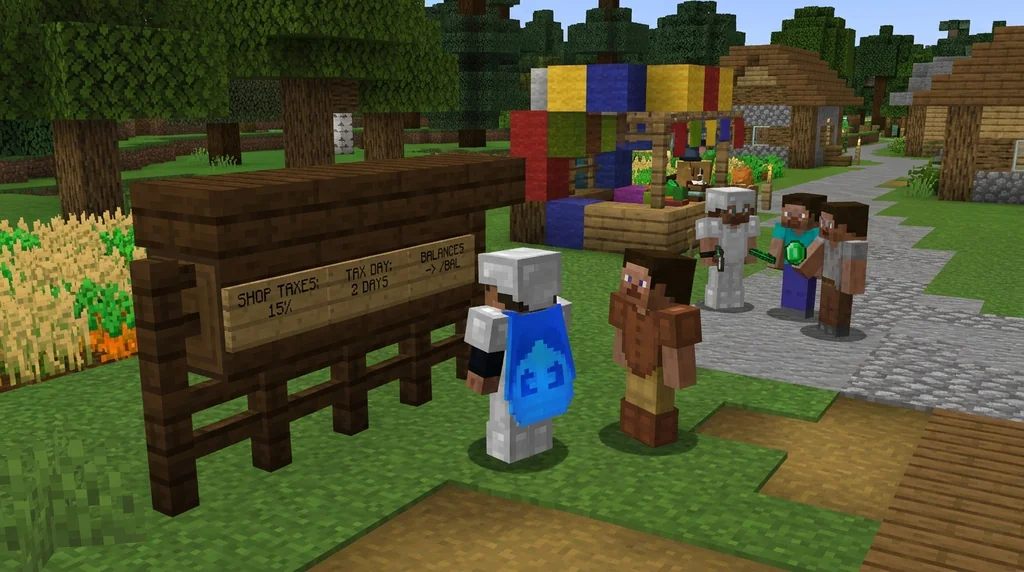
The hardest part of setting up taxes is choosing the right rate. Too high, and players feel punished. Too low, and the tax doesn't meaningfully remove currency.
Here's a starting point that works for most servers:
- Transaction tax: 1-3% on all trades
- Land tax: 1-5 currency per claimed chunk per week
- Salary tax: 2-5% of automatic payouts
- Shop tax: 1% on each shop sale, or a small weekly listing fee
Start on the low end and monitor your economy for a few weeks. If total money supply is still growing too fast, increase rates by 1% at a time. If players are struggling, decrease rates.
Minecoins (Tokens on PlayStation) are the digital in-game currency used to make purchases in the Marketplace and Character Creator platforms, as well as certain featured servers.
Minecoins are used to purchase content from the Marketplace, such as worlds, skin packs, add-ons, texture packs, mash-up packs, as well as character parts and emotes inside the Character Creator.
Who Should Act on This Information?
This analysis is most useful for:
- Server owners who run economy-based servers (towny, factions, survival) and want to prevent inflation.
- Plugin developers designing new economy plugins who need to understand player behavior around taxes.
- Admins troubleshooting a broken economy where prices are rising and new players can't compete.
If your server has fewer than 10 active players, taxes may not be necessary—you can manage the economy manually. But for servers with 20+ players, a well-configured tax system is one of the best tools you have.
The Evidence for Tax Effectiveness
While there's no single study on Minecraft economy plugins, the principle of money sinks is well established in game design. Servers that implement even a small transaction tax report slower inflation and more stable prices over months of play. Servers without taxes often see currency supplies double every few months as farms and grinders produce endlessly.
For a deeper look at how vanilla trading compares to player-run economies, check out our guide on Player Shops vs Villager Trading: Which Economy Fits Your Server?.
Final Thoughts
Economy plugin tax systems are a necessary tool for any serious Minecraft server. They're not about punishment—they're about fairness. A small tax on trades, land, or salaries keeps the economy balanced so that every player, whether they've been on the server for a day or a year, has a chance to build, trade, and thrive.
If you're setting up a new server, configure taxes from day one. It's much harder to add them later when players are used to tax-free trading.
Sources
- Minecoins (Tokens on PlayStation) are the digital in-game currency used to make purchases in the Marketplace and Character Creator platforms, as well as certain featured servers. — Minecoin
- Minecoins are used to purchase content from the Marketplace, such as worlds, skin packs, add-ons, texture packs, mash-up packs, as well as character parts and emotes inside the Character Creator. — Minecoin
Related guides
Player Shops vs Villager Trading: Which Economy Fits Your Server?
Compare player-run shops and villager trading in Minecraft multiplayer. Learn the pros, cons, and best use cases for each system in your server economy.
Minecraft Economy 101: How Supply and Demand Work on Player-Driven Servers
Learn how supply and demand shape Minecraft economies, from vanilla villager trading mechanics to player-driven server markets. Includes inflation control...
Piglin Bartering: Mechanics and Rewards
Learn the exact mechanics of piglin bartering in Minecraft Java and Bedrock. Includes cycle times, barter rewards, Soul Speed odds, and tips for efficient trading.
How to Build a Command Block Currency Exchange for Your Minecraft Server
Build a fully vanilla command block currency exchange for your Minecraft server. No plugins needed—just redstone and command blocks. Step-by-step guide...
Have a question or another approach?
Compare notes with other readers. Include your edition and version when discussing mechanics.