How to Master the Perpetual Tiny Mob Copper Orchestra 2026
Filed under Minecraft Gameplay Remix · How we create content
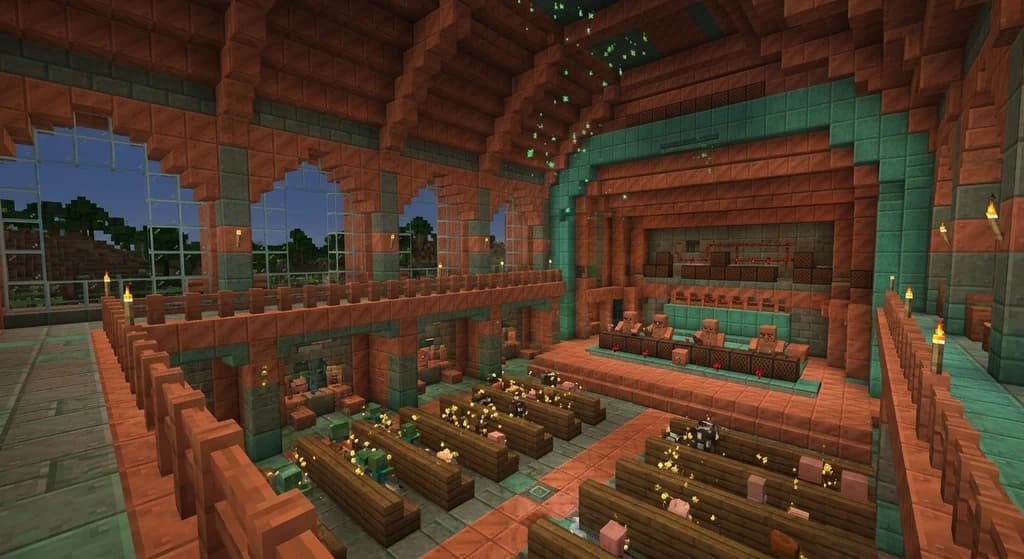
TL;DR
Bored in Minecraft? Here's how to build a Perpetual Tiny Mob Copper Orchestra — a living, breathing musical machine that fuses Golden Dandelion age-freezing, Copper Golem button-cycling automation, and the four-tier acoustic variance of Oxidized Copper Trumpets. After reading this guide, you'll be able to design, staff, and conduct a fully automated orchestra of eternal baby mobs that never stops playing.
Table of Contents
- What is the Perpetual Tiny Mob Copper Orchestra?
- How to Set Up Your Copper Orchestra
- Best Strategies for the Copper Orchestra Challenge
- Why the Perpetual Tiny Mob Copper Orchestra Works
- How to Put This Into Practice on Gaia Legends
- Conclusion
- FAQ
- Recommended
Introduction
You know the feeling. You've mined every ore, built every biome base, and defeated the Ender Dragon so many times it practically waves hello. Minecraft starts to feel less like a sandbox and more like a chore list. You log in, stare at your inventory, and log back out.
Here's how to shatter that feeling permanently.
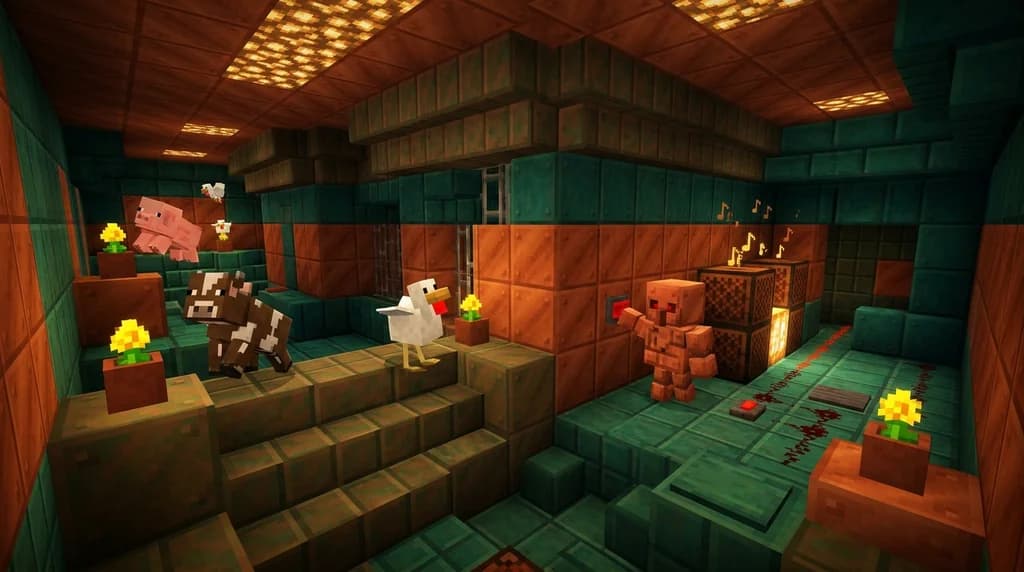
The Perpetual Tiny Mob Copper Orchestra is one of the most ambitious, most ridiculous, and most genuinely satisfying Minecraft gameplay challenges for bored players in 2026. It combines three of the freshest mechanics from the Tiny Takeover (Java 26.1) and Copper Age (Java 1.21.9) updates into a single, show-stopping build: age-frozen baby mobs as your "musicians," Copper Golems as your automated conductors, and Note Blocks placed on Copper Blocks of varying oxidation as your four-voice trumpet section.
The result? A concert hall that runs itself, sounds genuinely musical, and looks absolutely unhinged in the best possible way. Let's build it.
What is the Perpetual Tiny Mob Copper Orchestra?
The Perpetual Tiny Mob Copper Orchestra is a player-designed automated music system in which age-frozen baby mobs — preserved indefinitely using the Golden Dandelion introduced in Java 26.1 — are arranged as visual "performers" inside a concert hall, while Copper Golems cycle through Note Block buttons placed on Copper Blocks at four distinct oxidation stages to produce a continuously evolving trumpet soundscape.
This isn't just a jukebox. It's a living installation. Every element has a mechanical purpose:
- Baby mobs provide the visual cast — tiny, eternal, each with a unique sound variant assigned at spawn
- Golden Dandelions lock them in permanent youth, producing cascading green particles that double as ambient stage lighting
- Copper Golems serve as the autonomous button-pressers, randomly cycling through your note block array without any player input
- Oxidized Copper Trumpets (Note Blocks on Copper Blocks) deliver four distinct timbres depending on oxidation level — fresh, exposed, weathered, and oxidized — giving your orchestra genuine harmonic range
This is one of the most layered Minecraft gameplay ideas available right now, and it's only possible because of the 2025–2026 update cycle.
Note: The trumpet instrument only triggers when a Note Block is placed directly on top of a Copper Block. Make sure no other block type is sneaking underneath your note blocks, or you'll get the wrong instrument.
How to Set Up Your Copper Orchestra
Materials Checklist
Before you place a single block, gather everything you need. A full-scale orchestra requires:
Copper Blocks (all four oxidation stages):
- Fresh Copper Blocks — at least 8
- Exposed Copper Blocks — at least 8
- Weathered Copper Blocks — at least 8
- Oxidized Copper Blocks — at least 8
Automation & Mechanics:
- Note Blocks — 32 minimum (one per Copper Block, plus spares)
- Copper Golems — 4 to 8 (one per instrument section)
- Copper Golem Statue Blocks — for resetting or repositioning golems
- Redstone Dust, Repeaters, and Comparators — for timing circuits
- Buttons (any type) — for Golem interaction points
The Baby Mob Cast:
- At least 6 baby mobs of varying species (Wolf, Cat, Pig, Horse, Chicken all have new sound variants in 26.1)
- Golden Dandelions — one per baby mob, plus extras for replacements
- Name Tags — to keep your performers named and tracked
Stage & Hall:
- Copper Decorations (stairs, slabs, trapdoors) for the stage platform
- Copper Chests for on-site material storage
- Shelves for aesthetic prop placement
- Lighting of your choice (lanterns complement the copper palette beautifully)
Pro Tip: Wax your decorative Copper Blocks with a Honeycomb to lock them at your preferred oxidation stage. Only leave the functional Note Block bases un-waxed so they continue to oxidize naturally over time — this means your orchestra's sound profile will slowly evolve the longer the world runs.
World & Server Settings
- Mob griefing: Keep enabled — Copper Golems need to interact with buttons
- Mob spawning: Enabled, but use a fully enclosed hall to prevent unwanted spawns contaminating your cast
- Difficulty: Any — this build is non-combat
- Game mode: Survival adds the resource challenge; Creative lets you prototype fast
Step-by-Step Build Guide
-
Lay the orchestra pit. Build a rectangular platform at least 20×12 blocks using a mix of Copper Block variants. Arrange them in four horizontal rows — one oxidation stage per row — so each row produces a different trumpet timbre.
-
Place Note Blocks on every Copper Block. Right-click each Note Block to tune it. Assign a diatonic scale across each row (e.g., C–D–E–F–G–A–B–C) so the Golems have melodic options rather than random noise.
-
Deploy your Copper Golems. Place one Copper Golem per instrument row. Each Golem will autonomously wander and press buttons, triggering note blocks in its vicinity. Their randomness is a feature — it creates emergent melody rather than a rigid loop.
-
Age-freeze your baby mobs. Spawn your baby Wolf, Cat, Pig, Horse, and Chicken in the front rows of the hall. Hold a Golden Dandelion and interact with each one. Watch for the green particles moving downwards — that's your confirmation that aging has stopped. Each baby mob now has permanent youth and will never grow up.
-
Name your performers. Use Name Tags to give each baby mob a role: "First Violin", "Brass," "Percussion," "Conductor." It sounds silly. It makes the whole thing ten times better.
-
Wire the Golem patrol routes. Use fences or subtle block barriers to loosely guide each Golem's wandering range so it stays within its designated instrument row. Golems don't need redstone to function — their button-pressing is autonomous — but a little spatial design keeps each section coherent.
-
Add the green-particle ambience. Cluster several age-frozen baby mobs near the stage front. The downward-drifting green particles from their Golden Dandelion stasis create a hauntingly beautiful ambient light effect that no other Minecraft mechanic replicates.
-
Step back and listen. Your orchestra is now perpetual. The Golems will never stop. The babies will never age. The copper will slowly oxidize. The music will slowly change.
Best Strategies for the Copper Orchestra Challenge
Difficulty Tiers
| Tier | Name | Key Constraint | Goal |
|---|---|---|---|
| Casual | The Rehearsal | Creative mode, pre-oxidized blocks | Build and enjoy the soundscape |
| Standard | Opening Night | Survival mode, natural oxidation | Gather all copper and mobs legitimately |
| Hardcore | The Eternal Concerto | Hardcore survival, no waxing allowed | Let the orchestra evolve or die with you |
| Insane | The Grand Opus | 64+ Note Blocks, 8+ Golems, 20+ baby mobs | Build a full multi-movement symphony |
The Four Trumpet Voices — Quick Reference
The acoustic variance from Oxidized Copper Trumpets is the harmonic engine of this build. Here's how each voice behaves:
| Copper Stage | Trumpet Voice | Character | Best Used For |
|---|---|---|---|
| Fresh Copper | Bright Trumpet | Crisp, cutting | Melody leads |
| Exposed Copper | Warm Trumpet | Slightly muted | Counter-melody |
| Weathered Copper | Mid Trumpet | Rounded, softer | Harmonic fill |
| Oxidized Copper | Deep Trumpet | Dark, resonant | Bass lines |
Pro Tip: Tune your Oxidized Copper row to lower note values (left-click Note Blocks to decrease pitch) and your Fresh Copper row to higher values. This mimics a real brass section's register spread and makes the emergent Golem melodies sound surprisingly musical.
Solo vs. Multiplayer Variations
Solo play is about patience and craft — gathering the copper, hunting for baby mobs, tracking down Golden Dandelions. The resource grind is the challenge.
Multiplayer opens up a conductor role: one player manages Golem placement and routing while another handles the baby mob cast. On a server, you can run Orchestra Wars — two teams build competing orchestras in adjacent halls, then invite other players to vote on which sounds better after 10 minutes of autonomous play.
Scoring & Progression Ideas
- The Aging Clock: Score points for every in-game day your orchestra runs without a baby mob accidentally aging (e.g., a Golden Dandelion running out of stock)
- The Oxidation Race: Track how many of your Note Block bases have naturally progressed one oxidation stage — each transition is a "movement" of your symphony
- The Audience Metric: On a server, count how many players stop to listen for more than 30 seconds without being prompted
Why the Perpetual Tiny Mob Copper Orchestra Works
The Mechanic Synergy Is Genuinely Surprising
Each of these three mechanics was designed independently, but they combine with an elegance that feels almost intentional. Golden Dandelions solve the oldest problem with baby mob builds — they grow up and ruin everything. Now they don't. Copper Golems solve the automation problem — you don't need a player to run the show. And the four-tier trumpet variance solves the monotony problem — a single Note Block instrument gets boring fast, but four harmonically distinct voices create real texture.
The result is a build where the longer it runs, the better it sounds. Natural oxidation means a world that's been running for weeks has a deeper, more evolved orchestra than one that just launched. That's rare game design in any medium.
What Makes It Replayable
No two orchestras sound the same because Copper Golem behavior is procedurally random — they press buttons based on proximity and wandering, not a fixed sequence. Combine that with the fact that each baby mob receives a random sound variant at spawn (baby Cats, Pigs, Cows, and Chickens all have new variants in 26.1), and you have a system with genuine emergent variety.
The 5 new baby sound variants across Wolf, Cat, Pig, Horse, and Chicken mean your cast has acoustic personality. A baby Pig with its variant-2 sound profile reacts differently to the orchestra than a classic-variant Pig. It's a small detail that makes the hall feel alive.
How the 2025–2026 Updates Make This Possible
This build simply didn't exist before:
- Java 1.21.9 (The Copper Age) introduced Copper Golems, Copper Golem Statue Blocks, and Copper Decorations — giving us both the automation layer and the aesthetic palette
- Java 26.1 (Tiny Takeover) introduced Golden Dandelions for permanent baby mob stasis and the trumpet instrument for Note Blocks on Copper Blocks with 4 oxidation-based sound variants
- The combination of these two drops, separated by just a few months, created a perfect creative storm
How to Put This Into Practice on Gaia Legends
Building a full-scale Perpetual Tiny Mob Copper Orchestra in survival Minecraft is genuinely resource-intensive. You need copper in four distinct oxidation stages, which means either mining enormous quantities and waiting for natural oxidation, or sourcing pre-oxidized blocks through trade. You need Golden Dandelions for every baby mob in your cast. You need multiple Copper Golems, each requiring their own copper investment.
On Gaia Legends, the high-yield resource zones are purpose-built for exactly this kind of ambitious project. Copper veins in Gaia's Wilderness zones are dramatically more concentrated than vanilla generation, meaning a single mining session can yield enough material for a full orchestra pit. The player-driven economy lets you source Weathered and Oxidized Copper Blocks from other players who've been stockpiling — skipping weeks of waiting for natural oxidation.
Gaia's server also supports the full suite of Java 26.1 and 1.21.9 mechanics — Golden Dandelions work exactly as described, Copper Golems roam freely, and the trumpet instrument fires on every oxidation tier. There's even a dedicated Creative Plot district where you can prototype your orchestra layout before committing survival resources to the final build.
Gaia Legends is free to join, non-pay-to-win, and supports Java + Bedrock crossplay — so your whole friend group can attend opening night regardless of platform.
Join at gaialegends.pro and remix your Minecraft experience today.
Conclusion
The Perpetual Tiny Mob Copper Orchestra is proof that Minecraft in 2026 has more creative depth than ever — you just need to know where to look. Here are your three takeaways:
- Golden Dandelions are the missing piece for any permanent mob-based build — age-freezing transforms baby mobs from temporary visitors into eternal cast members
- Copper Golems are the best automation tool for non-redstone builders — their random button-pressing creates emergent music that no clock circuit can replicate
- Oxidation-based acoustic variance means your build has a built-in evolution arc — the longer it runs, the richer it sounds
Try building your first Rehearsal-tier orchestra tonight — even a 2×8 pit with two Golems and three frozen baby mobs is enough to hear the concept click. Then share your results. We want to hear what your orchestra sounds like.
FAQ
What are the best Minecraft gameplay challenges for bored players in 2026?
The best Minecraft gameplay challenges for bored players in 2026 combine multiple new mechanics from recent updates into a single ambitious project. The Perpetual Tiny Mob Copper Orchestra is a standout example — it fuses Golden Dandelion age-freezing, Copper Golem automation, and Oxidized Copper Trumpet acoustics into a self-running musical installation. Other strong options include Copper Golem dungeon runs and baby mob shepherd challenges. The key is layering mechanics so the challenge evolves over time.
What should I do when bored in Minecraft and I've already done everything?
When you've exhausted the standard progression loop, the answer is to invent new rules. Pick two or three mechanics that weren't designed to work together — like age-frozen baby mobs and automated Copper Golems — and design a challenge around their interaction. The Tiny Takeover and Copper Age updates from 2025–2026 added enough new systems that there are dozens of untested combinations waiting to be discovered. Start with the Orchestra and go from there.
How does the Golden Dandelion age-freezing mechanic work exactly?
The Golden Dandelion, added in Java Edition 26.1, stops a baby mob from aging when you interact with it while holding the flower. You'll see green particles moving downwards as confirmation. Interacting again with a Golden Dandelion will resume aging. There's no durability or timer — the stasis is indefinite until you manually cancel it. This makes it the perfect tool for any build that requires permanent baby mobs, including the Orchestra.
Do Copper Golems need redstone to press Note Block buttons?
No — Copper Golems autonomously wander and press any button they encounter within their patrol range. This is entirely independent of redstone. You don't need a clock, a pulse circuit, or any wiring to get them playing your Note Blocks. However, you can use subtle block barriers or fencing to loosely constrain their wandering so each Golem stays within its designated instrument section of the orchestra pit.
How many oxidation stages do Copper Trumpets have, and do they all sound different?
There are 4 oxidation stages for Copper Blocks — fresh, exposed, weathered, and oxidized — and each produces a distinctly different trumpet timbre when used as the base for a Note Block. Fresh copper gives a bright, cutting tone; oxidized copper produces a darker, more resonant sound. This four-voice range is what gives the Copper Orchestra its harmonic depth and is the core reason this build sounds musical rather than random.
Can I build the Perpetual Tiny Mob Copper Orchestra on a Bedrock server?
The core mechanics — Note Blocks, baby mobs, and oxidizing copper — exist on Bedrock, but some specifics may vary. The Golden Dandelion and Copper Golem were introduced in Java Edition updates (26.1 and 1.21.9 respectively), so their availability on Bedrock depends on parity updates. For the full experience as described in this guide, Java Edition is recommended. Gaia Legends supports Java + Bedrock crossplay, so check the server's current feature parity before committing to a Bedrock build.
Recommended
Frequently Asked Questions
What are the best Minecraft gameplay challenges for bored players in 2026?
The best Minecraft gameplay challenges for bored players in 2026 combine multiple new mechanics from recent updates into a single ambitious project. The Perpetual Tiny Mob Copper Orchestra is a standout example — it fuses Golden Dandelion age-freezing, Copper Golem automation, and Oxidized Copper Trumpet acoustics into a self-running musical installation. Other strong options include Copper Golem dungeon runs and baby mob shepherd challenges. The key is layering mechanics so the challenge evolves over time.
What should I do when bored in Minecraft and I've already done everything?
When you've exhausted the standard progression loop, the answer is to invent new rules. Pick two or three mechanics that weren't designed to work together — like age-frozen baby mobs and automated Copper Golems — and design a challenge around their interaction. The Tiny Takeover and Copper Age updates from 2025–2026 added enough new systems that there are dozens of untested combinations waiting to be discovered. Start with the Orchestra and go from there.
How does the Golden Dandelion age-freezing mechanic work exactly?
The Golden Dandelion, added in Java Edition 26.1, stops a baby mob from aging when you interact with it while holding the flower. You'll see green particles moving downwards as confirmation. Interacting again with a Golden Dandelion will resume aging. There's no durability or timer — the stasis is indefinite until you manually cancel it. This makes it the perfect tool for any build that requires permanent baby mobs, including the Orchestra.
Do Copper Golems need redstone to press Note Block buttons?
No — Copper Golems autonomously wander and press any button they encounter within their patrol range. This is entirely independent of redstone. You don't need a clock, a pulse circuit, or any wiring to get them playing your Note Blocks. However, you can use subtle block barriers or fencing to loosely constrain their wandering so each Golem stays within its designated instrument section of the orchestra pit.
How many oxidation stages do Copper Trumpets have, and do they all sound different?
There are 4 oxidation stages for Copper Blocks — fresh, exposed, weathered, and oxidized — and each produces a distinctly different trumpet timbre when used as the base for a Note Block. Fresh copper gives a bright, cutting tone; oxidized copper produces a darker, more resonant sound. This four-voice range is what gives the Copper Orchestra its harmonic depth and is the core reason this build sounds musical rather than random.
Can I build the Perpetual Tiny Mob Copper Orchestra on a Bedrock server?
The core mechanics — Note Blocks, baby mobs, and oxidizing copper — exist on Bedrock, but some specifics may vary. The Golden Dandelion and Copper Golem were introduced in Java Edition updates (26.1 and 1.21.9 respectively), so their availability on Bedrock depends on parity updates. For the full experience as described in this guide, Java Edition is recommended. Gaia Legends supports Java + Bedrock crossplay, so check the server's current feature parity before committing to a Bedrock build.
Related guides
How to Build a Copper Golem Baby Mob Racing Circuit 2026 Guide
Build a Copper Golem baby mob racing circuit in Minecraft 2026. Use Golden Dandelion age-locking, oxidation trumpet lap timers & Gaia Legends betting arenas.
Build an Automated Copper Golem Jazz Orchestra: 2026 Guide
Learn Minecraft copper golem automation to build a Jazz Orchestra with oxidizing Trumpet Note Blocks and Golden Dandelion baby mob choir vocals. Full 2026 setup guide.
How to Build a Copper Trumpet Stealth Heist Course 2026
Discover fun things to build in Minecraft when bored 2026: a Copper Trumpet Stealth Heist Course using oxidation-based pitch alarms, Copper Golem guards, and Mannequin decoys.
How to Build an Oxidizing Copper Escape Room: 2026 Guide
Discover the best minecraft redstone escape room ideas for 2026: build an oxidizing copper escape room using Trumpet Note Blocks, Copper Golem timers, and baby mob sound cues.
Have a question or another approach?
Compare notes with other readers. Include your edition and version when discussing mechanics.