How to Build an Oxidizing Copper Escape Room: 2026 Guide
Filed under Minecraft Gameplay Remix · How we create content
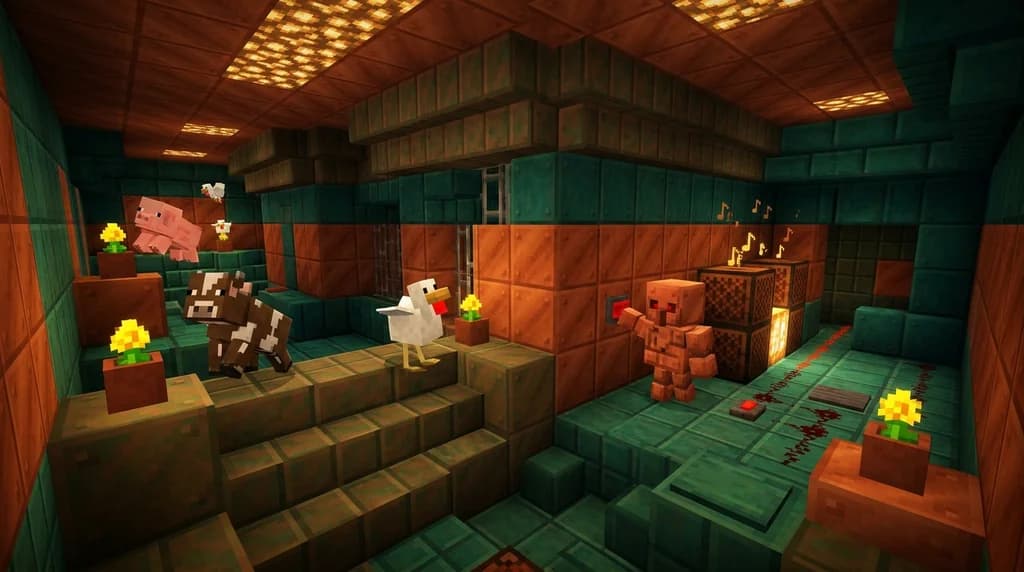
TL;DR
Bored in Minecraft? Build an Oxidizing Copper Escape Room — a living puzzle that literally changes state while players are inside it. Combine Trumpet Note Block pitch shifting (tied to copper oxidation levels), Copper Golem randomized button sequences, and Golden Dandelion baby mob sound cues into a redstone escape room that gets harder the longer players take to solve it.
Table of Contents
- What Is an Oxidizing Copper Escape Room?
- How to Set Up Your Oxidizing Copper Escape Room
- Best 5 Strategies for Copper Escape Room Design
- Why This Concept Works
- How to Put This Into Practice on Gaia Legends
- Conclusion
- FAQ
Introduction
You know that feeling. You've mined everything worth mining. Your base is beautiful. Your farms are humming. And yet — you log in, stand in your base, and feel absolutely nothing. Minecraft boredom is real, and it hits hardest when you've already done "everything."
Here's the thing: you haven't done this.
Imagine a room where the walls are slowly turning green. Where a little copper robot is randomly pressing buttons you need to decode. Where the only way to know which chest to open is to listen — really listen — to the squeak of a baby pig frozen in time by a golden flower. That's the Oxidizing Copper Escape Room, one of the most exciting things to do in Minecraft right now, made possible by the Copper Age drop (1.21.9) and the Tiny Takeover update (26.1).
This isn't just a build. It's a game design document. By the end of this guide, you'll have everything you need to build, run, and iterate on one of the most inventive Minecraft redstone escape room ideas ever conceived.
Let's build something unforgettable.
What Is an Oxidizing Copper Escape Room?
An Oxidizing Copper Escape Room is a Minecraft adventure map format where the puzzle environment physically changes state over time via copper oxidation, and players must decode audio cues from Trumpet Note Blocks and baby mob sounds before the room's oxidation level shifts the puzzle into a harder configuration.
It's a living escape room. Most escape rooms are static — you solve a puzzle, you move on. This one breathes. The copper blocks on the walls tick toward their next oxidation stage in real time. A freshly placed Copper Block plays a bright, high-pitched trumpet tone. A Weathered Copper Block plays a lower, warmer tone. An Oxidized Copper Block plays the deepest, most mournful note of all. These aren't just aesthetic differences — they're your puzzle's clock, your hint system, and your scoring mechanism all in one.
Layered on top of that, Copper Golems wander the room pressing buttons in randomized sequences. Players must observe, memorize, and replicate those sequences before the golem presses a "wrong" button that triggers a lockout. And scattered in alcoves are baby mobs — a baby pig here, a baby wolf there — each frozen at a specific age using a Golden Dandelion and each emitting a distinct new sound variant introduced in 26.1. Those sounds are your combination clues.
This is what Minecraft challenges look like in 2026.
How to Set Up Your Oxidizing Copper Escape Room
Materials Needed
Before you place a single block, gather these materials:
- Copper Blocks (all four oxidation stages: Copper, Exposed Copper, Weathered Copper, Oxidized Copper)
- Waxed variants of each oxidation stage (for "locked" puzzle elements that must not change)
- Copper Chests (oxidized variants for reward containers)
- Note Blocks (to be placed on Copper Blocks for Trumpet sounds)
- Copper Golem (spawned via Copper Golem Statue Block)
- Golden Dandelions (to freeze baby mobs at specific ages)
- Baby mobs — at minimum: baby Pig, baby Wolf, baby Chicken (each has distinct new sound variants from 26.1)
- Redstone — comparators, observers, repeaters, pistons, dispensers
- Observers (to detect oxidation state changes — see Pro Tip below)
World Settings
- Play on a flat or superflat world for precise redstone layouts
- Set difficulty to Normal so Copper Golems behave correctly
- Disable random tick speed changes during testing (use
/gamerule randomTickSpeed 0while building, then reset to3for live runs) - For multiplayer, assign one player as Puzzle Master who monitors oxidation via an observer dashboard outside the room
Building the Room: Step-by-Step
- Lay the foundation using a mix of freshly placed Copper Blocks and Weathered Copper Blocks. The asymmetry matters — players will use the color gradient as a map.
- Install the Trumpet Note Block grid. Place Note Blocks directly on top of Copper Blocks at each oxidation stage. A Note Block on a fresh Copper Block plays the highest trumpet pitch; on Oxidized Copper it plays the lowest. Use at least 4 Note Blocks across 4 oxidation stages to create a full tonal range.
- Spawn your Copper Golem using a Copper Golem Statue Block. The golem will wander and press nearby buttons randomly — this is your timer mechanic. Wire those buttons to a redstone sequence lock.
- Freeze your baby mobs. Breed the target species, then use a Golden Dandelion on each baby to stop aging. Each frozen baby emits its assigned sound variant on a loop (triggered by a redstone clock and dispenser with a sound-producing item nearby, or simply by proximity). Assign each baby a number: Baby Pig = 1, Baby Wolf = 2, Baby Chicken = 3.
- Wire the Copper Chests. Place Oxidized Copper Chests as reward containers. Each chest only opens when the correct combination — decoded from the baby mob sounds — is entered into a redstone sequence lock.
- Set the oxidation clock. Leave specific Copper Blocks unwaxed so they naturally progress during a run. A standard run should last 20–30 minutes, which maps to roughly one oxidation stage shift on exposed blocks under normal random tick speed.
Pro Tip: Place Observers facing Copper Blocks to detect the moment a block oxidizes and shifts stage. Wire those observers to a redstone signal that triggers a new Note Block melody — effectively giving players an audio alert that the puzzle just got harder.
Best 5 Strategies for Copper Escape Room Design
Strategy 1: The Pitch Ladder Combo Lock
Wire your four Trumpet Note Blocks (one per oxidation stage) to a combination lock. The correct combination is a musical sequence — players must press the Note Blocks in the order that spells out a rising or falling scale. As oxidation progresses, the tones shift, and the correct sequence changes. This means a team that takes too long must re-learn the combination mid-run.
Strategy 2: Golem Shadow Protocol
Let a Copper Golem roam freely among 9 buttons arranged in a 3×3 grid. Players must watch the golem's random presses and identify the one button the golem never presses — that's the exit code. The golem's randomized behavior means every run is unique. This is one of the best minecraft redstone escape room ideas for multiplayer because one player watches while others solve other puzzles simultaneously.
Strategy 3: Baby Mob Choir Cipher
Freeze three baby mobs (Pig, Wolf, Chicken) in soundproofed alcoves behind one-way glass. Each mob has a randomly assigned sound variant from the 26.1 update — classic, or one of the new variants. Players must identify which variant each mob is playing and match it to a codex posted at the room's entrance. The codex maps sound variants to numbers. Those numbers open the final Copper Chest.
Note: Baby Wolf and Baby Pig both received new sound variants in Java 26.1. Make sure you're running 26.1 or later, or the variant system won't work correctly.
Strategy 4: Wax-or-Oxidize Decision Gates
At key junctions, players find two Copper Blocks side by side — one waxed (frozen), one unwaxed (ticking). They must decide which block to interact with. Waxing the wrong block with a Honeycomb locks a door permanently. Letting the right block oxidize naturally opens a hidden passage. This creates meaningful, irreversible decisions under time pressure.
Strategy 5: The Oxidation Scoreboard
Track score by oxidation stage at time of escape:
| Oxidation Stage at Escape | Score Tier | Bonus Reward |
|---|---|---|
| Fresh Copper (0 shifts) | Legendary | Waxed Gold Trophy |
| Exposed Copper (1 shift) | Epic | Waxed Silver Trophy |
| Weathered Copper (2 shifts) | Rare | Copper Trophy |
| Oxidized Copper (3 shifts) | Common | No trophy |
| Failed / Locked Out | DNF | The Golem wins |
Difficulty Tiers
| Tier | Golem Count | Baby Mobs | Oxidation Speed | Waxed Locks |
|---|---|---|---|---|
| Casual | 1 Golem | 2 babies | Slow (tickspeed 1) | 2 locks |
| Hardcore | 2 Golems | 3 babies | Normal (tickspeed 3) | 4 locks |
| Insane | 3 Golems | 5 babies | Fast (tickspeed 6) | 6 locks + timed reset |
Why This Concept Works
The Mechanic Synergy Is Genuinely New
Each mechanic in this build was added in a different update, but they slot together like they were designed as a set. The Trumpet Note Block (added in 26.1) gives you a 4-stage audio system tied directly to a physical, visible, time-based process. The Copper Golem (added in 1.21.9) gives you a randomized, living timer that players can observe and interact with. The Golden Dandelion (added in 26.1) gives you a way to freeze a variable — the baby mob's sound variant — into a permanent clue that players must decode.
None of these mechanics are complicated on their own. Together, they create a puzzle ecosystem with 4 distinct oxidation-based pitch levels, a golem that randomizes button sequences on every run, and a baby mob cipher that uses brand-new sound variants most players have never even noticed. That's the sweet spot for escape room design: familiar tools, surprising combinations.
Replayability Is Baked In
The Copper Golem's button presses are random. The baby mobs' sound variants are randomly assigned at spawn. The oxidation clock creates a different time pressure on every run depending on how fast your team moves. A room you've solved once will feel meaningfully different on a second run — especially if you swap out which baby mobs you use or adjust the random tick speed.
The Time Pressure Is Diegetic
Most escape rooms use a countdown timer on a screen. This one uses the walls themselves. Watching a Copper Block shift from that warm orange-brown to a pale green while you're trying to decode a Note Block melody is genuinely stressful in the best possible way. The random tick speed governs oxidation — at default tickspeed 3, exposed copper blocks shift stage roughly every 50–82 in-game days, but in a controlled room with accelerated ticks, you can tune this to the exact pressure level you want.
How to Put This Into Practice on Gaia Legends
Building an Oxidizing Copper Escape Room on your own is deeply satisfying. Building one on Gaia Legends is a whole other level.
Gaia's exclusive server ranks unlock access to specialized Waxing Kits — custom items that let you freeze the oxidation level of any puzzle block or Trumpet Note Block permanently. This is a game-changer for escape room builders. Instead of hoping your unwaxed blocks tick at the right rate, you can architect exactly which blocks oxidize during a run and which stay locked. Your puzzle becomes deterministic where it needs to be, and chaotic where you want it to be.
Gaia also supports Java + Bedrock crossplay, which means your escape room is accessible to the widest possible audience. Invite your Bedrock friends, your Java friends, and watch them all struggle equally with your Copper Golem cipher.
The server's player-run adventure map ecosystem means your escape room can be listed, rated, and played by the entire Gaia community. Top-rated maps get featured on the server's weekly showcase — and with a concept this fresh, yours has a real shot.
Gaia Legends is free to join, non-pay-to-win, and supports Java + Bedrock crossplay.
Join at gaialegends.pro and remix your Minecraft experience today.
Conclusion
The Oxidizing Copper Escape Room is one of the most inventive Minecraft gameplay ideas available right now — and it's built entirely from vanilla mechanics that most players have barely scratched the surface of.
Here are your three takeaways:
- Oxidation is a clock. Use it as time pressure, not just decoration. The walls changing color is the timer.
- The Copper Golem is a randomizer. Its unpredictable button-pressing means your escape room has infinite variation built in for free.
- Baby mob sounds are a cipher. The new sound variants from 26.1 give you a rich audio puzzle layer that most players have never thought to exploit.
Try building your first room tonight — even a single-room prototype with one Golem, two Note Blocks, and one frozen baby mob. Share your results with the Gaia Legends community and see how fast your friends can escape before the walls go green.
FAQ
What are the best minecraft redstone escape room ideas using new 2026 mechanics?
The best minecraft redstone escape room ideas in 2026 combine oxidation-based Trumpet Note Block pitch shifting, Copper Golem randomized button sequences, and Golden Dandelion baby mob sound cues. These three mechanics — all added in the 1.21.9 Copper Age and 26.1 Tiny Takeover updates — create a living puzzle environment that changes state over time, giving you replayability and time pressure that static redstone puzzles simply can't match.
What should I do when bored in Minecraft and I've already built everything?
When boredom hits, shift from building things to designing experiences. An Oxidizing Copper Escape Room is one of the best things to do in Minecraft when you've exhausted standard gameplay — it combines redstone engineering, puzzle design, audio mechanics, and mob behavior into a single project that can take weeks to perfect and hours for others to play through.
Do I need any mods or plugins to build a copper escape room?
No mods are required. Everything in this guide uses vanilla Java Edition mechanics from updates 1.21.9 and 26.1. You'll need access to commands (/gamerule) for adjusting random tick speed during setup, but the core mechanics — Trumpet Note Blocks, Copper Golems, Golden Dandelions, and Copper Chests — are all base-game features.
How do Copper Golem timers work in an escape room context?
Copper Golems wander and press nearby buttons randomly. In an escape room, you wire those buttons to a redstone sequence lock. The golem's random presses serve as a living timer — if it presses the "wrong" button before players replicate the correct sequence, a lockout triggers. Because the golem's behavior is randomized, every run produces a different sequence for players to observe and decode.
How does the Golden Dandelion interact with baby mob sound cues?
Using a Golden Dandelion on a baby mob stops it from aging permanently — confirmed in the 26.1 changelog. This is crucial for escape rooms because it locks the mob at baby stage, ensuring it continuously emits its assigned baby sound variant. Since 26.1 added new sound variants for baby Wolves, Pigs, Chickens, and others, each frozen baby becomes a permanent audio clue with a specific "voice" players must identify and match to a codex.
How do copper oxidation levels affect Trumpet Note Block pitch?
A Note Block placed on top of a Copper Block plays a trumpet sound, and that sound's pitch varies based on the oxidation stage of the copper block beneath it — this was introduced in Java Edition 26.1. Fresh Copper produces the highest pitch, Exposed Copper a slightly lower one, Weathered Copper lower still, and Oxidized Copper the deepest tone. This gives escape room designers 4 distinct oxidation-based pitch levels to use as musical combination codes.
Recommended
Frequently Asked Questions
What are the best minecraft redstone escape room ideas using new 2026 mechanics?
The best minecraft redstone escape room ideas in 2026 combine oxidation-based Trumpet Note Block pitch shifting, Copper Golem randomized button sequences, and Golden Dandelion baby mob sound cues. These three mechanics — all added in the 1.21.9 Copper Age and 26.1 Tiny Takeover updates — create a living puzzle environment that changes state over time, giving you replayability and time pressure that static redstone puzzles simply can't match.
What should I do when bored in Minecraft and I've already built everything?
When boredom hits, shift from building things to designing experiences. An Oxidizing Copper Escape Room is one of the best things to do in Minecraft when you've exhausted standard gameplay — it combines redstone engineering, puzzle design, audio mechanics, and mob behavior into a single project that can take weeks to perfect and hours for others to play through.
Do I need any mods or plugins to build a copper escape room?
No mods are required. Everything in this guide uses vanilla Java Edition mechanics from updates 1.21.9 and 26.1. You'll need access to commands (/gamerule) for adjusting random tick speed during setup, but the core mechanics — Trumpet Note Blocks, Copper Golems, Golden Dandelions, and Copper Chests — are all base-game features available to any Java Edition player.
How do Copper Golem timers work in an escape room context?
Copper Golems wander and press nearby buttons randomly. In an escape room, you wire those buttons to a redstone sequence lock. The golem's random presses serve as a living timer — if it presses the wrong button before players replicate the correct sequence, a lockout triggers. Because the golem's behavior is randomized, every run produces a different sequence for players to observe and decode, ensuring no two runs feel identical.
How does the Golden Dandelion interact with baby mob sound cues in a puzzle?
Using a Golden Dandelion on a baby mob stops it from aging permanently, as confirmed in the 26.1 changelog. This locks the mob at baby stage so it continuously emits its assigned sound variant. Since 26.1 added new sound variants for baby Wolves, Pigs, Chickens, and others, each frozen baby becomes a permanent audio clue with a specific voice that players must identify and match to a codex to solve the puzzle.
How do copper oxidation levels affect Trumpet Note Block pitch in escape rooms?
A Note Block placed on a Copper Block plays a trumpet sound whose pitch varies by oxidation stage — introduced in Java 26.1. Fresh Copper produces the highest pitch, Exposed Copper a slightly lower one, Weathered Copper lower still, and Oxidized Copper the deepest tone. This gives designers 4 distinct pitch levels to use as musical combination codes that evolve during a run as unprotected blocks naturally oxidize.
Related guides
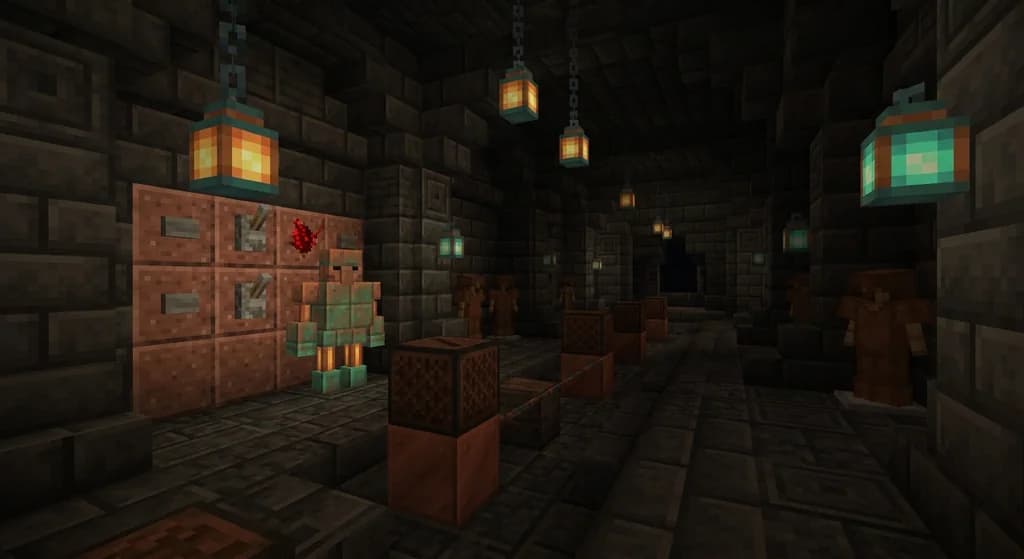
How to Build a Copper Trumpet Stealth Heist Course 2026
Discover fun things to build in Minecraft when bored 2026: a Copper Trumpet Stealth Heist Course using oxidation-based pitch alarms, Copper Golem guards, and Mannequin decoys.
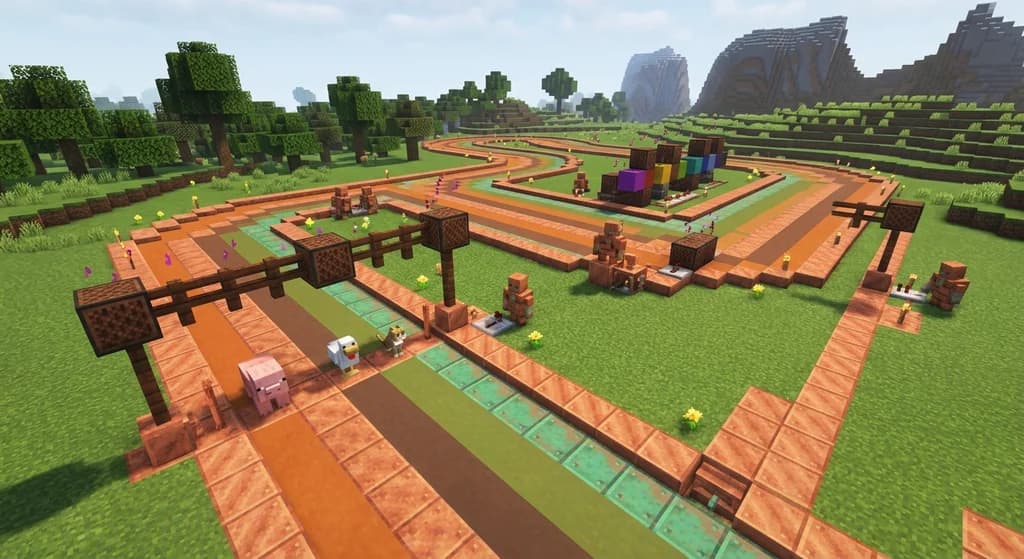
How to Build a Copper Golem Baby Mob Racing Circuit 2026 Guide
Build a Copper Golem baby mob racing circuit in Minecraft 2026. Use Golden Dandelion age-locking, oxidation trumpet lap timers & Gaia Legends betting arenas.
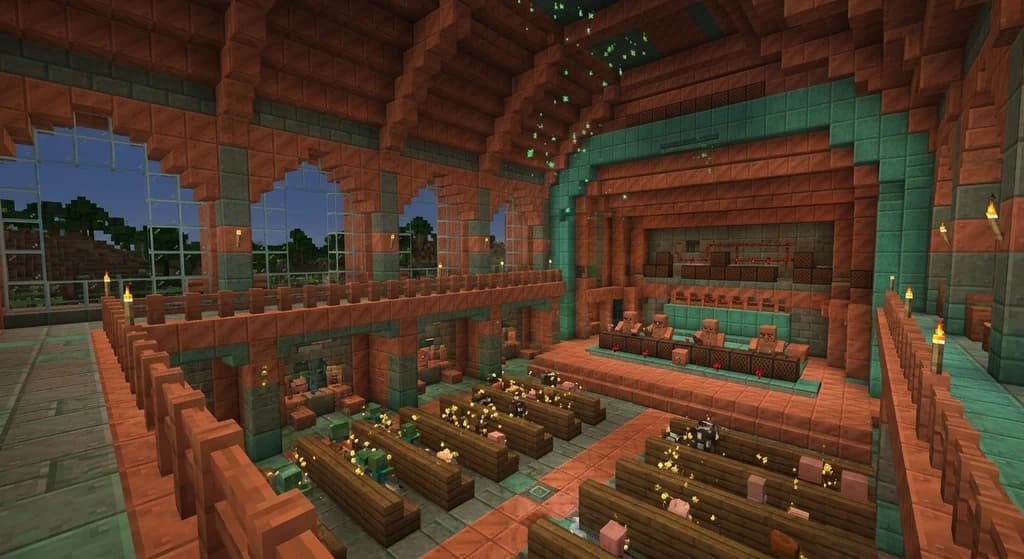
How to Master the Perpetual Tiny Mob Copper Orchestra 2026
Discover the ultimate Minecraft gameplay challenge for bored players: build a Perpetual Tiny Mob Copper Orchestra using Golden Dandelions, Copper Golems, and Oxidized Trumpets in 2026.
How to Build a Copper Golem Flash-Stealth Trial in Minecraft 2026
Bored in Minecraft? Build a Copper Golem Flash-Stealth Trial using The End's flashing skylight, Golden Dandelion obstacles, and randomized redstone traps. Fresh 2026 gameplay ideas inside.
Have a question or another approach?
Compare notes with other readers. Include your edition and version when discussing mechanics.