How to Build a Copper Golem Baby Mob Racing Circuit 2026 Guide
Filed under Minecraft Gameplay Remix · How we create content
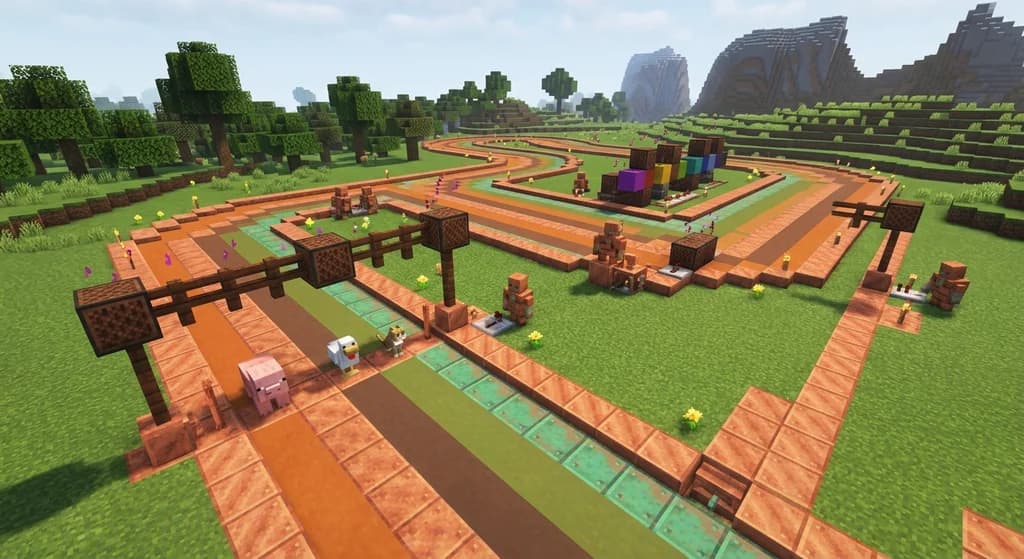
TL;DR
Bored in Minecraft? Here's how to build a fully automated baby mob racing circuit using three of 2026's most powerful mechanics: Golden Dandelion age-locking for consistent hitbox racers, Copper Golem RNG for dynamic gate automation, and oxidation-level Trumpet note blocks for real-time lap timing. By the end of this guide, you'll have a working race track, a scoring system, and the blueprint to turn it into a high-stakes multiplayer betting arena.
Table of Contents
- What Is a Copper Golem Baby Mob Racing Circuit?
- How to Set Up Your Baby Mob Racing Circuit
- Best Strategies for Your Racing Circuit
- Why This Concept Works
- How to Put This Into Practice on Gaia Legends
- Conclusion
- FAQ
- Recommended
What Is a Copper Golem Baby Mob Racing Circuit?
You know that feeling — you've mined everything, built a base, and now you're standing in your storage room staring at chests, wondering what the point of any of it is. The grind has gone flat. You need a project with stakes.
Enter the Copper Golem Baby Mob Racing Circuit: one of the wildest minecraft challenges for bored players that the 2026 update cycle has made possible.
A Copper Golem Baby Mob Racing Circuit is a player-designed competitive minigame where age-locked baby mobs race along a redstone-automated track, Copper Golems randomly trigger gates and obstacles, and oxidized Trumpet note blocks announce lap splits — all combining into a spectator sport you can actually bet on.
This isn't just "put some pigs in a pen and push them." This is a full minigame design system with three distinct mechanical layers working in concert:
- The Racers — baby mobs permanently frozen in their juvenile state using the Golden Dandelion, ensuring every racer has a predictably small hitbox and consistent movement physics.
- The Track Logic — Copper Golems positioned at gate junctions, using their native button-pressing RNG behavior to open and close lane dividers unpredictably, creating dynamic obstacles on every race.
- The Timing System — a chain of Trumpet note blocks placed on copper blocks at different oxidation stages, each producing a distinct pitch that signals lap checkpoints in real time.
This is exactly the kind of Minecraft gameplay idea that makes non-redstone players suddenly want to learn redstone — and makes veteran engineers finally have a reason to show off.
Why Now? The 2026 Update Window
The Tiny Takeover drop (Java Edition 26.1) introduced Golden Dandelions and new baby mob sounds, and the Copper Age drop (Java Edition 1.21.9) gave us Copper Golems and the Trumpet note block instrument. For the first time, all three systems exist simultaneously in the same version — and their interactions are more interesting than Mojang probably intended.
How to Set Up Your Baby Mob Racing Circuit
Materials Checklist
Before you lay a single block, gather everything you need. Running out of copper mid-build is a race-day disaster.
For the track:
- 200–400 blocks of Copper Block (mix of fresh, exposed, weathered, and oxidized for the timing system)
- 64+ Slabs (copper or stone) for the racing lane surface
- Fences and Fence Gates for lane dividers
- Leads and Name Tags (for identifying your racers)
- Hay Bales for mob feeding stations at the start gate
For the automation:
- At least 4 Copper Golems (craft using copper blocks + carved pumpkin)
- Note Blocks (one per checkpoint, placed on copper blocks)
- Observers, Redstone Dust, Redstone Comparators, and Pistons for gate logic
- Daylight Sensors or Buttons for race-start triggers
For the racers:
- At least 6 baby mobs (piglets, chicks, kittens, or foals work best)
- Golden Dandelions — one per racer to lock their age permanently
Note: Golden Dandelions stop baby mob aging when you interact with the mob while holding one. Green particles moving downward confirm the lock is active. Always verify the particle effect before race day — an accidentally grown-up pig will ruin your hitbox consistency.
World and Server Settings
- Play on Java Edition 26.1 or later to access all three mechanic layers simultaneously.
- Set mob griefing to ON — Copper Golems need to interact with buttons for their RNG gate logic to function.
- Keep the difficulty at Normal or Hard; mobs need to be active and responsive.
- For multiplayer, designate one player as Race Director with operator permissions to reset the track between heats.
Building the Track: Step-by-Step
-
Lay out your circuit. A 60×60 block oval is the sweet spot — large enough for interesting racing lines, small enough to keep spectators engaged. Mark the start/finish line with a row of waxed copper blocks (they won't oxidize, creating a permanent visual anchor).
-
Divide into lanes. Three lanes is the competitive standard. Use fence posts every 8 blocks with fence-gate openings at each checkpoint zone. Leave a 2-block-wide lane for each racer — baby mob hitboxes are roughly 0.5×0.5 blocks wide, so there's plenty of clearance.
-
Install Copper Golems at gate junctions. Place a Copper Golem beside each set of lane-dividing fence gates. Wire the gate's fence-gate mechanism to a button the Golem can reach. When the Golem randomly presses its button, the gate opens or closes — creating a live obstacle. Because Copper Golems press buttons at RNG intervals, no two races will ever be identical. Each Golem introduces what racers will quickly learn to call a "Clonk Zone" — the unpredictable section where gates slam shut mid-race.
-
Build your Trumpet timing system. At each of your three checkpoint positions, place a Note Block directly on top of a copper block. Use a different oxidation level at each checkpoint:
- Checkpoint 1: Fresh copper block → lowest Trumpet pitch (deep, resonant tone)
- Checkpoint 2: Weathered copper block → mid-range Trumpet pitch
- Checkpoint 3: Oxidized copper block → highest Trumpet pitch (bright, sharp tone)
Wire each note block to a pressure plate on the racing surface. When a racer crosses the plate, the Trumpet fires its distinct pitch. Spectators — and a lap-timer operator — can track positions by ear alone. The trumpet sound is different based on the oxidation level of the copper block, giving you 4 distinct tones across the full oxidation spectrum.
-
Age-lock your racers. Breed your chosen baby mobs and immediately interact with each one while holding a Golden Dandelion. Watch for the downward green particles. Now your racers are permanently juvenile — consistent hitboxes, consistent speeds, consistent chaos.
-
Set up the starting gate. Use a row of sticky pistons with copper slab faces, all wired to a single lever at the Race Director's podium. One pull of the lever and every piston retracts simultaneously, releasing the racers. For extra drama, add a 3-2-1 countdown using a repeater clock that fires three note block tones before triggering the gate.
Pro Tip: Name your baby mobs with Name Tags before age-locking them. Use racing numbers ("Racer #1", "Racer #2") so spectators can track their picks throughout the heat. The new baby mob sounds from the Tiny Takeover update mean each species has its own audio personality — lean into it. A squealing piglet rounding the final corner hits different when you've got 200 in-game currency riding on it.
Best Strategies for Your Racing Circuit
Difficulty Tiers
Not every server wants a full engineering project on day one. Here's how to scale the circuit to your group's skill level.
| Tier | Track Length | Copper Golems | Checkpoints | Betting System |
|---|---|---|---|---|
| Casual | 30×30 oval | 1 (one Clonk Zone) | 1 checkpoint | Honor system / verbal bets |
| Competitive | 60×60 oval | 3 (three Clonk Zones) | 3 checkpoints | Chest-based item wagers |
| Insane | 100×100 figure-8 | 6 (Clonk Zones everywhere) | 6 checkpoints | Full economy plugin integration |
The Clonk Zone Meta
Once your racers (and their human backers) understand that Copper Golems introduce RNG gates, strategy emerges fast. Experienced players will start reading Golem behavior — Golems tend to press buttons in short bursts before going idle. Watching a Golem's animation state before committing to a lane becomes a genuine skill. This is the kind of emergent gameplay that makes Minecraft challenges so endlessly replayable.
Race Formats
- Sprint Race: Single lap, first mob across the finish wins. Pure chaos, great for casual nights.
- Endurance Circuit: 3 laps, tracked by the Trumpet checkpoint system. Tests consistent mob pathing.
- Elimination Heat: 4 mobs race, last place each lap gets gently relocated (with a lead) out of the circuit. Last mob standing wins.
- Handicap Race: Faster species (horses, chickens) start 10 blocks behind slower ones (turtles, if you want to get creative). The Golden Dandelion's age-lock works on turtle hatchlings too — and a baby turtle is delightfully, infuriatingly slow.
Scoring and Progression
For a persistent multiplayer server, keep a running leaderboard on a wall of item frames near the spectator stands. Track:
- Most race wins per racer mob
- Best lap time (measured in Trumpet beats between checkpoints)
- Most successful Clonk Zone survivals without lane change
Note: Baby mobs don't navigate redstone circuits with any intelligence — they wander. The "skill" in racing them is in track design: use hay bales and flowers as soft attractors near the finish line to bias mob movement forward. Golden Dandelion flowers scattered along the track edges also add thematic visual polish.
Solo vs. Multiplayer Variations
Solo play: Use the circuit as a personal engineering challenge. Time how quickly you can complete a lap solo-running alongside your mobs, acting as a "pace car." Iterate on your track design to reduce average race time below 3 minutes per lap.
Multiplayer: Assign each player a racer to "sponsor." They're not controlling the mob — they're betting on it, cheering, and heckling. The Race Director manages gates and timing. This is one of the best things to do in Minecraft with a friend group that doesn't want to do another survival run.
Why This Concept Works
The Mechanic Synergy Is Real
Each of the three core mechanics solves a problem the others create:
- Golden Dandelion solves the hitbox problem. Without age-locking, a baby pig might grow up mid-race, changing its size and movement speed entirely. Age-locking creates a controlled variable — the racers stay racers.
- Copper Golem RNG solves the determinism problem. A static track gets memorized and boring after three races. Golems introduce genuine unpredictability without requiring a human operator to manually trigger obstacles.
- Trumpet note blocks solve the spectator problem. In a chaotic multi-mob race, it's hard to track positions visually. The distinct pitch-per-checkpoint system means even spectators looking away from the track can follow the race by ear. The trumpet sound is different based on the oxidation level of the copper block — 4 distinct tones across fresh, exposed, weathered, and oxidized stages give you a full sonic vocabulary.
Replayability by Design
The Copper Golem's button-pressing behavior is genuinely random — no two races will gate identically. Combined with the natural pathing variance of baby mobs (they don't run in straight lines), every heat feels different. This is the same design principle behind great board games: constrained randomness within a structured system.
What Makes It a Real Minecraft Challenge
The best minecraft challenges for bored players share three traits: they're easy to explain, hard to master, and generate stories. "My baby piglet got trapped in a Clonk Zone for 45 seconds while a chick lapped it twice" is a story. That's what you're building here — a story generator.
How to Put This Into Practice on Gaia Legends
Everything above works in vanilla Minecraft — but on Gaia Legends, the circuit becomes something else entirely: a full economy event.
Gaia Legends runs custom economy plugins that let players wager server currency on race outcomes through a dedicated betting interface. Before a heat, registered spectators can place bets on their chosen racer. After the Trumpet note blocks fire the final checkpoint tone and a winner crosses the finish line, the economy plugin automatically distributes winnings based on odds calculated from each mob's win-loss record.
The Swiftness server charms layer on top of this beautifully. Players who've earned Swiftness charms can apply a temporary speed buff to their sponsored racer once per race — creating a strategic resource management layer. Do you burn your charm in lap one to build a lead, or save it for the final straight?
Gaia Legends also supports Java + Bedrock crossplay, so your racing circuit can attract spectators from both platforms. Build it once, run it for the whole server community.
Gaia Legends is free to join, non-pay-to-win, and supports Java + Bedrock crossplay. Join at gaialegends.pro and remix your Minecraft experience today.
Conclusion
The Copper Golem Baby Mob Racing Circuit is proof that Minecraft's best gameplay ideas aren't handed to you — they're assembled from the parts Mojang leaves lying around. Here's what to take away:
- Golden Dandelion age-locking transforms baby mobs from temporary juveniles into permanent, consistent racing units with predictable hitboxes.
- Copper Golem RNG gates inject genuine unpredictability into every race, making your track replayable indefinitely without manual intervention.
- Oxidation-tuned Trumpet note blocks give your circuit a real-time audio timing system that works for spectators as much as participants.
Try building the Casual tier circuit tonight — it takes under an hour and will immediately make your server more interesting. Then share your race results. We want to hear about your first Clonk Zone disaster.
FAQ
What are the best minecraft challenges for bored players in 2026?
The best minecraft challenges for bored players in 2026 combine multiple new mechanics into systems with emergent gameplay. The Copper Golem Baby Mob Racing Circuit is a standout example — it uses Golden Dandelion age-locking, Copper Golem RNG automation, and oxidation-tuned Trumpet note blocks to create a competitive minigame with genuine replayability. Other strong options include automated living orchestras and oxidizing escape rooms using the same 2026 mechanic set.
What to do when bored in Minecraft if I don't know redstone?
Start with the Casual tier of the racing circuit — it requires only basic redstone (pressure plates wired to note blocks, a lever for the starting gate). You don't need complex logic. The Copper Golem handles its own automation natively by pressing buttons on its own. Focus on the track layout and mob collection first, then add redstone complexity as your confidence grows. The circuit scales with your skill level.
How does the Golden Dandelion work for racing?
Interacting with a baby mob while holding a Golden Dandelion stops it from aging. Green particles moving downward confirm the effect is active. This is permanent until you interact with the same mob again while holding another Golden Dandelion, which re-enables aging. For racing purposes, this means your baby pig stays a baby pig indefinitely — consistent hitbox, consistent movement speed, consistent racing conditions across every heat.
How do Copper Golems automate the race track gates?
Copper Golems naturally press buttons and levers they can reach as part of their base behavior. By placing a Copper Golem adjacent to a button wired to a fence-gate mechanism at each lane junction, the Golem will randomly open and close gates during the race. This RNG-driven obstacle is entirely hands-free — no player needs to operate it. The unpredictability is the feature, not a bug.
What Minecraft version do I need to build this circuit?
You need Java Edition 26.1 or later (released March 24, 2026) for Golden Dandelions and the Trumpet note block instrument, and the Copper Golem was introduced in Java Edition 1.21.9. Make sure your server is running at least 26.1 to access all three mechanic layers simultaneously. Bedrock players on Gaia Legends can participate as spectators and bettors via crossplay, though circuit construction requires Java Edition.
How do the Trumpet note blocks work as lap timers?
Place a Note Block directly on a Copper Block to unlock the Trumpet instrument. The pitch produced by the Trumpet is different depending on the oxidation level of the copper block beneath it — fresh copper gives the lowest tone, oxidized copper gives the highest. By placing checkpoints on copper blocks at different oxidation stages and wiring each to a pressure plate on the track surface, you create an audio signature for each checkpoint. Spectators can track race positions by ear alone.
Recommended
Frequently Asked Questions
What are the best minecraft challenges for bored players in 2026?
The best minecraft challenges for bored players in 2026 combine multiple new mechanics into systems with emergent gameplay. The Copper Golem Baby Mob Racing Circuit is a standout example — it uses Golden Dandelion age-locking, Copper Golem RNG automation, and oxidation-tuned Trumpet note blocks to create a competitive minigame with genuine replayability. Other strong options include automated living orchestras and oxidizing escape rooms using the same 2026 mechanic set.
What to do when bored in Minecraft if I don't know redstone?
Start with the Casual tier of the racing circuit — it requires only basic redstone (pressure plates wired to note blocks, a lever for the starting gate). You don't need complex logic. The Copper Golem handles its own automation natively by pressing buttons on its own. Focus on the track layout and mob collection first, then add redstone complexity as your confidence grows. The circuit scales with your skill level.
How does the Golden Dandelion work for racing?
Interacting with a baby mob while holding a Golden Dandelion stops it from aging permanently. Green particles moving downward confirm the effect is active. This can be reversed by interacting with the same mob again while holding another Golden Dandelion, which re-enables aging. For racing, this means your baby pig stays a baby pig indefinitely — consistent hitbox, consistent movement speed, and consistent racing conditions across every heat.
How do Copper Golems automate the race track gates?
Copper Golems naturally press buttons and levers they can reach as part of their base behavior. By placing a Copper Golem adjacent to a button wired to a fence-gate mechanism at each lane junction, the Golem will randomly open and close gates during the race. This RNG-driven obstacle is entirely hands-free — no player needs to operate it. The unpredictability is the feature, not a bug, creating a different race experience every single heat.
What Minecraft version do I need to build this circuit?
You need Java Edition 26.1 or later (released March 24, 2026) for Golden Dandelions and the Trumpet note block instrument, and the Copper Golem was introduced in Java Edition 1.21.9. Make sure your server is running at least 26.1 to access all three mechanic layers simultaneously. Bedrock players on Gaia Legends can participate as spectators and bettors via crossplay, though circuit construction is best done on Java Edition.
How do the Trumpet note blocks work as lap timers?
Place a Note Block directly on a Copper Block to unlock the Trumpet instrument. The pitch is different depending on the oxidation level of the copper block beneath it — fresh copper gives the lowest tone, oxidized copper gives the highest. By placing checkpoints on copper blocks at different oxidation stages and wiring each to a pressure plate on the track, you create a distinct audio signature per checkpoint. Spectators can track race positions by ear alone.
Related guides
Build an Automated Copper Golem Jazz Orchestra: 2026 Guide
Learn Minecraft copper golem automation to build a Jazz Orchestra with oxidizing Trumpet Note Blocks and Golden Dandelion baby mob choir vocals. Full 2026 setup guide.
How to Master the Perpetual Tiny Mob Copper Orchestra 2026
Discover the ultimate Minecraft gameplay challenge for bored players: build a Perpetual Tiny Mob Copper Orchestra using Golden Dandelions, Copper Golems, and Oxidized Trumpets in 2026.
How to Build a Copper Trumpet Stealth Heist Course 2026
Discover fun things to build in Minecraft when bored 2026: a Copper Trumpet Stealth Heist Course using oxidation-based pitch alarms, Copper Golem guards, and Mannequin decoys.
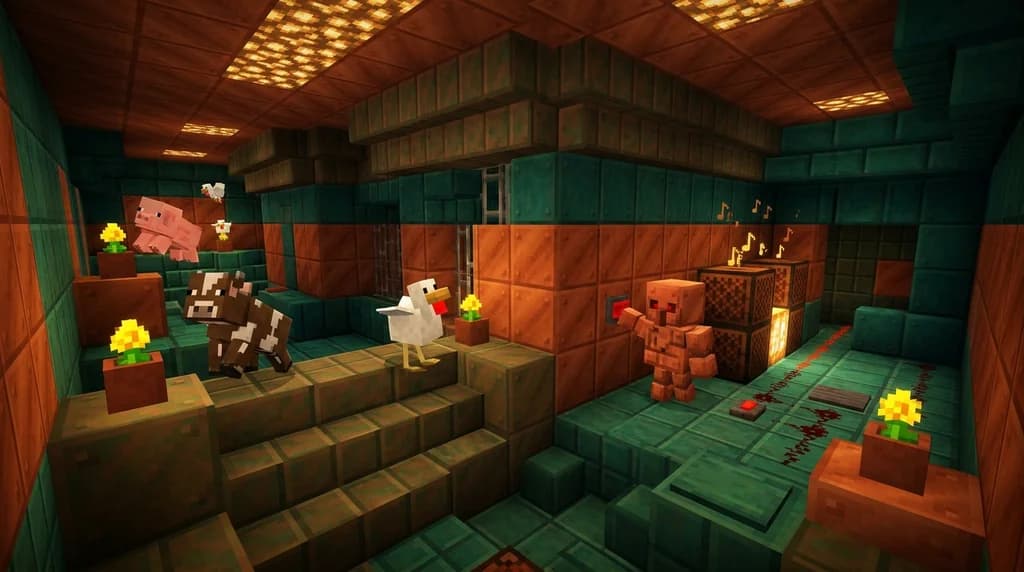
How to Build an Oxidizing Copper Escape Room: 2026 Guide
Discover the best minecraft redstone escape room ideas for 2026: build an oxidizing copper escape room using Trumpet Note Blocks, Copper Golem timers, and baby mob sound cues.
Have a question or another approach?
Compare notes with other readers. Include your edition and version when discussing mechanics.