How to Build a Minecraft Speedrun Portal Fast: 2026 Pro Methods
Filed under Speedrunning & Competitive Minecraft · How we create content
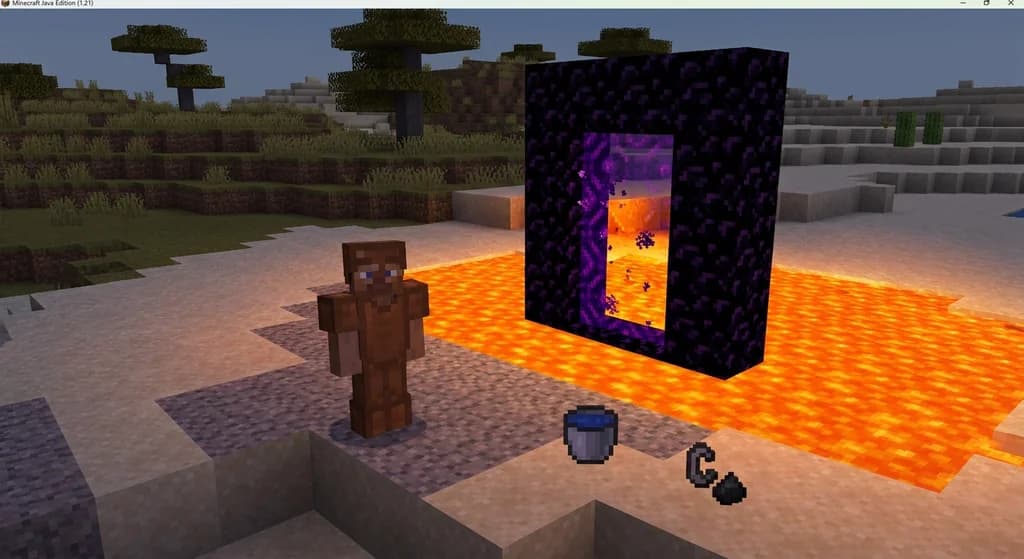
Key Takeaways
| Point | Details |
|---|---|
| Lava pool method is fastest | Casting obsidian directly from a surface lava pool skips all mining and saves 60–90 seconds compared to digging obsidian underground. |
| Bucket count matters | Carry exactly 1 water bucket and 1 lava bucket — any more wastes inventory slots that could hold food or a flint and steel. |
| Frame shape is flexible | A 2×3 interior (10 obsidian) is the minimum portal size and the fastest to build — never waste time on a larger frame. |
| Flint and steel beats fire charge | Flint and steel costs no blaze rods and is craftable in seconds — always prefer it over a fire charge for lighting the portal. |
| Seed knowledge amplifies speed | Knowing your seed's lava pool locations before the run can cut portal search time by over a minute on average. |
| Practice the cast motion | Muscle memory for water-bucket placement is the single most time-lossy step — drill it in isolation before full runs. |
Table of Contents
- What Is a Minecraft Speedrun Portal?
- How to Build a Lava Pool Portal Step by Step
- Best Portal Building Methods Compared
- Tips for Shaving More Seconds Off Your Portal
- Why Seed Knowledge Changes Everything
- How to Put This Into Practice on Gaia Legends
- Conclusion
- Frequently Asked Questions
- Recommended
Every second you waste building your portal is a second your competition banks on the leaderboard. Most new runners spend three to five minutes on their first Nether portal — top runners do it in under thirty seconds. The gap isn't talent. It's technique.
This guide breaks down every pro method for building a Minecraft speedrun portal fast in 2026, from the classic lava pool cast to bucket-only tricks that skip mining entirely. Whether you're chasing a personal best or grinding ranked matchmaking, these methods will transform the most time-lossy moment in any Any% run.
What Is a Minecraft Speedrun Portal?
A Minecraft speedrun portal is a Nether portal constructed as quickly as possible using environmental resources — primarily surface lava pools and water buckets — instead of mining obsidian underground. The technique exploits the game mechanic where water flowing over lava source blocks instantly converts them into obsidian, letting runners "cast" a portal frame in seconds without a diamond pickaxe.
The standard portal frame requires 10 obsidian blocks for the minimum 2×3 interior size (4 corners are skippable). According to the Minecraft Wiki, a Nether portal can be activated with a frame as small as 4 wide × 5 tall on the outside, but the 2×3 interior with corner-less construction is the universally accepted speedrun standard because it uses the fewest obsidian blocks possible.
Note: You cannot skip the corners in all versions. In Java Edition 1.21+, corner-less portals (10 obsidian) are valid. Always verify your version before assuming corner skips work.
How to Build a Lava Pool Portal Step by Step
This is the method every competitive runner learns first. It requires zero obsidian in your inventory at the start.
What You Need
- 1 water bucket
- 1 flint and steel (iron ingot + flint)
- A surface lava pool of at least 10 lava source blocks
- A flat or near-flat casting surface
Step-by-Step Build
- Locate a surface lava pool. Open terrain in desert, savanna, or badlands biomes tends to expose lava pools at or near Y=0. In 2026 Java Edition world generation, lava pools also appear at the surface in lower terrain.
- Shape the lava. Use a bucket or block placement to arrange 10 lava source blocks in the portal frame shape — two columns of 3 with a row of 2 connecting the bottom.
- Place your water. Stand at the top of the frame and pour your water bucket so it flows down over the lava sources. Water converts lava sources to obsidian on contact.
- Pick up the water. Re-bucket the water immediately — you'll need it for emergencies later.
- Remove any excess blocks used to shape the frame (gravel, dirt, whatever you grabbed).
- Light it. Right-click the interior with flint and steel. The portal activates instantly.
Pro Tip: Pre-shape the lava pool before placing water. Trying to pour water over an unshaped pool wastes casts and forces resets. One clean pour = one clean portal.
Done correctly, this entire sequence takes 20–35 seconds for a practiced runner.
Best Portal Building Methods Compared
Not every run gives you a perfect surface lava pool. Here's how the main methods stack up:
| Method | Obsidian Needed | Avg. Time (practiced) | Best For |
|---|---|---|---|
| Lava pool cast | 0 (cast on site) | 20–35 sec | Any% Glitchless, RSG |
| Bucket lava transport | 0 (carry lava) | 45–70 sec | Seeds with no surface lava |
| Pre-mined obsidian | 10 blocks | 10–15 sec | Set Seed, known spawns |
| Ruined portal repair | 1–7 blocks | Varies | RSG with lucky spawn |
The lava pool cast wins for random seed runs because it requires no pre-gathered obsidian. The ruined portal repair method can be faster when your spawn drops you next to a ruined portal with most blocks intact — but that's seed-dependent luck, not skill.
Warning: Never waste time mining obsidian with an iron pickaxe. Iron picks cannot mine obsidian — you'll break the block with no drop and lose precious seconds. You need at least a diamond pickaxe to mine obsidian, which is why casting is almost always faster.
For Set Seed runs, check out Best Minecraft Speedrun Seeds for Set Seed Glitchless 2026 — knowing exactly where your lava pool spawns turns this into a 10-second sequence.
Tips for Shaving More Seconds Off Your Portal
Master the One-Bucket Cast
The single biggest time save is learning to cast obsidian with one water bucket placement. This means:
- Pre-shaping your lava correctly before any water touches it
- Pouring water from the highest point of the frame
- Letting gravity do the conversion work in a single flow
Runners who need two or three water pours are losing 10–15 seconds per attempt. Drill the one-pour cast until it's automatic.
Use Gravel as a Shaping Tool
Gravel falls, which makes it perfect for shaping lava pools quickly. Drop gravel into lava source blocks you don't want, shape the pool, then retrieve the gravel. It's faster than placing and breaking dirt because gravel drops as an item when you break it — no wasted block.
Flint and Steel Over Fire Charge
Flint and steel is craftable from 1 iron ingot + 1 flint — materials you'll pick up naturally in the first two minutes of any run. A fire charge requires blaze powder, which means entering the Nether first. Always use flint and steel to light your portal on the Overworld side.
Pre-Craft While Moving
Don't stop moving to open your crafting table. Use your 2×2 inventory grid to pre-craft flint and steel while you're running toward the lava pool. Every second of idle standing is a second lost.
For a deeper look at how portal decisions connect to your overall ranking, see How to Improve Your MCSR Ranked ELO: Competitive Guide 2026 — portal efficiency is one of the top three ELO-separating skills at mid-tier play.
Why Seed Knowledge Changes Everything
Random Seed vs. Set Seed Portal Strategy
In Random Seed Glitchless (RSG) runs, you're reacting to whatever the world gives you. That means scanning terrain fast, identifying lava pool candidates, and making a quick go/no-go decision on each one.
In Set Seed Glitchless (SSG) runs, you know exactly where every lava pool is before you load the world. The portal build becomes a rehearsed sequence, not a reactive one.
The Minecraft Wiki documents that lava pools generate as a feature in the Overworld at Y=0 and below, with surface exposure depending on terrain height. In practice, desert and badlands biomes expose the most accessible surface lava for runners because their flat terrain keeps pools visible.
Pro Tip: When evaluating a new RSG seed, the first thing top runners check is whether a lava pool is within 200 blocks of spawn. A pool farther than that usually means a reset is faster than the travel time.
Understanding where to travel after your portal is just as important as building it fast. The How to Master Blind Portals for Minecraft Speedrunning in 2026 guide covers the exact nether coordinate math you need once you step through.
And if you're working on your overall competitive game beyond just portal speed, How to Climb MCSR Ranked ELO: 2026 Competitive Strategy Guide breaks down the full skill tree from early-game routing to end-game execution.
How to Put This Into Practice on Gaia Legends
Knowing the technique is one thing. Drilling it under pressure is another. That's exactly what the Gaia Legends practice server is built for.
Gaia Legends runs dedicated time-trial leaderboards where you can race portal builds in isolation — no full run required. Load into a practice world, find your lava pool, and see your portal time posted to the board in real time. It's the fastest feedback loop available for runners who want to isolate and improve a single mechanic.
The server also hosts competitive SMP seasons where early-game Nether access directly impacts your resource lead over other players. Every second you shave off your portal build translates into a real advantage in the season economy. Community coaching sessions run weekly, and experienced runners regularly share routing notes in the Discord.
Gaia Legends is free to join, non-pay-to-win, and supports Java + Bedrock crossplay — so your whole crew can practice together regardless of platform.
Join at gaialegends.pro and start your legend today.
Conclusion
Building a fast Minecraft speedrun portal comes down to three things:
- Use the lava pool cast method — it's the fastest option for 90% of runs and requires zero pre-mined obsidian
- Master the one-bucket pour — a single clean water placement saves 10–15 seconds over sloppy multi-pour attempts
- Know your seed — even basic knowledge of where surface lava generates in your biome cuts search time dramatically
The difference between a 3-minute portal and a 25-second portal is pure repetition. Pick one method, drill it until it's muscle memory, then move on to the next bottleneck in your run. Good luck out there.
Frequently Asked Questions
What is the fastest Minecraft speedrun portal method?
The fastest Minecraft speedrun portal method for most runs is the lava pool cast: find a surface lava pool, shape it into a portal frame using gravel or bucket manipulation, pour one water bucket over the top to convert lava sources into obsidian, then light it with flint and steel. Practiced runners complete this in 20–35 seconds without mining a single block.
Do you need a diamond pickaxe to build a speedrun portal?
No — the lava pool cast method requires no pickaxe at all. You only need a diamond pickaxe if you plan to mine obsidian directly from the ground. Since mining obsidian with a diamond pick takes about 9.4 seconds per block, casting from a lava pool is almost always faster for Any% runs.
How many obsidian blocks does a minimum Nether portal need?
A minimum Nether portal in Java Edition requires 10 obsidian blocks using the corner-less frame design (2×3 interior). The four corner blocks are optional and can be left empty, which is why the standard speedrun portal uses 10 rather than 14 blocks.
What biome has the best surface lava pools for speedrunning?
Desert and badlands biomes expose the most accessible surface lava pools because their flat, low-elevation terrain keeps lava visible and reachable. Savanna biomes are a close second. Dense forest biomes can hide pools under tree cover, making them harder to spot quickly during a live run.
Can you build a speedrun portal without a water bucket?
Yes, but it's much slower. Without a water bucket, you'd need to mine obsidian with a diamond pickaxe — which requires finding diamonds first. Some runners use the ruined portal repair method if they spawn near one with most blocks intact, but this is seed-dependent. For consistent runs, always carry a water bucket.
How do I practice portal building without doing full runs?
The best approach is isolated portal drills: create a flat creative world, practice the lava-shaping and water-pour motion until it's automatic, then test in survival. Servers like Gaia Legends also offer dedicated practice modes with time-trial leaderboards so you can benchmark your portal speed against real competition without committing to a full run.
Recommended
- Why mobs despawn in Minecraft: mechanics, fixes, and pro tips
- How to Solve Minecraft Storage Problems with Vanilla Plus Mods
- 7 Best Industrial Block Palettes for Minecraft Builds in 2026
- How to Obtain Legendary Item Sets on Minecraft Servers in 2026
Ready to play? Join Gaia Legends today — no pay-to-win, Java + Bedrock crossplay.
- Java:
join.gaialegends.pro - Bedrock:
join.gaialegends.pro— Port19132
Further reading
These references were recorded with the article; specific claims have not been matched to source excerpts.
Frequently Asked Questions
What is the fastest Minecraft speedrun portal method?
The fastest Minecraft speedrun portal method for most runs is the lava pool cast: find a surface lava pool, shape it into a portal frame, pour one water bucket over the top to convert lava sources into obsidian, then light it with flint and steel. Practiced runners complete this in 20–35 seconds without mining a single block of obsidian.
Do you need a diamond pickaxe to build a speedrun portal?
No — the lava pool cast method requires no pickaxe at all. You only need a diamond pickaxe if you plan to mine obsidian directly from the ground. Since mining obsidian with a diamond pick takes roughly 9.4 seconds per block, casting from a lava pool is almost always faster for Any% Glitchless runs.
How many obsidian blocks does a minimum Nether portal need?
A minimum Nether portal in Java Edition requires 10 obsidian blocks using the corner-less frame design (2×3 interior). The four corner blocks are optional and can be left empty. This is the universally accepted speedrun standard because it uses the fewest obsidian blocks while still producing a valid, activatable portal.
What biome has the best surface lava pools for speedrunning?
Desert and badlands biomes expose the most accessible surface lava pools because their flat, low-elevation terrain keeps lava visible and reachable without dense tree cover. Savanna biomes are a close second. Avoid dense forest biomes during a live run — pools can hide under canopy and cost you valuable search time.
Can you build a speedrun portal without a water bucket?
Yes, but it's much slower. Without a water bucket you'd need to mine obsidian with a diamond pickaxe, which requires finding diamonds first. Some runners use the ruined portal repair method near spawn, but that's seed-dependent. For consistent, repeatable runs across random seeds, always carry a water bucket as your primary portal tool.
How do I practice portal building without doing full runs?
The best approach is isolated portal drills: set up a survival world with a known lava pool nearby and time yourself repeatedly until the one-bucket cast is automatic. Servers like Gaia Legends offer dedicated practice modes with time-trial leaderboards so you can benchmark your portal speed against real competition without committing to a complete speedrun.
Related guides
How to Improve Your MCSR Ranked ELO: Competitive Guide 2026
Learn how to improve your MCSR Ranked ELO in 2026 with proven strategies, bastion routing practice, matchmaking tips, and competitive Minecraft...
How to Speedrun Minecraft in 2026: The Complete Beginner's Guide
Learn how to speedrun Minecraft in 2026 with this complete beginner's guide. Master categories, portal building, bastion routing, and practice methods to...
7 Best Minecraft Speedrun Practice Maps for Pro Training 2026
Discover the 7 best Minecraft speedrun practice maps for 2026. Train bastion routing, nether travel, and dragon mechanics to cut your run time fast.
How to One Cycle the Ender Dragon: Minecraft Speedrun Guide 2026
Master the ender dragon one cycle in Minecraft. Step-by-step bed cycle timing, positioning, and speedrun tips to kill the dragon in a single perch phase.
Have a question or another approach?
Compare notes with other readers. Include your edition and version when discussing mechanics.