How to Master Blind Portals for Minecraft Speedrunning in 2026
Filed under Speedrunning & Competitive Minecraft · How we create content
Key Takeaways
| Point | Details |
|---|---|
| Coordinate Math is Everything | Divide overworld X and Z by 8 to find the matching nether position — off by even 5 blocks and your exit portal spawns hundreds of blocks away. |
| Blind Travel vs. Mapless Travel | Blind travel means navigating without a pre-known destination; mastering it requires memorizing your target coordinates before entering the nether. |
| Triangulation Locks the Stronghold | Throw two ender eyes from different angles and trace the intersection — this two-point method is faster and more accurate than single-eye throws. |
| Nether Roof Saves Minutes | Running on the nether roof at Y=128 eliminates mob interference and cuts travel distance dramatically on most competitive seeds. |
| Practice Seeds Build Muscle Memory | Drilling blind portal math on known seeds before racing unknown ones is how top runners drop their times consistently. |
| High-Tick Servers Reduce False Reads | Practicing on a stable, high-tick-rate server ensures your portal-link behavior matches what you'll see in a real competitive run. |
Table of Contents
- What Is a Blind Portal in Minecraft Speedrunning?
- How to Calculate Nether Coordinates for Blind Travel
- How to Execute the Blind Portal Step by Step
- Best Blind Travel Strategies for Competitive Seeds
- How to Master Stronghold Triangulation After Your Exit Portal
- Why Consistent Practice Beats Raw Talent
- How to Put This Into Practice on Gaia Legends
- Conclusion
- Frequently Asked Questions
- Recommended
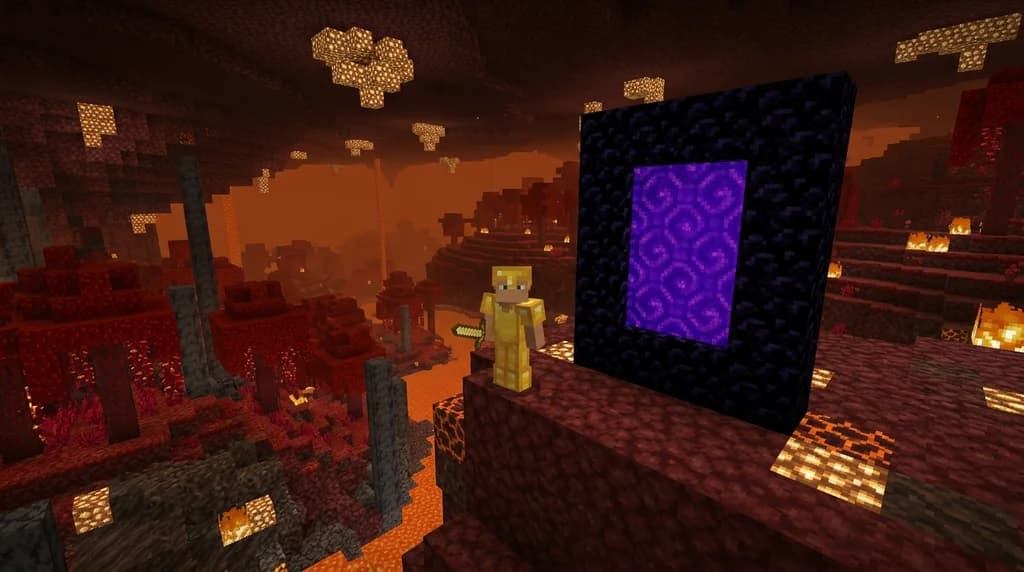
Most runners don't lose time in the End — they lose it in the nether. A shaky minecraft speedrun blind portal guide approach, a miscalculated exit, a portal that links 400 blocks from the stronghold: these are the mistakes that separate sub-20 attempts from finished runs. The good news is that blind portal technique is almost entirely learnable math and muscle memory. This guide breaks down the coordinate system, the step-by-step execution, and the triangulation method that top runners use so you can drill it until it's second nature.
What Is a Blind Portal in Minecraft Speedrunning?
A blind portal is a nether portal built at deliberately calculated nether coordinates, designed to exit into the overworld as close as possible to a target location — without the runner ever having visited that overworld destination first.
The word "blind" doesn't mean random. It means you're trusting coordinate math rather than pre-scouted knowledge. In Any% runs, the most common target is the stronghold ring — specifically the 1,408–2,688 block radius from spawn where roughly 128 strongholds generate per world in Java Edition, according to the Minecraft Wiki. You pick a point inside that ring, calculate the nether equivalent, build your portal there, and hope the exit spawns close enough to throw ender eyes efficiently.
This is different from a divine travel or mapless approach. Blind travel is deliberate and math-driven. Divine travel relies on a lucky portal link to a pre-known structure. Understanding the difference helps you choose the right strategy for the seed you're running.
Note: Blind portal technique applies to Java Edition speedrunning. Bedrock Edition has different portal-linking rules and stronghold generation patterns, so the coordinate math below is Java-specific.
How to Calculate Nether Coordinate Math for Blind Travel
This is the core skill. The nether coordinate math for Minecraft is straightforward once you internalize it.
The 8:1 Ratio
The overworld and nether share a coordinate system with an 8:1 scale ratio. Every block you travel in the nether equals 8 blocks traveled in the overworld. To find your target nether position:
- Identify your overworld target coordinates (X, Z).
- Divide both by 8.
- Build your nether portal within 1–2 blocks of that result.
Example: If your stronghold ring target is overworld X=1,600, Z=800, your nether destination is X=200, Z=100.
Warning: Minecraft's portal-linking algorithm searches for the nearest existing portal within a 128-block radius on the same axis. If you're off by more than 16 nether blocks (~128 overworld blocks), the game may link to a completely different portal or generate a new one far from your target. Precision matters.
Quick Reference Table
| Overworld X/Z | Nether X/Z (÷8) | Max Linking Error (nether blocks) |
|---|---|---|
| 800 | 100 | ±16 |
| 1,600 | 200 | ±16 |
| 2,400 | 300 | ±16 |
| 3,200 | 400 | ±16 |
Keep this ratio locked in your head. Runners who hesitate on the math lose 10–20 seconds per attempt.
How to Execute the Blind Portal Step by Step
Knowing the math is half the battle. Here's the full execution loop used in competitive runs.
Pre-Nether Prep
- Collect obsidian early. Most runners loot a ruined portal or craft a bucket for lava-casting to minimize obsidian mining time. According to the Minecraft Wiki, a standard nether portal requires a minimum of 10 obsidian blocks for the frame.
- Note your overworld spawn coordinates. You'll need these to calculate your return portal position if you're doing a two-portal strategy.
- Decide your target ring position. Pick a cardinal or diagonal direction from spawn. Runners typically aim for 1,500–2,000 blocks out — close enough to reach quickly, far enough to land in a dense stronghold zone.
Inside the Nether
- Open your debug screen (F3) immediately on entry.
- Confirm your current nether X and Z.
- Calculate the gap between your current position and your target nether coordinates.
- Travel that distance — on the nether roof if possible.
- Build your exit portal at the target coordinates.
- Step through.
Pro Tip: If you're running on the nether roof at Y=128, remember that portal-linking still uses your X and Z position. Your Y coordinate doesn't affect which overworld portal gets linked or created — only X and Z matter for the 8:1 calculation.
On the Gaia Legends Server
Best Blind Travel Strategies for Competitive Seeds
Not all blind portal approaches are equal. Here are the three most common strategies ranked by reliability.
Strategy 1: Diagonal Blind (Most Common)
Aim diagonally (roughly 45 degrees from spawn). This maximizes distance gained per block traveled and tends to land you in a denser stronghold cluster. Most top-tier Any% runners default to this approach on random seeds.
Strategy 2: Cardinal Blind
Aim due north, south, east, or west. Simpler navigation, slightly less efficient distance coverage. Good for beginners because it's easier to track coordinates in one axis at a time.
Strategy 3: Bastion-First Blind
Enter a bastion first for blaze rods and gold, then build your exit portal from inside or near the bastion. The bastion's coordinates become your reference point. This adds complexity but can consolidate loot and portal steps into a single nether segment.
| Strategy | Difficulty | Time Potential | Best For |
|---|---|---|---|
| Diagonal Blind | Medium | High | Experienced runners |
| Cardinal Blind | Low | Medium | Beginners |
| Bastion-First Blind | High | Very High | Advanced routing |
How to Master Stronghold Triangulation After Your Exit Portal
Once you step out of your blind portal into the overworld, you need to find the stronghold fast. Stronghold triangulation is the technique of throwing two ender eyes from two different positions and tracing the intersection of their trajectories to pinpoint the stronghold's location.
The Two-Point Method
- Throw one eye of ender. Note the direction it travels (use F3 to read your facing angle).
- Walk 200–300 blocks perpendicular to that direction.
- Throw a second eye. Note the new direction.
- The stronghold sits where those two lines intersect.
This method is significantly faster and more accurate than repeatedly following a single eye. Single-eye chasing wastes eyes and adds unnecessary running distance. According to the Minecraft Wiki, strongholds generate in rings, with the first ring containing 3 strongholds between 1,408 and 2,688 blocks from world origin — knowing this ring radius helps you mentally constrain where the intersection should fall before you even throw the first eye.
Pro Tip: Use a protractor overlay or the in-game F3 facing angle (displayed as degrees) to calculate the intersection mathematically rather than eyeballing it. Several free speedrun tools exist to do this math in real time — runners call this "eye math" and it can save 30+ seconds on a bad exit.
Why Consistent Practice Beats Raw Talent
Blind portal execution is a skill, not a gift. The runners who make it look effortless have drilled the same coordinate calculations hundreds of times on practice seeds.
The most effective training loop:
- Step 1: Load a known seed with a mapped stronghold location.
- Step 2: Execute your full blind portal route without looking at the map.
- Step 3: Check how close your exit portal landed to the stronghold.
- Step 4: Identify the error (math mistake, portal placement drift, wrong target ring).
- Step 5: Repeat until your exit consistently lands within 200 overworld blocks of the stronghold.
Drilling on a stable server — one where portal-linking behavior is predictable and tick rate doesn't fluctuate — is critical. On a laggy environment, portals can link incorrectly due to timing issues, which teaches you bad habits that won't transfer to a real competitive run.
How to Put This Into Practice on Gaia Legends
Gaia Legends runs on a high-tick-rate Java server infrastructure specifically tuned for consistent game mechanics — which makes it an ideal environment to drill blind portal math without worrying about lag-induced false portal links.
Here's how to use Gaia for speedrun practice:
- Use creative mode practice worlds to drill coordinate math repetitions without wasting survival resources on failed attempts.
- Run timed nether segments with friends on the server to simulate race pressure — blind portal execution under pressure is different from solo drilling.
- Test your triangulation accuracy by having a friend secretly mark a stronghold location, then racing to find it using only ender eyes and your two-point method.
Gaia Legends is free to join, non-pay-to-win, and supports Java + Bedrock crossplay — so your whole speedrun practice group can run together regardless of platform. The stable server performance means your portal math translates cleanly, and the community includes players actively working on competitive times who can give you real feedback.
Join at gaialegends.pro and start your legend today.
Conclusion
Blind portal mastery comes down to three things:
- Lock in the 8:1 coordinate math — divide overworld X and Z by 8, build within 2 blocks of that target, and never eyeball it.
- Use two-point triangulation — two ender eye throws from different positions find the stronghold faster and more reliably than chasing a single eye across the map.
- Practice on stable infrastructure — laggy environments teach you bad habits; consistent server behavior means your muscle memory actually transfers to competitive runs.
The gap between a runner who understands blind portals conceptually and one who executes them cleanly under pressure is pure repetition. Start drilling today.
Frequently Asked Questions
What is a minecraft speedrun blind portal guide and how does it differ from divine travel?
A blind portal guide teaches you to build a nether portal at mathematically calculated coordinates — dividing your overworld target by 8 — so your exit spawns near a stronghold without pre-scouting. Divine travel, by contrast, relies on a lucky portal link to a structure you've already located. Blind travel is skill-based and repeatable; divine travel is seed-dependent and faster when it works but can't be trained the same way.
How accurate does my nether portal placement need to be for blind travel?
You need to be within roughly 16 nether blocks of your target coordinates. Minecraft's portal-linking algorithm searches a 128-block overworld radius (16 nether blocks) for the nearest existing portal. Exceed that margin and the game either links to a wrong portal or generates a new one far from your intended exit point, potentially costing you hundreds of overworld blocks.
What is the best blind travel strategy for beginner speedrunners?
Start with cardinal blind travel — aiming due north, south, east, or west from spawn. It's easier to track a single coordinate axis while doing the ÷8 math in your head. Once you're consistently landing within 300 blocks of your stronghold target, graduate to diagonal blind, which covers more distance per nether block traveled and lands you in denser stronghold rings.
How many ender eyes do I need for stronghold triangulation?
Two well-placed throws are enough for accurate triangulation using the two-point method. In practice, carry at least 6–8 eyes in case of breakage — ender eyes have a 1 in 5 chance of shattering on each throw, according to the Minecraft Wiki. Carrying extras ensures you don't run out before you've locked the intersection.
Does the 8:1 nether coordinate ratio work the same in Bedrock Edition?
No. Bedrock Edition uses the same 8:1 horizontal scale between the nether and overworld, but stronghold generation, portal-linking behavior, and the overall world structure differ significantly from Java Edition. The blind portal math is the same, but the stronghold ring radii and triangulation targets are different. This guide focuses on Java Edition competitive speedrunning.
How do I practice blind portals without wasting resources on failed attempts?
Use a practice seed with a known stronghold location and drill the full route in survival mode, treating each attempt as a real run. Many runners also use creative mode to test portal placement accuracy in isolation — build the portal, step through, check your overworld coordinates, and measure the error. Repeating this loop on a stable server like Gaia Legends ensures your portal-link results are consistent and your practice data is reliable.
Recommended
- Top 7 Minecraft Chest and Storage Mods for Vanilla+ Play 2026
- How to Master the Ultimate Minecraft Progression Guide in 2026
- How to Use Natural Palettes: A 2026 Minecraft Build Guide
- How to Write a Minecraft Server Lore Document: 2026 RPG Guide
Ready to play? Join Gaia Legends today — no pay-to-win, Java + Bedrock crossplay.
- Java:
join.gaialegends.pro - Bedrock:
join.gaialegends.pro— Port19132
Further reading
These references were recorded with the article; specific claims have not been matched to source excerpts.
Frequently Asked Questions
What is a minecraft speedrun blind portal guide and how does it differ from divine travel?
A blind portal guide teaches you to build a nether portal at mathematically calculated coordinates — dividing your overworld target by 8 — so your exit spawns near a stronghold without pre-scouting. Divine travel relies on a lucky portal link to a structure you've already located. Blind travel is skill-based and repeatable; divine travel is seed-dependent and faster when it works but can't be trained the same way.
How accurate does my nether portal placement need to be for blind travel?
You need to be within roughly 16 nether blocks of your target coordinates. Minecraft's portal-linking algorithm searches a 128-block overworld radius (16 nether blocks) for the nearest existing portal. Exceed that margin and the game either links to a wrong portal or generates a new one far from your intended exit point, potentially costing you hundreds of overworld blocks of extra travel.
What is the best blind travel strategy for beginner speedrunners?
Start with cardinal blind travel — aiming due north, south, east, or west from spawn. It's easier to track a single coordinate axis while doing the ÷8 math in your head. Once you're consistently landing within 300 blocks of your stronghold target, graduate to diagonal blind, which covers more distance per nether block traveled and lands you in denser stronghold rings.
How many ender eyes do I need for stronghold triangulation?
Two well-placed throws are enough for accurate triangulation using the two-point method. In practice, carry at least 6–8 eyes in case of breakage — ender eyes have a 1 in 5 chance of shattering on each throw, according to the Minecraft Wiki. Carrying extras ensures you don't run out before you've locked the intersection point and found the stronghold entrance.
Does the 8:1 nether coordinate ratio work the same in Bedrock Edition?
The 8:1 horizontal scale applies in Bedrock Edition too, but stronghold generation, portal-linking behavior, and world structure differ significantly from Java Edition. The blind portal math is the same, but the stronghold ring radii and triangulation targets are different. This guide focuses on Java Edition competitive speedrunning, so verify Bedrock-specific mechanics separately before applying these techniques.
How do I practice blind portals without wasting resources on failed attempts?
Use a practice seed with a known stronghold location and drill the full route in survival mode, treating each attempt as a real run. Many runners also use creative mode to test portal placement accuracy in isolation — build the portal, step through, check your overworld coordinates, and measure the error. Repeating this loop on a stable server ensures your portal-link results are consistent and your practice data is reliable.
Related guides
The Midoffs LIVE Speedrunning Tournament at TwitchCon
Discover everything about The Midoffs LIVE speedrunning tournament at TwitchCon Rotterdam 2026. Learn the event date, location, and what made it a landmark for competitive Minecraft.
7 Best Minecraft Speedrun Practice Maps for Pro Training 2026
Discover the 7 best Minecraft speedrun practice maps for 2026. Train bastion routing, nether travel, and dragon mechanics to cut your run time fast.
How to One Cycle the Ender Dragon: Minecraft Speedrun Guide 2026
Master the ender dragon one cycle in Minecraft. Step-by-step bed cycle timing, positioning, and speedrun tips to kill the dragon in a single perch phase.
How to Master Minecraft Bastion Routing: Pro Speedrun Guide 2026
Master Minecraft bastion routing in 2026. Learn all four bastion types, optimal loot paths, piglin bartering strategies, and pro speedrun nether routing tips.
Have a question or another approach?
Compare notes with other readers. Include your edition and version when discussing mechanics.