How to Build a Greek Temple in Minecraft: Marble Block Palette Guide (2026)
Filed under Minecraft Build Palette & Block Harmony · How we create content
Version scope: 1.20+ (not edition-specific)
Key Takeaways
| Point | Details |
|---|---|
| Quartz blocks crafted from | Quartz blocks crafted from Nether Quartz form the perfect marble-like material for Greek temples. |
| Use a 3 | 1 ratio of quartz pillars to smooth quartz for columns, and fill walls with smooth quartz. |
| Nether Quartz is obtained | Nether Quartz is obtained by mining quartz ore in the Nether or bartering with Piglins at a 4.26% chance. |
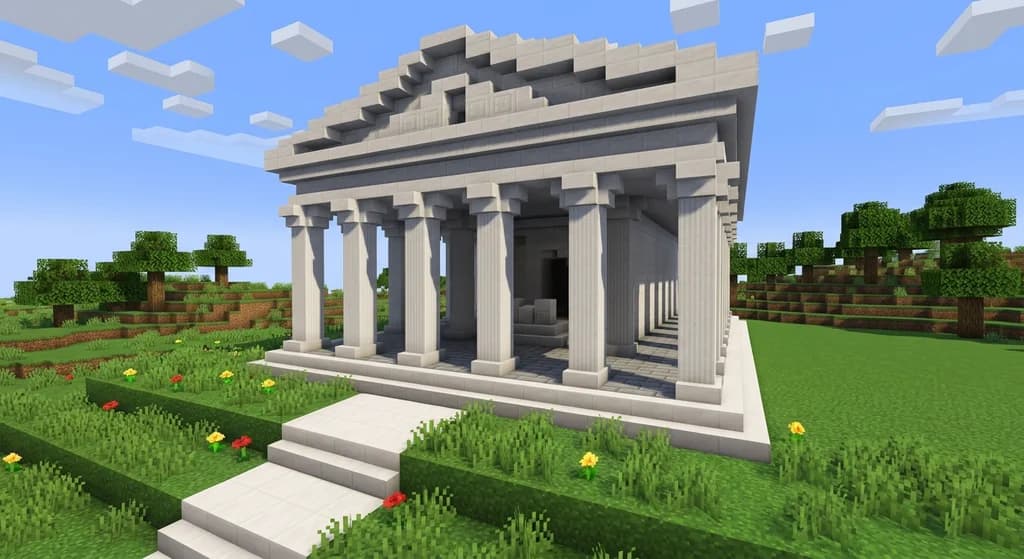
| The temple structure follows classical orders | stylobate, colonnade, cella, pediment, and roof. |
| Smooth quartz steps and | Smooth quartz steps and slabs create realistic roof tiles without mods. |
| This palette works for | This palette works for both small shrines and large Parthenon-style builds by scaling the block counts. |
Building a Greek temple in Minecraft is one of the most rewarding classical architecture projects. The key is finding the right block palette to mimic marble—and the best material in the game is Nether Quartz. This guide walks you through a complete build recipe using quartz blocks, quartz pillars, and smooth quartz, with Nether Quartz as the raw material. Whether you're constructing a small shrine or a full Parthenon, these steps will give you an authentic marble look.
Why Quartz Blocks Work as Marble
Nether quartz is a mineral found in the Nether used mainly for crafting decorative blocks and redstone components. When smelted, nether quartz can be crafted into quartz blocks, chiseled quartz, quartz pillars, and smooth quartz. These blocks have a clean white hue, subtle texture variations, and a polished surface reminiscent of real marble. Unlike concrete which has a flat matte finish, quartz blocks have a slight sheen that catches light beautifully.
For a Greek temple palette, use:
- Quartz Pillars – fluted columns
- Smooth Quartz – walls and pediments
- Chiseled Quartz – decorative friezes and trim
- Quartz Block – accent details and interior flooring
Materials and Quantities for a Standard Temple (9x5 base, 8 columns)
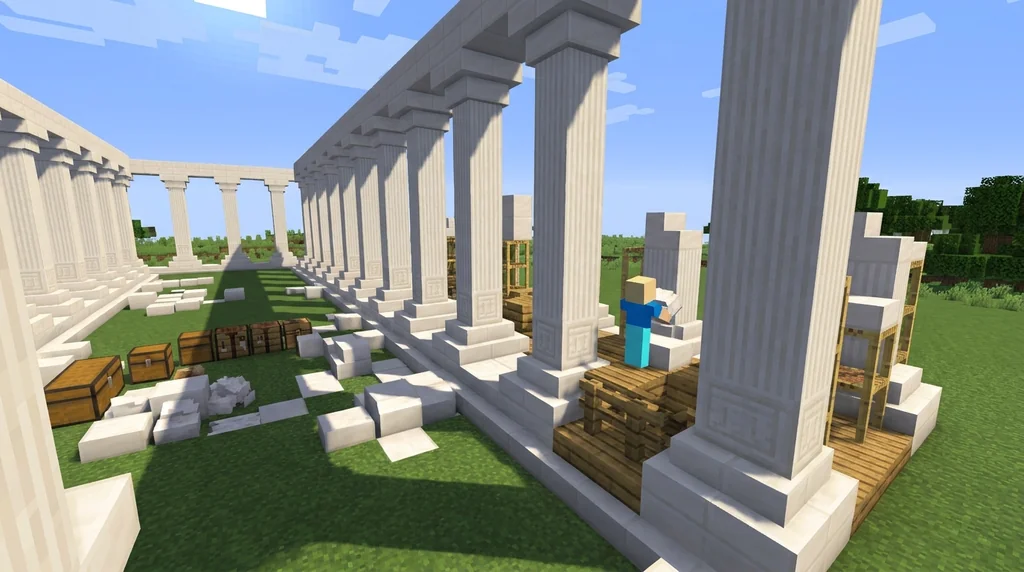
This ratio produces a temple that fits within a 20x10 block area. Scale up by multiplying blocks.
| Block Type | Quantity | Purpose |
|---|---|---|
| Quartz Pillars | 64 | Columns (8 columns, 6 blocks each) |
| Smooth Quartz | 256 | Stylobate, walls, pediment, roof tiles |
| Chiseled Quartz | 8 | Triglyph accents and capital details |
| Quartz Block | 32 | Interior floor and cella walls |
| Nether Quartz (raw) | ~10 stacks | Required to craft all the above blocks |
Where to get Nether Quartz:
- Mining: "Nether quartz ore mined using a pickaxe drops one unit of Nether quartz." Efficiency V and Fortune III yield more.
- Bartering: "Piglins have approximately a 4.26% chance (20⁄469) to barter 5–12 Nether quartz when given a gold ingot."
Build Sequence
1. Stylobate (Foundation)
The temple rests on a raised platform. Build a 9x5 rectangle of smooth quartz 2 blocks tall. Add an extra row of quartz pillars around the edge for a decorative border.
2. Colonnade (Columns)
Place quartz pillars on top of the stylobate edges. For a standard peristyle, place columns on all four sides. Each column is 6 blocks high. Leave a 1-block gap between columns (applies to long sides, corners have double columns). Total 8 columns.
3. Architrave and Frieze
Run a row of smooth quartz across the top of the columns (2 blocks high). On the front and back, add a layer of chiseled quartz in a repeating pattern: every other block, to represent triglyphs.
4. Cella (Inner Chamber)
Build walls inside the colonnade using smooth quartz. Leave a 2-block-wide entrance at the front. The cella walls are 4 blocks high. Use quartz block interior for the floor.
5. Pediment (Triangular Gable)
At the front and back of the roof, build a triangle using smooth quartz stairs and slabs. The base is the width of the temple (9 blocks). Slope up to a peak at the center. Fill the interior with smooth quartz blocks.
6. Roof
Lay smooth quartz slabs across the roof from front to back, starting at the pediment and dropping by 1 block per row. This creates a subtle barrel-vault feel. Use quartz stairs at the edges for eaves.
7. Finishing Details
- Add a statue inside the cella (use armor stands with white armor or a quartz block structure).
- Place a few lanterns (or sea lanterns) for lighting without breaking the palette.
- Surround the temple with a courtyard of quartz path blocks and diorite or calcite for contrast (though those blocks aren't from Nether Quartz, they blend well).
Palette Variations
If you want a slightly different marble shade, try these blocks (all available in 1.20+):
- Calcite – brighter white, but less texture
- White Concrete – pure matte white, good for interior
- Diorite – greyish marble, good for accent However, for the most authentic Greek marble look, pure quartz blocks are unbeatable.
Internal Links to Related Palettes
Need more palette inspiration? Check out our other guides:
- How to Build a Minecraft Bridge with 5 Block Palettes (2026)
- How to Use the 60-30-10 Rule for Balanced Minecraft Builds (2026)
- How to Create Your Own Block Palettes in Minecraft (2026)
FAQ
Can I build this temple without visiting the Nether? Not if you want a pure quartz palette. Nether Quartz only generates in the Nether. You could substitute white concrete or calcite, but the texture won't be as marble-like.
How many blocks do I need for a larger temple? For each additional column on the long side, add ~24 more quartz pillars. Scale the stylobate and roof proportionally. A Parthenon-style temple (16 columns) would require about 250 quartz pillars and 600 smooth quartz blocks.
Does this build work in Bedrock Edition? Yes. Quartz blocks and Nether Quartz function identically in Java and Bedrock. The build sequence is the same.
What if I want a weathered marble look? Mix in a few blocks of light gray terracotta or andesite. Place them randomly in the stylobate or walls to simulate age.
Can I use a texture pack to improve marble appearance? Absolutely. Any fantasy or realism texture pack that makes quartz blocks more reflective will enhance the marble illusion.
Sources
- Nether quartz is a mineral found in the Nether used mainly for crafting decorative blocks and redstone components. — Nether Quartz
Frequently Asked Questions
Can I build this temple without visiting the Nether?
Not if you want a pure quartz palette. Nether Quartz only generates in the Nether. You could substitute white concrete or calcite, but the texture won't be as marble-like.
How many blocks do I need for a larger temple?
For each additional column on the long side, add ~24 more quartz pillars. Scale the stylobate and roof proportionally. A Parthenon-style temple (16 columns) would require about 250 quartz pillars and 600 smooth quartz blocks.
Does this build work in Bedrock Edition?
Yes. Quartz blocks and Nether Quartz function identically in Java and Bedrock. The build sequence is the same.
What if I want a weathered marble look?
Mix in a few blocks of light gray terracotta or andesite. Place them randomly in the stylobate or walls to simulate age.
Can I use a texture pack to improve marble appearance?
Absolutely. Any fantasy or realism texture pack that makes quartz blocks more reflective will enhance the marble illusion.
Related guides
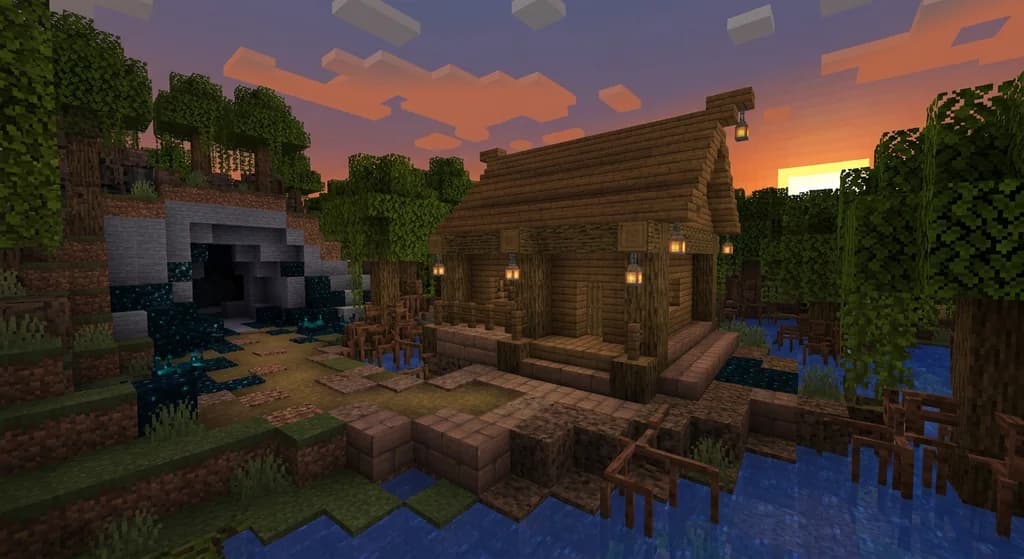
Creative Block Combinations from The Wild Update for Building
Discover six block palettes from The Wild Update: mangrove wood, mud bricks, sculk, and froglight combos for your next Minecraft build.
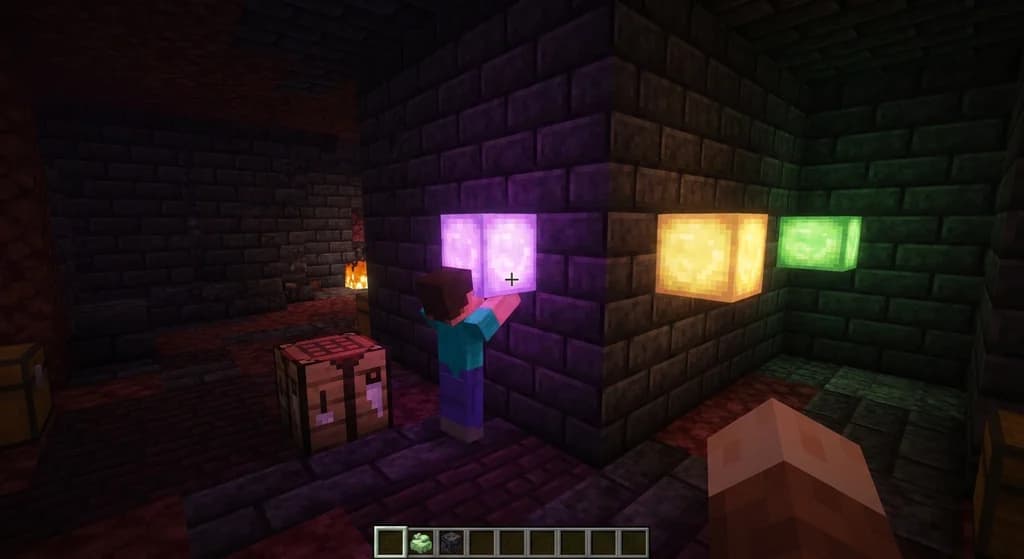
Froglight: The Brightest Light Block in Minecraft
Discover why the froglight is Minecraft's brightest light block. Learn how to get all three froglight colors, their unique melting properties, and the best ways to use them in your builds.

Minecraft Dragon Head: How to Obtain and Use It
Learn exactly how to get a dragon head in Minecraft, from looting End ships to using Creative mode. Discover its unique redstone animation, practical stealth benefits, and decorative uses.
Minecraft Wood Blocks: Types and Basic Properties
A quick reference to every wood block type in Minecraft, from classic oak to pale oak. Learn how to get wood, strip it, craft with it, and use it as fuel.
Have a question or another approach?
Compare notes with other readers. Include your edition and version when discussing mechanics.