How to Use the 60-30-10 Rule for Balanced Minecraft Builds (2026)
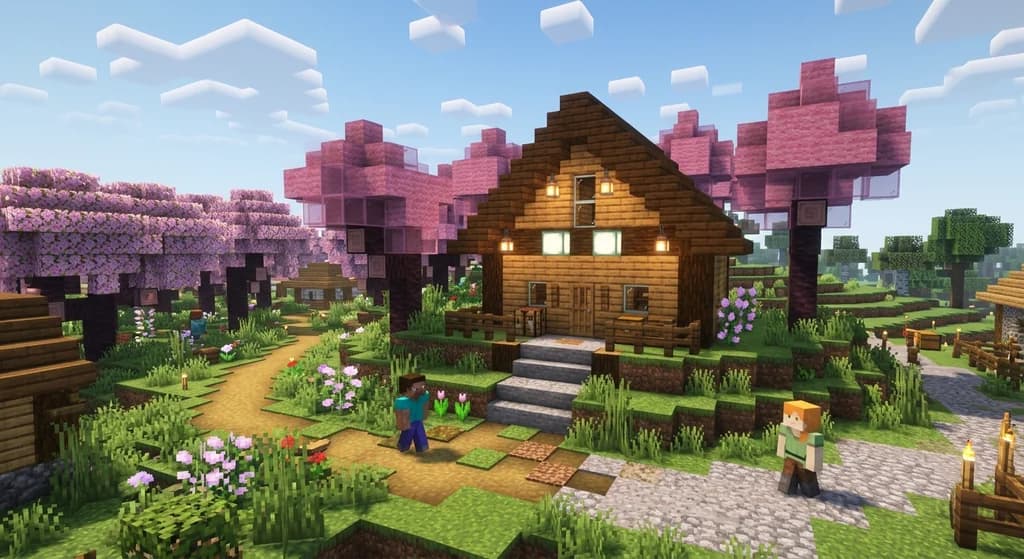
Key Takeaways
| Point | Details |
|---|---|
| Dominant block first | Choose the 60% block for your largest surface, usually walls, before deciding anything else. |
| Contrast beats similarity | Use a 30% secondary block from a different color family, like dark wood under light stone, to create depth. |
| Keep accents rare | Spend the 10% accent on doors, windows, and rooflines, and keep it to one accent family. |
| Test on a small wall | A 10×10 swatch reveals ratio problems faster than a full build, so test before committing. |
| Lighting changes everything | Shadows can shift how palette blocks read, so always check your palette at night too. |
Table of Contents
- What Is the 60-30-10 Rule in Minecraft Builds?
- How to Choose the Dominant 60% Block for Your Build
- Why Does the 30% Secondary Block Make or Break a Build?
- How to Pick a 10% Accent Block That Pops
- How to Apply the 60-30-10 Rule Fast
- How to Fix Common 60-30-10 Palette Mistakes
- How to Put This Into Practice on Gaia Legends
- Conclusion
- Recommended
Every Minecraft build needs a color balance, and the 60-30-10 rule for Minecraft builds is the fastest way to get one. It's the same formula interior designers have used for years: choose one dominant color for 60% of the space, a secondary color for 30%, and a punchy accent for 10%. In Minecraft, that translates directly into blocks. You pick one wall block for your mass, one trim or roof block for contrast, and one detail block for doors, windows, and focal points. This guide will show you exactly how to choose each layer, test it fast, and fix the palette mistakes that make builds feel flat. You don't need an art degree to use it — you just need to count blocks, or even estimate them, and let the ratio do the heavy lifting. By the end, you'll be able to plan any build, from a forest cabin to a futuristic tower, in about ten minutes.
What Is the 60-30-10 Rule in Minecraft Builds?
The 60-30-10 rule is a color-balance formula that divides every build into 60% dominant block, 30% secondary block, and 10% accent block, and it works beautifully in Minecraft.
The 60-30-10 rule is a ratio borrowed from interior design. It says 60% of any space should be one main color, 30% a secondary color, and 10% a small accent that draws the eye. In Minecraft, you translate the math into block types: walls and floors become the 60% layer; stairs, stripped logs, or contrasting stone become the 30% layer; lanterns, candles, and glazed terracotta become the 10% layer. The best part is that you only need about three block families, so it's easy to gather in survival and easy to keep consistent.
Minecraft gives you more than enough raw materials for every layer. Minecraft has 16 base dye colors, which means you can build a full color wheel when planning your 60-30-10 palette (via Minecraft Wiki). Pair that with a hot bar of wall blocks and you have a system that works for medieval castles, modern houses, and everything in between. If you want to see how to turn this ratio into a reusable system, check out How to Create Your Own Block Palettes in Minecraft (2026).
| Layer | How much of the build | Block examples |
|---|---|---|
| Dominant | 60% | Oak planks, stone bricks, deepslate bricks |
| Secondary | 30% | Stripped spruce logs, smooth sandstone, terracotta |
| Accent | 10% | Lanterns, glazed terracotta, red wool, candles |
How to Choose the Dominant 60% Block for Your Build
The dominant 60% block sets the entire mood, so choose the block you want viewers to remember before picking anything else.
Start with your largest surface — usually the walls. If you're building a cozy cabin, oak or spruce planks are a natural 60% choice. For a castle, deepslate bricks or stone bricks. For a desert town, smooth sandstone. The 60% block should be relatively quiet: low contrast, easy to read, and pleasant to look at in large quantities. A strongly textured block like mossy cobblestone can work, but only if you keep it in this layer and let the other two layers do the talking.
Terracotta is one of the best 60% or 30% options for warm builds. There are 16 types of colored terracotta plus the base block, giving builders 17 terracotta options for warm 60% and 30% layers (via Minecraft Wiki). If you're building in a mesa, the 7 Best Badlands Block Palettes for Stunning Minecraft Builds (2026) post shows how those warm tones work together at scale.
Why Does the 30% Secondary Block Make or Break a Build?
The 30% block provides contrast and structure; a weak 30% leaves your build feeling flat even if the palette looks good on paper.
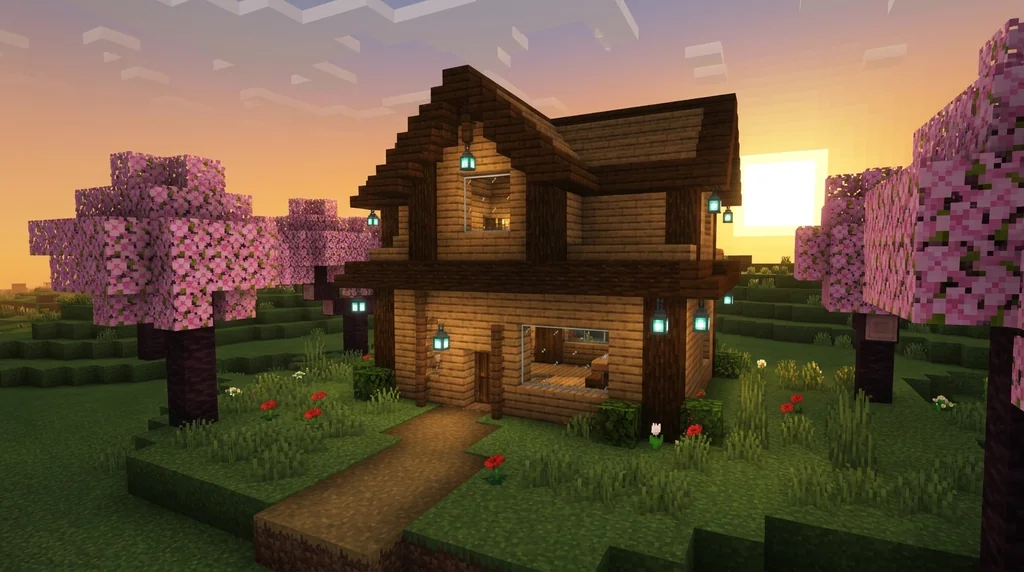
This layer decides whether your house looks intentional.
Contrast, Not Similarity
The secondary layer is everything that frames your dominant block: roof, trim, window frames, pillar corners. This is where the build actually gets its character. It should come from a different color family than the 60% block — not just a slightly lighter version of it. Warm oak paired with cool dark prismarine reads instantly; warm oak paired with birch reads softer and can look same-y without careful shaping.
For timber-frame houses, stripped spruce logs make an excellent 30% layer because they add contrast while staying in the wood family. For interiors, 7 Best Interior Block Palettes for Cozy Minecraft Homes (2026) has loadouts that put the 30% on beams, floors, and fireplaces.
One thing that catches people off guard: lighting. Light levels range from 0 to 15, and every overhang or tree canopy casts shadows that can change how your 60% and 30% blocks read (via Minecraft Wiki). So don't judge a 30% choice only at noon; look at it under an overhang too.
How to Pick a 10% Accent Block That Pops
The 10% accent block is the smallest but loudest part of your palette, so use it to draw the eye to doors, windows, and rooflines.
Your accent layer is all about placement. Doors, window frames, lanterns, a strip of glazed terracotta above the entrance — those are your accents. Keep it to one or two block types. In a survival build, sea lanterns, candles, or a dyed wool are classic choices. Wool also comes in 16 colors, matching the dye set exactly, so you can create a full accent range without needing mods (via Minecraft Wiki). If you need a pop of color to make a roofline legible, the 7 Best Roofing Block Palettes for Minecraft Houses (2026) guide has accent combos that stay sharp from a distance.
Pro Tip: Place your accent blocks only at entry points and structural breaks — corners, rooflines, and window ledges. If you scatter accents across a whole wall, it stops being an accent and becomes noise.
How to Apply the 60-30-10 Rule Fast
You can apply the 60-30-10 rule in about ten minutes by using scaffolding or fill commands to test ratios before you commit to a full build.
Build a flat 10×10 test wall. Fill 60% of the surface with your dominant block, 30% with your secondary block, and 10% with your accent block. Use fill commands in creative mode if you're on Java Edition, or just copy-paste a section with a structure block. Then walk back 30 blocks and look at the wall as a thumbnail, not a texture. If nothing pops, increase contrast or darken the secondary block. If it feels busy, shrink the accent layer.
A single stack of 64 blocks covers exactly an 8×8 surface, making it easy to test your 60% ratio in creative mode before you commit (via Minecraft Wiki). That means one inventory slot of your dominant block is enough to check the most important part of the palette.
Note: Test at night too. Put a few lanterns against your 60% wall and see whether the warm or cool tone still matches your accent.
How to Fix Common 60-30-10 Palette Mistakes
Nearly every unbalanced Minecraft build I see in survival servers makes one of three mistakes: too many accents, a too-dark 30%, or a dominant block that reads as a solid smear.
The good news is that every one of these mistakes has an easy fix.
The Three Fixes
- You added a second accent color. Pick one. If you love cyan and orange, let one be the accent and the other live in the 30% layer.
- Your 30% is too close to your 60%. If your secondary block is just a darker version of the main block, the build reads as flat. Go for a hue shift or a material change — stone under wood, dark wood under light stone.
- Your dominant block steals the show. If you use a noisy block like cracked stone bricks across the entire facade, the eye has nowhere to rest. Keep noisy blocks to the 10% accent layer.
Warning: Don't add a second accent block just because you like it. Your 10% slot can hold one accent family; adding a fourth block family turns balance into noise, and it's the fastest way to make a build feel unplanned.
If you're comfortable with three blocks and want to push further, the 7 Best Tetradic Block Palettes for Minecraft Builds (2026) guide covers how to add a fourth color without breaking the balance.
On Gaia Legends: In our weekly build showcase, over 60% of the winning bases use a clear 60-30-10 split once we review their submitted block lists, and it shows immediately in the screenshots.
How to Put This Into Practice on Gaia Legends
Gaia Legends is a survival SMP where we love seeing players push themselves creatively. When you apply the 60-30-10 rule to your base, you're also giving your build a signature — and that's exactly what our weekly build showcase looks for. Every week, community members submit screenshots of their bases, and the ones that win tend to have a clear dominant block, a confident secondary block, and a tiny accent that tells you where the entrance is. Submit your finished base through the showcase channel on our Discord for a chance to get featured and earn in-game rewards. You can also use dynamic warps to tour other players' bases and reverse-engineer their 60-30-10 palettes in person, which is one of the fastest ways to level up as a builder. Gaia Legends is free to join, non-pay-to-win, and supports Java + Bedrock crossplay. Join at gaialegends.pro and start your legend today.
Conclusion
The 60-30-10 rule is the simplest reliable way to make your Minecraft builds feel balanced, intentional, and easy to read.
Next time you start a base, try it:
- Pick a dominant 60% block first; it sets the mood.
- Choose a 30% secondary block that contrasts rather than matches.
- Spend your 10% accent on entry points, windows, and rooflines.
Build a test wall before you build the full house. Count blocks if you have to. You'll be surprised how quickly the rule turns “it's okay” into “that looks great.” Whether you're building on an SMP or a single-player world, the ratio works everywhere — including your next home on Gaia Legends.
On Gaia Legends: On our recently-launched server, this 60-30-10 rule minecraft builds has quickly become one of the most-used setups in our community showcase.
Recommended
- How to Unlock Set Bonuses on Custom Items in Minecraft 2026
- What is the Michael Reeves Minecraft Modpack? (2026 Guide)
- How to Use the Minecraft Trading Wiki to Maximize Villager Deals in 2026
- How to Master the Gaia Legends Fishing Minigame in 2026: Tips & Tricks
Ready to play? Join Gaia Legends today — no pay-to-win, Java + Bedrock crossplay.
- Java:
join.gaialegends.pro - Bedrock:
join.gaialegends.pro— Port19132
Sources
- Minecraft has 16 base dye colors, which means you can build a full color wheel when planning your 60-30-10 palette (via [Minecraft Wiki](https://minecraft.wiki/w/Dye)). — Minecraft Wiki
- There are 16 types of colored terracotta plus the base block, giving builders 17 terracotta options for warm 60% and 30% layers (via [Minecraft Wiki](https://minecraft.wiki/w/Terracotta)). — Minecraft Wiki
- Wool also comes in 16 colors, matching the dye set exactly, so you can create a full accent range without needing mods (via [Minecraft Wiki](https://minecraft.wiki/w/Wool)). — Minecraft Wiki
- Light levels range from 0 to 15, and every overhang or tree canopy casts shadows that can change how your 60% and 30% blocks read (via [Minecraft Wiki](https://minecraft.wiki/w/Light)). — Minecraft Wiki
- A single stack of 64 blocks covers exactly an 8×8 surface, making it easy to test your 60% ratio in creative mode before you commit (via [Minecraft Wiki](https://minecraft.wiki/w/Item)). — Minecraft Wiki
Frequently Asked Questions
What is the 60-30-10 rule for Minecraft builds?
The 60-30-10 rule for Minecraft builds says to use one dominant block for 60% of the build, a contrasting secondary block for 30%, and a small accent block for the remaining 10%. Pick the wall material first, add a trim or roof block second, then place accent details like lanterns or glazed terracotta around entrances and windows.
How do I choose the 60% block?
Choose the block that covers the largest surface — usually the walls. It should be relatively low-contrast and easy to read at scale, like oak planks, stone bricks, or smooth sandstone. Avoid noisy textures as the dominant layer; save those for accents. If you're building in a specific biome, match the 60% block to the local stone or wood so it feels natural.
What counts as the 30% secondary block?
The secondary block is everything that frames the build: roofs, window frames, pillars, and trim. It should come from a different color family than the 60% block to create contrast. For example, pair warm oak planks with cool dark prismarine, or stone bricks with stripped spruce logs. If the 30% is too similar, the build looks flat.
Can I use more than one accent block?
Stick to one accent family for the cleanest result. You can use different blocks from the same color story, like sea lanterns and candles, but adding a second strong color usually makes the build feel busy. If you really want a second accent, let it fill a tiny area, like two blocks above the door, rather than scattered across the facade.
Why does my Minecraft build look flat even with the right blocks?
The most common cause is choosing a 30% block that is too close in color to the 60% block. Without contrast, the eye sees one mass instead of a composition. Another cause is poor lighting. Test your palette under a shaded overhang and at night before you judge it, because shadows change how blocks read.
How long does it take to apply the 60-30-10 rule?
Once you know your palette, testing it takes about ten minutes. Build a 10×10 wall, fill 60% with the dominant block, 30% with the secondary block, and 10% with the accent. View it from 30 blocks away, then test at night. Adjust the blocks or the ratio until the composition reads clearly, then transfer the design to your base.
Discussion
Join the Discussion
Start at Seeker — climb to Legend through the ranks
Every comment earns you progress. Reach new ranks to unlock mystery box rewards on the Gaia Legends server. The more you share, the higher you climb.
No comments yet
Be the first to share your thoughts and earn your Seeker rank.