How to Build a Copper Golem Baby Mob Command Center (2026 Guide)
Filed under Minecraft Gameplay Remix · How we create content
TL;DR
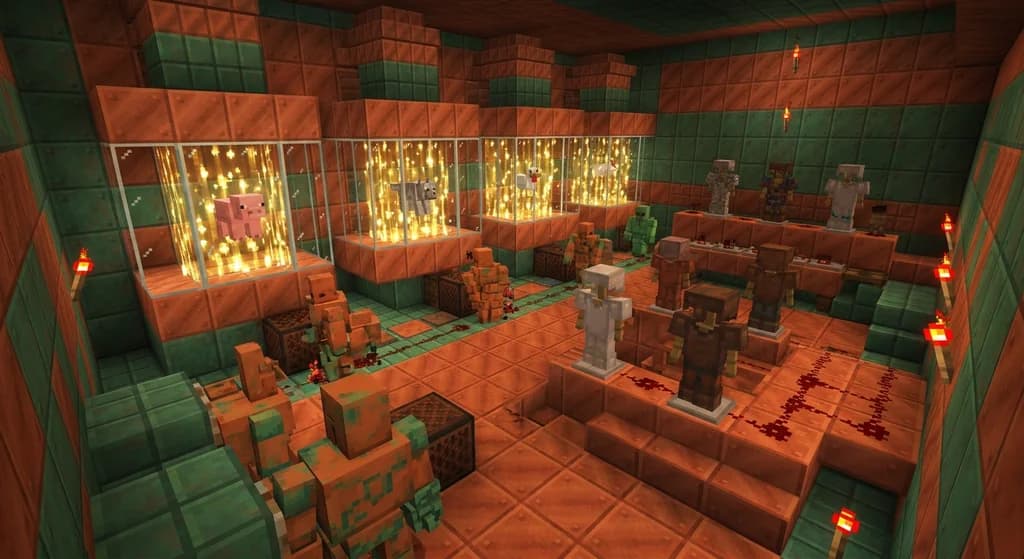
Bored in Minecraft? Here's how to build a Copper Golem Baby Mob Command Center — a technical masterpiece that combines Golden Dandelion age-locking to create permanent micro-familiars, oxidized Copper Block trumpet note sequences for automated signaling, and Mannequin NPC logic gates for multi-stage command routing. After reading, you'll be able to design and run a fully automated 5-stage baby mob control system.
Table of Contents
- What Is the Copper Golem Baby Mob Command Center?
- How to Set Up Your Command Center
- Best 5 Strategies for the Command Center Challenge
- Why This Concept Works
- How to Put This Into Practice on Gaia Legends
- Conclusion
- FAQ
What Is the Copper Golem Baby Mob Command Center?
You know the feeling. You've built the mega-base, tamed every mob, and your storage system is so organized it practically runs itself. And then — nothing. The world goes quiet. The game stops pulling you forward.
Here's the cure: the Copper Golem Baby Mob Command Center.
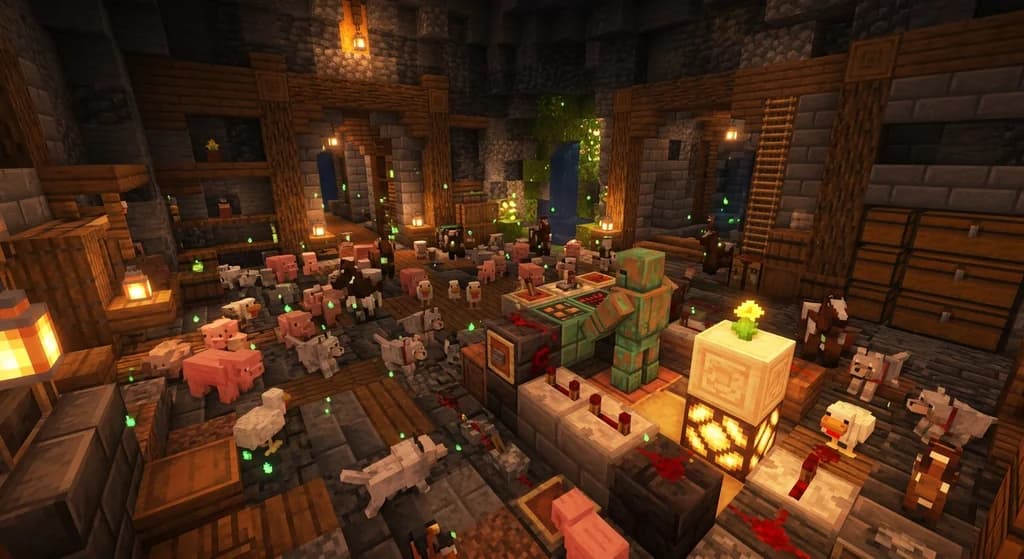
The Copper Golem Baby Mob Command Center is a multi-stage automated build that uses age-locked baby mobs as permanent "micro-familiars," Copper Golems as button-pressing signal generators, oxidized trumpet note blocks as tonal command outputs, and Mannequin NPCs as programmable logic gates — all wired together into a living, clunking, trumpet-blaring control room that you design, tune, and expand.
This is one of the most layered minecraft challenge ideas to emerge from the 2025–2026 update cycle. It pulls from three distinct update drops:
- The Copper Age (1.21.9): Copper Golems, Copper Chests, and Mannequins
- Tiny Takeover (26.1): Golden Dandelion age-locking and new baby mob sounds
- The trumpet mechanic: Note Blocks placed on Copper Blocks now produce a trumpet sound — and the oxidation level of the Copper Block changes the trumpet's tone, giving you 4 distinct pitches across unoxidized, exposed, weathered, and oxidized copper
That last detail is the secret ingredient. Four oxidation stages, four distinct trumpet tones, five command center stages. The math is delicious.
The Core Loop
The gameplay loop works like this:
- Age-lock baby mobs with Golden Dandelions to create permanent micro-familiars stationed at each command post
- Place Copper Golems near Note Blocks set on Copper Blocks at different oxidation stages
- Golems randomly press the Note Blocks, triggering trumpet sequences
- Mannequins positioned as logic gate sentinels visually signal which "command" has been issued
- You — or your teammates — respond to the trumpet signal by completing the corresponding objective before the next sequence fires
It's part automation showcase, part rhythm puzzle, part mob management sim. And it looks absolutely incredible.
How to Set Up Your Command Center
Materials Checklist
Before you lay a single block, gather everything you need. Missing one item mid-build is the fastest way to lose momentum.
Copper & Redstone:
- At least 20 Copper Blocks (a mix of all 4 oxidation stages — unoxidized, exposed, weathered, oxidized)
- 5 Note Blocks
- Redstone dust, repeaters, and comparators for signal routing
- 5 Copper Chests for stage-specific loot storage
- Copper Golem Statue Blocks (to place your Golems)
Mob & Flora:
- At least 5 baby mobs — one per command stage (recommended: Baby Pig, Baby Wolf, Baby Chicken, Baby Horse, Baby Cat)
- At least 5 Golden Dandelions (one per baby mob to age-lock them)
- Name tags for each baby familiar (name them after their command stage: "ALPHA," "BRAVO," "CHARLIE," "DELTA," "ECHO")
Mannequins & Decoration:
- 5 Mannequins dressed in color-coded armor to represent each logic gate state
- Banners, item frames, and copper decorations for visual clarity
World & Server Settings
- Play on Java Edition 26.1 or later — you need both the Copper Age features and the Tiny Takeover drop
- Enable mob griefing if you want Golems to interact with their environment freely
- For multiplayer, designate one player as the Command Operator who monitors trumpet signals; others are Field Agents who execute orders
Building the 5-Stage Layout
Think of your Command Center as a pentagon. Each of the 5 command stages occupies one point of the pentagon, with a central hub where your Copper Chests and primary redstone routing live.
Stage layout (one per point):
- Stage 1 — ALPHA Post: Unoxidized Copper Block + Note Block (bright, clean trumpet tone). Baby Pig familiar. Mannequin in white armor.
- Stage 2 — BRAVO Post: Exposed Copper Block + Note Block (slightly warmer tone). Baby Wolf familiar. Mannequin in yellow armor.
- Stage 3 — CHARLIE Post: Weathered Copper Block + Note Block (mellow, aged tone). Baby Chicken familiar. Mannequin in green armor.
- Stage 4 — DELTA Post: Oxidized Copper Block + Note Block (deep, resonant tone). Baby Horse familiar. Mannequin in cyan armor.
- Stage 5 — ECHO Post: A combination block — use an unoxidized Copper Block waxed at a specific stage for a "locked" tone. Baby Cat familiar. Mannequin in purple armor.
Pro Tip: Age-lock each baby familiar before you name-tag them. Interacting with a baby mob while holding a Golden Dandelion stops aging immediately — you'll see green particles drifting downward as confirmation. Do this step early; a baby that grows up mid-build breaks the whole aesthetic.
Wiring the Trumpet Sequence
Each Copper Golem is placed via its Copper Golem Statue Block adjacent to its stage's Note Block. Golems will randomly press the Note Block, firing the trumpet tone. Your redstone routing should:
- Run a comparator output from each Note Block into a central signal bus
- Use repeaters to set the signal delay (longer delay = more time for Field Agents to respond)
- Route the final signal into a Copper Chest at the hub — this is your "command log," visually filling as stages are triggered
Note: Copper Golems press buttons and Note Blocks at random intervals — you cannot fully predict when a stage fires. This unpredictability is the entire point. Design your objectives so they're completable within a reasonable window, not instant.
Best 5 Strategies for the Command Center Challenge
Difficulty Tiers
| Tier | Mode | Oxidation Rule | Response Window | Scoring |
|---|---|---|---|---|
| 🟢 Casual | Solo, Creative | All blocks pre-oxidized | Unlimited | Completion only |
| 🟡 Standard | Solo/Duo, Survival | Natural oxidation over time | 5 minutes per signal | Points per stage |
| 🔴 Hardcore | Multiplayer, Survival | No waxing allowed | 90 seconds per signal | Penalty for missed signals |
| ⚫ Insane | Multiplayer, Hardcore | Random waxing/scraping mid-run | 30 seconds per signal | Elimination on 3 misses |
Strategy 1 — The Oxidation Timer Challenge
Don't pre-oxidize your Copper Blocks. Start with all 5 stages using fresh, unoxidized copper and let them weather naturally over your play sessions. As the blocks oxidize, the trumpet tones shift — your command center literally evolves over weeks of gameplay. Each new oxidation stage unlocks a new command type. This is arguably the most satisfying long-game version of the build.
Strategy 2 — The Mannequin Logic Gate Puzzle
Dress your Mannequins in specific armor combinations that encode rules. For example: a Mannequin in iron helmet + leather chest at the CHARLIE post means "only respond to this signal if ALPHA has already fired today." You're essentially programming conditional logic using armor loadouts as visual code. It's the most creative use of Mannequins outside of the Mannequin RPG builds we've covered elsewhere.
Strategy 3 — The Baby Mob Sound Cue System
The Tiny Takeover update added distinct new baby sounds for Wolf, Cat, Pig, Horse, and Chicken. Use these sounds as secondary signal confirmation. If you hear a baby pig squeal and the ALPHA trumpet fires, that's a "double-confirmed" command — worth double points in your scoring system. Train yourself to distinguish the 5 unique baby mob sound variants by ear. It adds a genuine audio-skill dimension to the challenge.
Strategy 4 — The Copper Chest Loot Routing Challenge
Each Copper Chest at the hub stores stage-specific resources. When a trumpet fires, the Field Agent must retrieve the correct resource from the correct Copper Chest and deliver it to the corresponding stage post before time expires. The twist: Copper Chests oxidize too, making them harder to visually distinguish over time. Color-code with item frames above each chest early, or you'll be frantically guessing which oxidized chest is which under pressure.
Pro Tip: Wax your Copper Chests at specific oxidation stages to create a permanent visual "tier" system. An exposed-copper chest always holds Tier 2 resources. An oxidized chest always holds Tier 4. This turns oxidation from a nuisance into a UI feature.
Strategy 5 — The 5-Stage Oxidized Trumpet Sequence Run
This is the flagship challenge — and the one that ties directly into Gaia Legends' progression system. The goal: trigger all 5 command stages in sequence (ALPHA through ECHO) within a single in-game day, with each stage firing in oxidation order from unoxidized to fully oxidized. This requires careful Golem placement, precise redstone timing, and a team that knows their roles cold.
Why This Concept Works
The Mechanic Synergy
Three updates, three mechanic families, one coherent system. That's rare. Most challenge builds feel like they're forcing mechanics together. This one doesn't — because each mechanic fills a distinct role:
- Golden Dandelion solves the "mobs keep growing up" problem permanently, letting you design around baby mobs as static, reliable set dressing
- Copper Golem provides organic, non-player-controlled signal generation — the randomness is a feature, not a bug
- Oxidized trumpet tones give you 4 distinct audio states from a single instrument type, enabling tonal encoding without any mods or command blocks
- Mannequins provide visual state memory — they hold their pose and armor loadout indefinitely, functioning as a physical scoreboard
What Makes It Replayable
The natural oxidation mechanic means your build literally changes over time. A Command Center you build today will sound and look different in three weeks. Copper Blocks move through 4 oxidation stages unpredictably (unless waxed), which means the trumpet tones at each post will shift — creating emergent difficulty scaling without any manual intervention.
Add in the random Golem button-pressing behavior, and no two play sessions produce the same sequence of trumpet signals. The Command Center generates its own content.
How Recent Updates Make This Possible
Before Java Edition 1.21.9, none of this existed. Copper Golems, Mannequins, and Copper Chests were all introduced in the Copper Age drop. The trumpet note block instrument — with its oxidation-dependent tone variation — was added in the same update. Then Java Edition 26.1 layered in the Golden Dandelion and new baby mob sounds, completing the toolkit.
This is a build that simply could not have existed 12 months ago. That freshness is part of the appeal — you're playing on the frontier of what Minecraft's mechanics can do.
Note: The "Removed Baby Herobrine" line in the 26.1 patch notes is a classic Mojang joke. Don't let it confuse your changelog reading — there's no Herobrine mechanic to worry about here.
How to Put This Into Practice on Gaia Legends
Everything described above works in vanilla Java Edition — but if you want to take the Copper Golem Baby Mob Command Center to its absolute ceiling, Gaia Legends is where you do it.
Gaia runs a custom progression system built around the exact mechanics in this guide. Players who successfully automate a 5-stage oxidized trumpet sequence using Copper Golems — triggering all five stages in oxidation order within a single in-game day — unlock an exclusive server rank that can't be purchased or grinded any other way. It's a pure skill and creativity gate.
Beyond the rank unlock, Gaia's community of technical builders means you'll find collaborators, inspiration, and friendly competition the moment you log in. Share your Command Center layout in the build showcase channel and watch other engineers iterate on your design in real time.
Gaia Legends is free to join, non-pay-to-win, and supports Java + Bedrock crossplay — so your whole crew can participate regardless of platform.
Join at gaialegends.pro and remix your Minecraft experience today.
Conclusion
The Copper Golem Baby Mob Command Center is proof that Minecraft's 2025–2026 update cycle didn't just add new blocks — it added new systems that reward players who think like game designers.
Here are your three takeaways:
- Age-lock your baby mobs first. Golden Dandelion stasis is the foundation of the entire build — without permanent micro-familiars, the Command Center loses its identity.
- Embrace the randomness. Copper Golem button-pressing is unpredictable by design. Build your objectives around that unpredictability instead of fighting it.
- Let oxidation do the work. Don't pre-oxidize everything. The slow tonal shift of your trumpet stages over real-world weeks is the best long-term progression system in the game right now.
Try the 5-stage oxidized trumpet sequence tonight and share your results. Tag your screenshots with #CopperCommandCenter and let's see what you build.
FAQ
What are the best minecraft challenge ideas using Copper Golems in 2026?
The best minecraft challenge ideas using Copper Golems in 2026 revolve around their random button-pressing behavior as an unpredictable signal generator. The Copper Golem Baby Mob Command Center is the most layered option, but you can also build Golem-triggered trap mazes, oxidation-race timers, or trumpet-note memory games. The key is designing challenges around the Golem's randomness rather than trying to control it.
What do you do when bored in Minecraft and you've already built everything?
When you've built everything in vanilla survival, the cure is systemic gameplay — builds that generate their own content. The Command Center does exactly this: Copper Golems fire signals randomly, oxidation shifts your trumpet tones over time, and baby mob sound cues add an audio-skill layer. You're not just building a thing; you're building a machine that plays with you.
How does the Golden Dandelion age-locking mechanic work?
Interacting with a baby mob while holding a Golden Dandelion permanently stops that mob from aging into an adult. You'll see green particles drifting downward as visual confirmation. Interacting again with another Golden Dandelion reverses the effect and lets the mob age normally. This was added in Java Edition 26.1 (the Tiny Takeover drop) and is the key mechanic for creating permanent baby mob familiars in your Command Center.
How many trumpet tones does the oxidized Copper Block note block produce?
Placing a Note Block on a Copper Block produces a trumpet sound, and the oxidation level of the Copper Block changes the trumpet's tone — giving you 4 distinct pitches across unoxidized, exposed, weathered, and oxidized copper. This means you can encode 4 different "commands" using tone alone, which is the foundation of the 5-stage Command Center's audio signaling system.
Do I need mods or command blocks to build the Command Center?
No mods or command blocks are required. Everything in the Copper Golem Baby Mob Command Center uses vanilla mechanics from Java Edition 1.21.9 (Copper Age) and Java Edition 26.1 (Tiny Takeover). You'll need standard redstone components — comparators, repeaters, and dust — but nothing beyond what's craftable in survival mode. The Mannequin logic gate system is purely visual and uses no command block logic.
Can I build the Copper Golem Command Center in multiplayer?
Absolutely — multiplayer is where this build shines brightest. Assign one player as the Command Operator who monitors trumpet signals from the central hub, and the rest as Field Agents who execute the corresponding objectives when a stage fires. The 90-second response window in Hardcore tier is nearly impossible solo but very achievable with a coordinated two- or three-person team. On Gaia Legends, the 5-stage sequence run is designed as a multiplayer challenge.
Recommended
Frequently Asked Questions
What are the best minecraft challenge ideas using Copper Golems in 2026?
The best minecraft challenge ideas using Copper Golems in 2026 revolve around their random button-pressing behavior as an unpredictable signal generator. The Copper Golem Baby Mob Command Center is the most layered option, but you can also build Golem-triggered trap mazes, oxidation-race timers, or trumpet-note memory games. The key is designing challenges around the Golem's randomness rather than trying to control it.
What do you do when bored in Minecraft and you've already built everything?
When you've built everything in vanilla survival, the cure is systemic gameplay — builds that generate their own content. The Command Center does exactly this: Copper Golems fire signals randomly, oxidation shifts your trumpet tones over time, and baby mob sound cues add an audio-skill layer. You're not just building a thing; you're building a machine that plays with you indefinitely.
How does the Golden Dandelion age-locking mechanic work?
Interacting with a baby mob while holding a Golden Dandelion permanently stops that mob from aging into an adult. You'll see green particles drifting downward as visual confirmation. Interacting again with another Golden Dandelion reverses the effect and lets the mob age normally. This was added in Java Edition 26.1 (the Tiny Takeover drop) and is the key mechanic for creating permanent baby mob familiars in your Command Center.
How many trumpet tones does the oxidized Copper Block note block produce?
Placing a Note Block on a Copper Block produces a trumpet sound, and the oxidation level of the Copper Block changes the trumpet's tone — giving you 4 distinct pitches across unoxidized, exposed, weathered, and oxidized copper. This means you can encode 4 different commands using tone alone, which is the foundation of the 5-stage Command Center's audio signaling system.
Do I need mods or command blocks to build the Copper Golem Command Center?
No mods or command blocks are required. Everything in the Copper Golem Baby Mob Command Center uses vanilla mechanics from Java Edition 1.21.9 (Copper Age) and Java Edition 26.1 (Tiny Takeover). You'll need standard redstone components — comparators, repeaters, and dust — but nothing beyond what's craftable in survival mode. The Mannequin logic gate system is purely visual and uses no command block logic.
Can I build the Copper Golem Command Center in multiplayer?
Absolutely — multiplayer is where this build shines brightest. Assign one player as the Command Operator who monitors trumpet signals from the central hub, and the rest as Field Agents who execute corresponding objectives when a stage fires. The 90-second response window in Hardcore tier is nearly impossible solo but very achievable with a coordinated two- or three-person team. On Gaia Legends, the 5-stage sequence run is designed as a multiplayer challenge.
Related guides
How to Beat the Tiny Trumpet Stealth Minecraft Challenge (2026)
Master the Tiny Trumpet Stealth minecraft challenge ideas using Golden Dandelion age-locking, oxidation trumpet notes, and Copper Golem detection. Full 2026 guide.
Build an Eternal Baby Mob Menagerie With Copper Golems 2026
Bored in Minecraft? Build an Eternal Baby Mob Menagerie using Golden Dandelion age-locking, Copper Golem automation, and oxidation trumpet signals. New challenge for 2026.
How to Create an Automated Baby Mob Living Orchestra: 2026 Guide
Discover the best minecraft challenge ideas 2026: build an Automated Baby Mob Living Orchestra using Golden Dandelion age-locking, Copper Golem redstone, and trumpet note blocks.
How to Survive the Eternal Baby Mob Challenge Map (2026 Guide)
Master the Eternal Baby Mob Challenge with golden dandelion age-locking, copper golem automation, and hardcore survival rules. The freshest minecraft challenge ideas of 2026.
Have a question or another approach?
Compare notes with other readers. Include your edition and version when discussing mechanics.