How to Establish a Minecraft Player Government: Social Guide 2026
Filed under Minecraft Community & Social Play · How we create content
Key Takeaways
| Point | Details |
|---|---|
| Pick your government type first | Democracy, council republic, and constitutional monarchy each suit different server sizes and playstyles. |
| Write a constitution early | A short 5–10 rule document prevents 90% of future disputes before they start. |
| Hold elections on a schedule | Bi-weekly or monthly election cycles keep the government feeling alive and give new players a path to power. |
| Use in-game mechanics as law enforcement | Claim plugins, chest locks, and trade signs make rules self-enforcing without needing an admin online 24/7. |
| Start small and expand | Launch with one governing body and add branches (judiciary, treasury) only after the core loop is stable. |
| Tie government to server events | Linking votes to real in-game consequences — like choosing the next community build project — skyrockets engagement. |
Table of Contents
- What Is a Minecraft Player Government?
- What Are the Best Government Types for an SMP?
- How to Write a Minecraft Server Constitution
- How to Run Elections and Assign Roles
- Why Do Player Governments Fail — and How to Prevent It?
- Tips for Enforcing Server Law Ideas Without an Admin Online
- How to Put This Into Practice on Gaia Legends
- Conclusion
- Frequently Asked Questions
- Recommended
Most Minecraft servers die not from griefing, but from boredom. The players who stick around for months aren't just building — they're governing. A well-designed Minecraft player government turns a flat sandbox into a living civilization where every vote, law, and election keeps players logging back in. This guide walks you through every step: picking a government type, writing a constitution, running fair elections, and enforcing server law ideas with in-game mechanics. No admin babysitting required.
What Is a Minecraft Player Government?
A Minecraft player government is a community-agreed system of roles, rules, and decision-making processes that gives players genuine authority over how a server or town operates.
The keyword here is genuine. A government that exists only on paper — where admins override every decision — isn't a government, it's theater. Real player governments tie votes to real in-game consequences: which biome gets colonized next, how the community treasury is spent, who gets banned for breaking server law.
This concept overlaps heavily with Minecraft roleplay etiquette rules because both require players to agree on shared norms before the fun can start. The difference is that a government formalizes those norms into a structure that outlasts any individual player.
Note: Player governments work best on servers with 10+ active players. Fewer than that, and a simple rulebook is usually enough.
What Are the Best Government Types for an SMP?
The three most effective Minecraft government types are direct democracy, council republic, and constitutional monarchy — each scaling differently based on server size and how much drama you want.
Here's a quick comparison to help you choose:
| Government Type | Best For | Decision Speed | Drama Risk |
|---|---|---|---|
| Direct Democracy | Small servers (10–25 players) | Slow | Low |
| Council Republic | Mid-size servers (25–60 players) | Medium | Medium |
| Constitutional Monarchy | Large or RP servers (60+) | Fast | High |
| Faction Oligarchy | PvP/faction servers | Very Fast | Very High |
Direct Democracy
Every player votes on every major decision. It's slow but deeply fair. Use a Discord poll or an in-game sign vote. This model works beautifully when paired with community event planning — players vote on the next event type and feel ownership over the outcome.
Council Republic
Players elect 3–7 representatives who vote on their behalf. This is the sweet spot for most SMPs. It's fast enough to make decisions, representative enough to feel legitimate, and structured enough to survive player turnover.
Constitutional Monarchy
One elected or appointed leader holds executive power, checked by a council or written constitution. Works well in heavy roleplay environments where a single narrative voice adds immersion. Pair it with a strong server lore document to give the monarchy in-world justification.
How to Write a Minecraft Server Constitution
A Minecraft server constitution is a short written document — ideally 5 to 10 rules — that defines what the government can and cannot do, preventing disputes before they start.
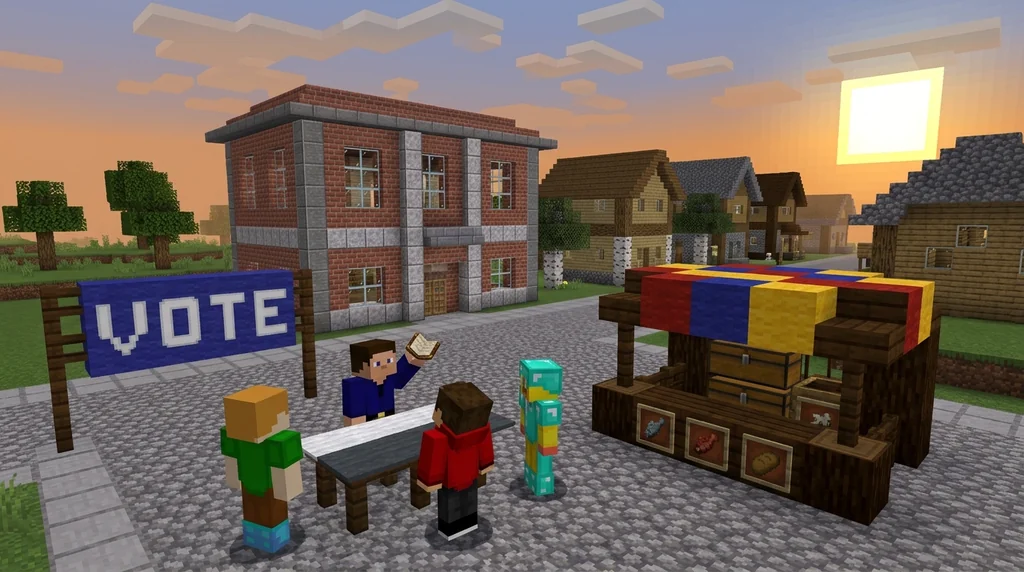
Keep it simple. Long constitutions get ignored. Here's a proven structure:
- Preamble — One sentence stating the server's purpose and values.
- Citizen Rights — What every player is guaranteed (claim protection, fair trial before ban, etc.).
- Government Structure — Which roles exist and how they're filled.
- Legislative Process — How laws are proposed and passed (e.g., majority vote of council).
- Judicial Process — How disputes are resolved and by whom.
- Amendment Process — How the constitution itself can be changed (require a supermajority).
Pro Tip: Post your constitution in a read-only Discord channel AND inside the game as a written book in the town hall's lectern. Players who find it in-game feel the immersion immediately.
Store the original in a locked chest in your town hall — a structure that doubles as a social hub. For building inspiration, check out this guide on how to build a Minecraft community house to design a space that feels like a real seat of government.
Building a government from scratch shares a lot of DNA with building a thriving Minecraft guild — both require clear roles, a recruitment pipeline, and a reason for people to show up every week.
How to Run Elections and Assign Roles
Fair elections on a fixed schedule — every two to four weeks — are the single most important habit that keeps a Minecraft player government feeling alive and legitimate.
Setting Up an Election
- Announce the election 3–5 days in advance in Discord and in-game via signs.
- Open nominations — any citizen can run by posting their platform in a #nominations channel.
- Run the vote — Discord polls work well; for in-game voting, use a sign-and-book system or a plugin like EssentialsX's
/voteequivalent. - Certify results — a neutral admin or "election commissioner" role confirms the outcome.
- Inaugurate the winner — hold a short in-game ceremony. It sounds silly. It works.
Key Government Roles to Assign
- Mayor / President — Executive decisions, breaks ties
- Council Members — Vote on legislation, represent districts or guilds
- Treasurer — Manages the community chest or shop fund
- Sheriff / Judge — Handles disputes and enforces server law
- Town Crier — Announces decisions to the server (great for a newer player)
Warning: Never let one player hold two major roles simultaneously. Role stacking is the fastest way to kill trust in your government.
Why Do Player Governments Fail — and How to Prevent It?
Most Minecraft player governments collapse within four weeks because they lack three things: real consequences for decisions, a succession plan for when leaders quit, and a low barrier for new players to participate.
The research on player retention in online games consistently shows that social structures and meaningful choices are the primary drivers of long-term engagement (via Minecraft.net). A government that makes real decisions — where to build the next road, how to spend the diamond treasury, whether to declare war on a rival faction — keeps players invested far longer than one that's purely ceremonial.
The Three Failure Modes
- The Dictator Problem — One admin overrides every vote. Solution: write admin powers explicitly into the constitution and limit them.
- The Ghost Town Problem — Leaders quit and no one knows what to do. Solution: every role needs a documented deputy.
- The Complexity Problem — Too many branches, too many rules, new players can't figure out how to participate. Solution: start with one governing body and expand slowly.
Tips for Enforcing Server Law Ideas Without an Admin Online
The best server law ideas are self-enforcing: use claim plugins, locked containers, and trade signs to make the rules physically built into the world rather than dependent on a moderator watching.
Here's how to translate common laws into in-game mechanics:
- Property law → Use a land-claiming plugin (GriefPrevention, Towny) so only the owner can build in their claim. Minecraft's Towny plugin supports over 200 configurable town permissions (via Towny GitHub).
- Trade law → Use chest shops or villager trades with fixed prices so no player can price-gouge.
- Tax law → Designate a community chest in the town hall; citizens deposit a set amount weekly as "taxes" on the honor system, enforced by the Treasurer role.
- Border law → Use WorldGuard regions to define town limits and prevent building outside them.
- Criminal law → For serious offenses, document evidence in screenshots and hold a formal council trial before any punishment.
Pro Tip: Announce every law change in-game via a sign in the town square AND in Discord. Laws that players don't know about are laws that create resentment, not order.
Running a safe, well-governed server also means thinking about access controls from day one — the guide on how to play Minecraft multiplayer with friends safely covers the technical side of keeping your government's infrastructure secure.
For servers that want to grow their governed community into a full guild ecosystem, building a thriving Minecraft community server is the natural next read after this one.
How to Put This Into Practice on Gaia Legends
Gaia Legends is built specifically for the kind of community-driven play that makes player governments thrive. The server provides infrastructure for players to vote on server-wide events and changes — meaning your in-game government's decisions can have real, server-sanctioned consequences, not just social ones.
Three features make Gaia Legends the ideal sandbox for a player government:
- Community vote integration — Players can participate in structured polls that influence server-wide events, giving your council's decisions actual weight.
- Java + Bedrock crossplay — Your citizens can join from any platform, which means a larger, more diverse electorate and no one gets locked out of a vote because of their device.
- Non-pay-to-win economy — Every player starts on equal footing, so your government's treasury and trade laws aren't undermined by someone buying their way to dominance.
Gaia Legends is free to join, non-pay-to-win, and supports Java + Bedrock crossplay. Join at gaialegends.pro and start your legend today.
Conclusion
Building a Minecraft player government is one of the highest-leverage things you can do for your server's long-term health. Here are the three things to walk away with:
- Choose the right structure for your size — direct democracy for small servers, council republic for mid-size, constitutional monarchy for large or heavy-RP environments.
- Write a short constitution before you do anything else — 5–10 rules, posted in-game and in Discord, prevents most disputes before they happen.
- Make laws self-enforcing — claim plugins, locked chests, and trade signs do more work than any moderator can.
Start with one governing body, run your first election this week, and let the civilization grow from there. The blocks are already there. Now give your players a reason to care about them.
Ready to play? Join Gaia Legends today — no pay-to-win, Java + Bedrock crossplay.
- Java:
join.gaialegends.pro - Bedrock:
join.gaialegends.pro— Port19132
Further reading
These references were recorded with the article; specific claims have not been matched to source excerpts.
Frequently Asked Questions
What is a Minecraft player government and how does it work?
A Minecraft player government is a community-agreed system of roles, rules, and voting processes that gives players real authority over how a server or town operates. It works by assigning roles like mayor, council members, and treasurer, writing a short constitution, and holding regular elections. Decisions made by the government — like where to build next or how to spend community resources — carry real in-game consequences, which is what makes them meaningful.
What are the best server law ideas for a Minecraft SMP?
The most effective server law ideas are ones that can be enforced by in-game mechanics rather than moderator oversight. Top examples include: land claim laws enforced by a plugin like Towny or GriefPrevention, trade price laws enforced by chest shops, border laws enforced by WorldGuard regions, and tax laws using a community chest. For criminal offenses, document evidence and hold a formal council trial before issuing any punishment.
How do you run a Minecraft player democracy on a small server?
For small servers (10–25 players), direct democracy works best. Announce a vote 3–5 days in advance, open nominations or proposals in Discord, run the poll (Discord polls or in-game sign voting both work), and have a neutral player certify the results. Hold votes on a fixed schedule — every two to four weeks — so the government feels alive. Tie each vote to a real in-game outcome to keep participation high.
How do you prevent a Minecraft government from collapsing?
The three most common failure modes are: one admin overriding every vote, leaders quitting with no succession plan, and rules being too complex for new players to understand. Prevent these by writing admin power limits into your constitution, assigning a documented deputy for every major role, and keeping your initial rule set to 5–10 clear laws. Expand the government's branches only after the core loop is stable and trusted.
How do you run a Minecraft town government with roleplay elements?
Combine your government structure with a strong server lore document that gives each role in-world justification — a mayor becomes a 'High Elder,' a treasurer becomes a 'Master of Coin.' Hold elections as in-character events with speeches and ceremonies. Use your town hall building as the literal seat of power, and post laws as written books on lecterns inside. The more the government is embedded in the world's story, the more players treat it as real.
What plugins help run a Minecraft player government?
The most useful plugins for running a player government are: Towny Advanced (town claiming, resident/mayor roles, town taxes), GriefPrevention (individual land claims), WorldGuard (region-based build permissions), EssentialsX (economy and basic permissions), and LuckPerms (assigning government roles with specific in-game permissions). All are available on Spigot or Paper and are actively maintained for current Minecraft versions.
Related guides
Minecraft Community Challenges in Official Events: An Analysis
Explore the Garden Awakens community challenges, their Java and Bedrock rewards, and Mojang's separate live event server.
How to Find the Best Minecraft Community for You in 2026
Learn how to find a Minecraft community that fits your playstyle in 2026. Compare server types, spot toxic signs, and discover active servers with our...
How to Write a Minecraft Server Code of Conduct in 2026
Learn how to write a Minecraft server code of conduct in 2026: practical templates, enforcement tips, and community-first wording that reduce griefing and...
How to Create a Minecraft Server Community Wiki in 2026
Learn how to create a Minecraft server community wiki in 2026 with this step-by-step guide. Covering platforms, plugins, structure, and ways to keep...
Have a question or another approach?
Compare notes with other readers. Include your edition and version when discussing mechanics.