Minecraft Crafter Block: Complete Reference
Filed under Speedrunning & Competitive Minecraft · How we create content
Version scope: Not established
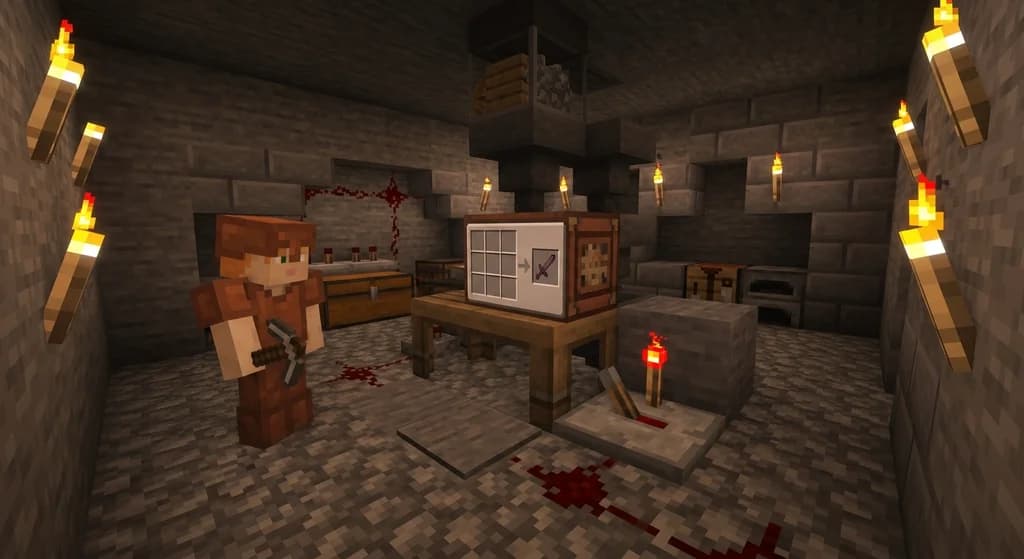
Key Takeaways
| Point | Details |
|---|---|
| The Crafter has nine | The Crafter has nine inventory slots arranged like a crafting grid. Slots can be enabled or disabled to control item placement. |
| When a redstone signal | When a redstone signal is received, the Crafter waits 4 game ticks (0.2 seconds) and then crafts one item from the ingredients in its slots. |
| Crafted items are ejected | Crafted items are ejected from the front; if facing a container, they are transferred into it. |
| Disabled slots prevent items | Disabled slots prevent items from entering, allowing automatic crafting for any recipe when combined with hoppers. |
| A comparator outputs signal | A comparator outputs signal strength equal to the number of disabled or occupied slots. |
| In Java Edition, crafters | In Java Edition, crafters cannot be moved by pistons and are not affected by quasi-connectivity. |
The Crafter block is a redstone-powered crafting station that automates item production. Unlike a regular crafting table, it stores ingredients and crafts on demand.
What Is a Crafter Block?
A crafter is a low-capacity storage block that can use its contents to craft items when given a redstone signal, ejecting the results into the world or into a container it is facing.
A crafter is a low-capacity storage block that can use its contents to craft items when given a redstone signal, ejecting the results into the world or into a container it is facing.
Inventory and Slot Locking
A crafter has nine slots of inventory space, arranged in a 3-by-3 grid like a crafting table. Its GUI can be accessed by using it. A slot can be enabled or disabled, which can be toggled by clicking on it when empty. Disabled slots cannot have items put in them.
Its inventory slots can be individually locked so hoppers and similar blocks cannot fill them, while not affecting crafting recipes.
Redstone Crafting
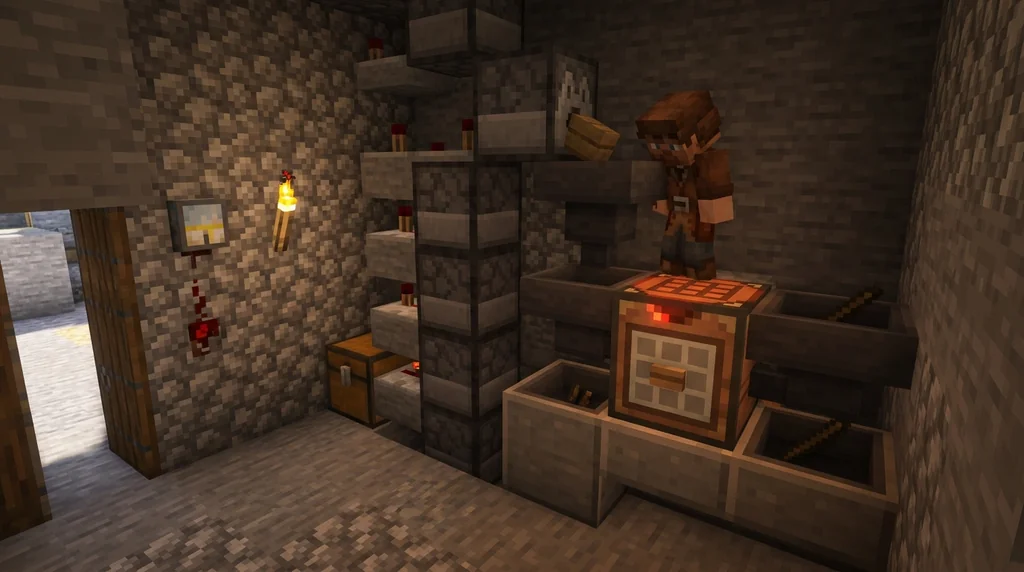
When a crafter receives a redstone signal, it waits for 4 game ticks (0.2 seconds) before ejecting one crafted item using the ingredients from the nine inventory slots. The crafted items are subsequently ejected from the front of the crafter. If the front of a crafter is facing a container (including another crafter), the crafted items are transferred into the container.
When a crafter receives a redstone signal, it waits for 4 game ticks (0.2 seconds) before ejecting one crafted item using the ingredients from the nine inventory slots.
If the front of a crafter is facing a container (including another crafter), the crafted items are transferred into the container.
Automatic Crafting
Because disabled slots prevent items from entering the slot, crafters can be used to craft any item in the game automatically without any input from the player, using a series of hoppers and/or droppers and the correct configuration of disabled slots for the recipe.
Because disabled slots prevent items from entering the slot, crafters can be used to craft any item in the game automatically without any input from the player, using a series of hoppers and/or droppers and the correct configuration of disabled slots for the recipe.
Comparator Output
A comparator placed next to a crafter can read its state. The signal strength equals the number of crafting slots that are either disabled or occupied by an item. The stack size of the items does not affect the signal. This is useful for monitoring the crafter's status in redstone circuits.
Edition Differences
In Java Edition, unlike dispensers and droppers, crafters are not affected by quasi-connectivity. Additionally, crafters cannot be moved by pistons in Java Edition. These differences matter when designing compact redstone circuits. For more on choosing between editions for speedrunning, see our guide on Java vs Bedrock for speedrunning.
In Java Edition, unlike dispensers and droppers, crafters aren't affected by quasi-connectivity.
Sources
- A crafter is a low-capacity storage block that can use its contents to craft items when given a redstone signal, ejecting the results into the world or into a container it is facing. — Crafter
- Its inventory slots can be individually locked so hoppers and similar blocks cannot fill them, while not affecting crafting recipes. — Crafter
- When a crafter receives a redstone signal, it waits for 4 game ticks (0.2 seconds) before ejecting one crafted item using the ingredients from the nine inventory slots. — Crafter
- If the front of a crafter is facing a container (including another crafter), the crafted items are transferred into the container. — Crafter
- Because disabled slots prevent items from entering the slot, crafters can be used to craft any item in the game automatically without any input from the player, using a series of hoppers and/or droppers and the correct configuration of disabled slots for the recipe. — Crafter
- In Java Edition, unlike dispensers and droppers, crafters aren't affected by quasi-connectivity. — Crafter
Related guides
Minecraft April Fools' Snapshots: 23w13a_or_b & 25w14craftmine
Explore two of Minecraft Java Edition's most creative April Fools' joke snapshots: 23w13a_or_b (Vote Update) and 25w14craftmine (Craftmine Update). A quick-reference guide to their unique mechanics and features.

Lighthouses in Minecraft: Quick Reference
Discover how to build a lighthouse in Minecraft with this quick reference guide. Learn about the award-winning Lightning Rod Lighthouse build and the...

Minecraft Speedrunning in the Novel The Tournament
Discover how Minecraft speedrunning appears in the novel Minecraft: The Tournament. Learn about Jett Warner's gardening club run, Hurston Preparatory...

Minecraft Random Generation Quick Reference: Seeds and /random Command
Master Minecraft random generation: world seed mechanics and the /random command. Quick reference covers seed basics, viewing seeds, command syntax, and...
Have a question or another approach?
Compare notes with other readers. Include your edition and version when discussing mechanics.