How to Create an Automated Baby Mob Living Orchestra: 2026 Guide
Filed under Minecraft Gameplay Remix · How we create content
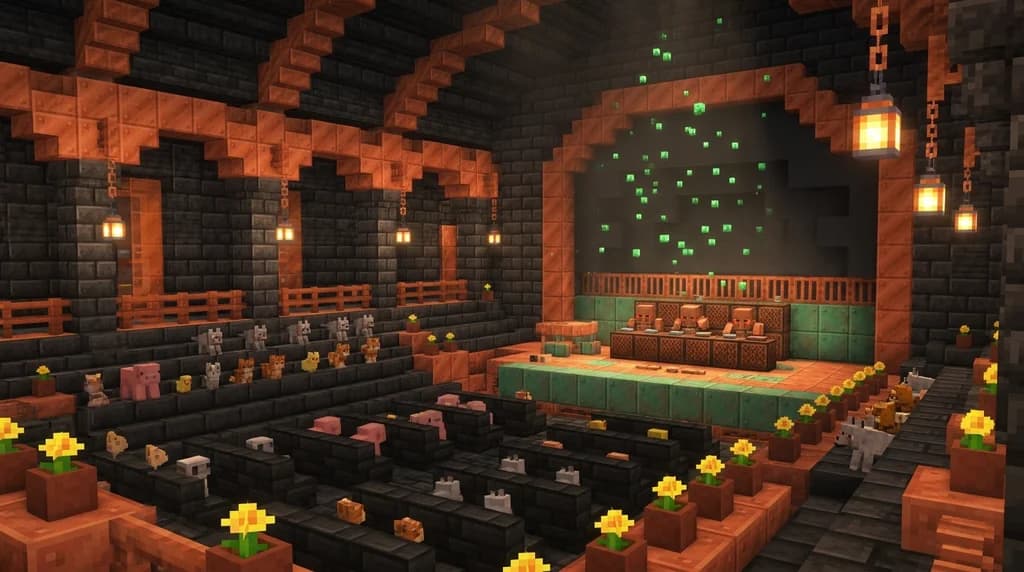
TL;DR: Bored in Minecraft? Here's how to build a fully Automated Baby Mob Living Orchestra — a redstone music machine where Golden Dandelion age-locking keeps your baby mobs permanently tiny and consistent-sounding, Copper Golem randomized button-cycling drives the rhythm, and oxidation-tuned Trumpet Note Blocks on Copper Blocks shift pitch over time. After reading, you'll be able to design, wire, and perform a living symphony that evolves every session.
Table of Contents
- What Is the Automated Baby Mob Living Orchestra?
- How to Set Up Your Living Orchestra
- Best Strategies for Your Living Orchestra
- Why the Living Orchestra Works
- How to Put This Into Practice on Gaia Legends
- Conclusion
- FAQ
- Recommended
What Is the Automated Baby Mob Living Orchestra?
You know that feeling — you've mined every ore, built every biome base, and conquered every boss. Minecraft suddenly feels like a game you've already finished. That feeling is a lie, and I'm about to prove it.
The Automated Baby Mob Living Orchestra is one of the most inventive minecraft challenge ideas to emerge from the 2026 update cycle. It's a living, breathing redstone music installation where real mobs are the instruments, Copper Golems are the conductors, and the passage of time literally changes the music.
The Automated Baby Mob Living Orchestra is a player-designed redstone music system that combines age-locked baby mobs (held permanently in their juvenile state by Golden Dandelions), randomized Copper Golem button-pressing, and Trumpet Note Blocks whose pitch shifts based on the oxidation level of the Copper Block beneath them — producing a generative symphony that sounds different every time you visit.
This isn't just a cool build. It's a minecraft gameplay idea with real mechanical depth:
- Sound consistency is achieved through age-locking — baby mobs have their own distinct sound variants introduced in Java Edition 26.1, and locking them young means your orchestra never "graduates" to adult sounds mid-performance.
- Rhythmic randomness comes from Copper Golems, who wander and press nearby buttons unpredictably — making them the world's most chaotic (and adorable) percussionists.
- Pitch evolution is baked into the build itself. As your Copper Blocks oxidize through four stages — unoxidized, exposed, weathered, and oxidized — the Trumpet Note Block pitch shifts, so your orchestra literally ages musically even as your baby mobs stay forever young.
This is what things to do in Minecraft looks like when you treat the game as a design space rather than a checklist.
How to Set Up Your Living Orchestra
Materials You'll Need
Gather these before you break ground:
- Golden Dandelions (at least one per baby mob — craft or find in meadow biomes)
- Copper Blocks in all four oxidation stages: unoxidized, exposed, weathered, and oxidized (or let them oxidize naturally over time)
- Note Blocks (one per instrument slot — place on top of Copper Blocks for the Trumpet sound)
- Copper Golems (spawn using a Copper Golem Statue Block, introduced in Java Edition 1.21.9)
- Buttons (stone or wooden — placed adjacent to each Note Block for Golem interaction)
- Baby mobs of your choice: Wolf pups, kittens, piglets, foals, and chicks all received new baby sounds in 26.1
- Name Tags (to keep your performers from despawning)
- Leads and fencing to section off your orchestra pit
World Settings
- Play on Java Edition 26.1 or later — you need the Tiny Takeover baby sounds, Golden Dandelion, Copper Golem, and Trumpet Note Block features simultaneously.
- Set the world to Peaceful or Normal depending on your risk tolerance. Peaceful removes hostile interference; Normal adds dramatic tension.
- Enable keepInventory if you're playing solo and want to focus on design over survival.
- On a server, make sure the mob cap is high enough to support your full ensemble. A 32-mob orchestra section will need careful pen design.
Step-by-Step Build Guide
- Design your concert hall. Build a tiered amphitheater using copper, deepslate, and wood. Assign sections: strings (Chickens), brass (Pigs), woodwind (Cats), and percussion (Wolves).
- Lay your Copper Block stage. Place Copper Blocks in a grid pattern across each section. Deliberately mix oxidation stages — put oxidized blocks at the back for low, mellow trumpet tones and unoxidized blocks up front for bright, sharp ones.
- Place Note Blocks on top of every Copper Block. Each Note Block on a Copper Block produces the new Trumpet instrument sound, with pitch determined by right-clicking (tune them) and timbre shaped by oxidation level.
- Add Buttons adjacent to each Note Block. Copper Golems will randomly press these, triggering your trumpet notes. Place buttons at Golem height — one block off the ground.
- Spawn and age-lock your baby mobs. Breed your chosen animals, then immediately right-click each baby with a Golden Dandelion. You'll see green particles drifting downward — that's your confirmation. The mob will never grow up.
- Name-tag every performer. This prevents despawning and lets you give your musicians proper stage names. (May I suggest "Oinkestra" for the lead pig?)
- Place Copper Golems near the button arrays. They'll wander and press buttons on their own — no redstone clock needed. Their oxidation state also changes over time, so wax them if you want consistent behavior, or let them oxidize for increasing unpredictability.
- Test your hall. Walk in, listen. Adjust Note Block tuning by right-clicking until each section has a coherent pitch range.
Pro Tip: Use waxed Copper Blocks in one section and unwaxed in another. The waxed section stays pitch-stable forever, acting as your "anchor" melody, while the unwaxed section slowly drifts to lower pitches — giving your orchestra a built-in slow modulation over weeks of gameplay.
Note: Golden Dandelion age-locking is reversible. Right-clicking a locked baby again with a Golden Dandelion restarts aging. Don't accidentally un-lock your performers mid-show — keep spare dandelions in a labeled chest offstage.
Best Strategies for Your Living Orchestra
Difficulty Tiers
Not every player wants the same level of complexity. Here's how to scale the challenge:
| Tier | Name | Setup | Golem Count | Mob Sections |
|---|---|---|---|---|
| Casual | The Busker | 1 mob type, 4 Note Blocks | 1 Golem | 1 section |
| Standard | The Chamber Ensemble | 3 mob types, 12 Note Blocks | 2–3 Golems | 3 sections |
| Hardcore | The Grand Symphony | All 5 baby types, 32+ Note Blocks | 5+ Golems | 5 sections |
| Insane | The Eternal Orchestra | All 5 types + all 4 oxidation stages | 8+ Golems, unwaxed | Full hall, no waxing |
The Oxidation Score System
Turn your orchestra into a Minecraft challenge with a scoring mechanic:
- Record a "Day 1" performance by listening and noting which Note Blocks are active.
- Revisit every 7 in-game days. As Copper Blocks oxidize, the trumpet pitch lowers. Track how many blocks have shifted stage.
- Score 1 point per oxidation stage shift observed per block. A block that goes from unoxidized all the way to oxidized scores 3 points total across its lifetime.
- Challenge a friend: whoever's section accumulates the most oxidation shifts in 30 real-world days wins. Copper Blocks take roughly 50–82 in-game days to fully oxidize — so the race is real.
Multiplayer Variations
Playing with friends unlocks entirely new ensemble dynamics:
- Conductor Role: One player waxes and un-waxes Copper Blocks in real time during a "performance," manually shifting pitch sections like a live sound engineer.
- Mob Wrangler Role: One player manages the baby mob pens — re-locking any mobs that accidentally got un-locked, and introducing new baby variants mid-show for fresh sounds.
- Golem Handler Role: One player places and removes Golems from sections to control which instruments are "playing" at any moment.
The Sound Variant Shuffle
Java 26.1 introduced random sound variants for Cats, Pigs, Cows, and Chickens — each animal gets one of several sound profiles assigned at spawn. This means two piglets in your brass section might sound subtly different from each other. Embrace it. Use it deliberately:
- Breed multiple piglets and listen carefully before age-locking. Keep the ones whose sounds complement each other; release the rest.
- Cats now have one new sound variant on top of their classic set — hunt for the rare variant by breeding until you hear something unexpected.
- Chickens have one new sound variant too, making your percussion section more interesting than you'd expect.
Pro Tip: Label your mob pens by sound variant using item frames and dye. A red item frame means "classic variant," blue means "new variant." This turns mob collection into its own mini-game within the orchestra project — one of the most replayable Minecraft challenges in the build.
Why the Living Orchestra Works
The Mechanic Synergy
Three mechanics from two different updates lock together here in a way that feels almost designed:
- Golden Dandelion + Baby Sounds = permanent, consistent vocal performers. Without age-locking, your baby Wolf would grow into an adult Wolf within 20 in-game minutes, completely changing its sound profile and ruining your carefully tuned section.
- Copper Golem + Buttons = zero-maintenance rhythm automation. Golems press buttons randomly and continuously without any redstone clock, comparator, or observer setup. The randomness isn't a bug — it's the entire musical philosophy. Jazz, baby.
- Trumpet Note Block + Oxidation = temporal pitch drift. The Trumpet instrument produces 4 distinct timbres — one per oxidation stage — meaning your orchestra's tone evolves over weeks without you touching a single block. It's generative music baked into the game's physics.
No other combination of current Minecraft mechanics produces a build that is simultaneously automated, living, and time-evolving. That's why this works.
Replayability
Every session with your Living Orchestra is unique because:
- Copper Golem button-pressing is non-deterministic — the same Golem will never play the same rhythm twice.
- Sound variants are randomly assigned at mob spawn, so a new litter of kittens brings fresh tonal color.
- Oxidation is irreversible without scraping — your orchestra's sound slowly, permanently deepens over the life of your world.
What Recent Updates Make Possible
Before Java 26.1 and 1.21.9, this build simply couldn't exist:
- No baby-specific sounds existed — babies sounded like quieter adults.
- No Golden Dandelion meant no reliable age-locking — your performers would always graduate.
- No Copper Golem meant you needed complex redstone clocks for automation.
- No Trumpet instrument meant Note Blocks on Copper Blocks played the same as any other surface.
All four of those gaps closed within two update cycles. The Living Orchestra is the intersection point — and 2026 is the exact moment to build it.
How to Put This Into Practice on Gaia Legends
Gaia Legends is where the Living Orchestra stops being a solo art project and becomes a community event.
The server's persistent world means your Copper Blocks oxidize in real time between play sessions — your orchestra literally ages while you're at school or work. Log back in and the brass section has deepened. That's a feature no single-player world can replicate with the same social stakes.
But here's the Gaia-exclusive trick: sync your Living Orchestra with Gaia's Discord-integrated music bot to broadcast your mob symphonies live to your server guildmates. Record a session, clip the audio, and drop it in your guild's channel. Suddenly your redstone music project is a community performance — other players tune in, vote on which mob section sounds best, and challenge you to hit specific notes by adjusting your Golem placement.
Gaia's guild system also enables orchestra competitions — two guilds build competing halls, the server votes on the best performance, and the winner earns bragging rights (and possibly some very cute baby mob bragging rights too).
Gaia Legends is free to join, non-pay-to-win, and supports Java + Bedrock crossplay. Join at gaialegends.pro and remix your Minecraft experience today.
Conclusion
The Automated Baby Mob Living Orchestra is proof that Minecraft in 2026 has more creative depth than ever — you just need to know where to look.
Here are your three takeaways:
- Age-lock your baby mobs with Golden Dandelions the moment they spawn — consistency is the foundation of every good orchestra.
- Let your Copper Golems conduct themselves — their randomness isn't chaos, it's jazz, and it means your build plays music even when you're not there.
- Embrace oxidation as composition — your Trumpet Note Blocks will sound different in a month, and that slow evolution is the most interesting thing happening in any Minecraft world right now.
Try the Living Orchestra tonight and share your results. Name your ensemble, record a clip, post it. I promise at least one person will ask "wait, how did you make that?" — and that question is the best feeling in Minecraft.
FAQ
What are the best minecraft challenge ideas for redstone musicians in 2026?
The best minecraft challenge ideas for redstone musicians in 2026 combine the new Trumpet Note Block (placed on Copper Blocks), Copper Golem automation, and Golden Dandelion age-locking. The Automated Baby Mob Living Orchestra hits all three — it's automated, it evolves over time, and it uses living mobs as instruments. It's one of the few builds that rewards both technical redstone skill and creative sound design simultaneously.
What should I do when I'm bored in Minecraft and have already built everything?
When you've built everything, shift from construction to systems design. The Living Orchestra is a perfect example — instead of building a structure, you're designing a machine that generates music. The goal isn't a finished product; it's an ongoing performance that changes every session. Copper oxidation, random Golem behavior, and new baby mob sound variants ensure no two visits sound alike.
How does the Golden Dandelion work for age-locking baby mobs?
Right-click any baby mob while holding a Golden Dandelion and it will stop aging permanently. You'll see green particles drifting downward as confirmation. The effect is reversible — right-clicking the same locked baby with another Golden Dandelion restarts the aging timer. For orchestra use, age-lock immediately after birth to preserve the baby-specific sound variants introduced in Java Edition 26.1, which are distinct from adult sounds.
How does the Trumpet Note Block work and what affects its pitch?
A Note Block placed on top of any Copper Block produces the Trumpet instrument sound, added in Java Edition 26.1. The timbre of the trumpet changes based on the oxidation level of the Copper Block beneath it — unoxidized produces the brightest tone, while fully oxidized produces the deepest, most mellow sound. Pitch within each stage is still tuned by right-clicking the Note Block as normal, giving you both tonal color and precise pitch control.
Do I need a Copper Golem to automate the orchestra, or can I use a redstone clock?
You can use a redstone clock, but a Copper Golem is far more interesting. Copper Golems press nearby buttons randomly and continuously without any additional redstone — no clock, observer, or comparator needed. Their unpredictability creates a generative rhythm that a clock can't replicate. They also oxidize over time, which subtly changes their wandering behavior, adding another layer of temporal evolution to your build.
What Java Edition version do I need to build the Living Orchestra?
You need Java Edition 26.1 or later. This version introduced baby-specific mob sounds for Wolves, Cats, Pigs, Horses, and Chickens, as well as the Golden Dandelion for age-locking. The Copper Golem and Trumpet Note Block were added in Java Edition 1.21.9. All four features must be present simultaneously for the full Living Orchestra experience, so 26.1 is the minimum viable version.
Recommended
Frequently Asked Questions
What are the best minecraft challenge ideas for redstone musicians in 2026?
The best minecraft challenge ideas for redstone musicians in 2026 combine the new Trumpet Note Block (placed on Copper Blocks), Copper Golem automation, and Golden Dandelion age-locking. The Automated Baby Mob Living Orchestra hits all three — it's automated, it evolves over time, and it uses living mobs as instruments. It's one of the few builds that rewards both technical redstone skill and creative sound design simultaneously.
What should I do when I'm bored in Minecraft and have already built everything?
When you've built everything, shift from construction to systems design. The Living Orchestra is a perfect example — instead of building a structure, you're designing a machine that generates music. The goal isn't a finished product; it's an ongoing performance that changes every session. Copper oxidation, random Golem behavior, and new baby mob sound variants ensure no two visits sound alike.
How does the Golden Dandelion work for age-locking baby mobs?
Right-click any baby mob while holding a Golden Dandelion and it will stop aging permanently. You'll see green particles drifting downward as confirmation. The effect is reversible — right-clicking the same locked baby with another Golden Dandelion restarts the aging timer. For orchestra use, age-lock immediately after birth to preserve the baby-specific sound variants introduced in Java Edition 26.1, which are distinct from adult sounds.
How does the Trumpet Note Block work and what affects its pitch?
A Note Block placed on top of any Copper Block produces the Trumpet instrument sound, added in Java Edition 26.1. The timbre of the trumpet changes based on the oxidation level of the Copper Block beneath it — unoxidized produces the brightest tone, while fully oxidized produces the deepest, most mellow sound. Pitch within each stage is still tuned by right-clicking the Note Block as normal, giving you both tonal color and precise pitch control.
Do I need a Copper Golem to automate the orchestra, or can I use a redstone clock?
You can use a redstone clock, but a Copper Golem is far more interesting. Copper Golems press nearby buttons randomly and continuously without any additional redstone — no clock, observer, or comparator needed. Their unpredictability creates a generative rhythm that a clock can't replicate. They also oxidize over time, which subtly changes their wandering behavior, adding another layer of temporal evolution to your build.
What Java Edition version do I need to build the Living Orchestra?
You need Java Edition 26.1 or later. This version introduced baby-specific mob sounds for Wolves, Cats, Pigs, Horses, and Chickens, as well as the Golden Dandelion for age-locking. The Copper Golem and Trumpet Note Block were added in Java Edition 1.21.9. All four features must be present simultaneously for the full Living Orchestra experience, so 26.1 is the minimum viable version.
Related guides
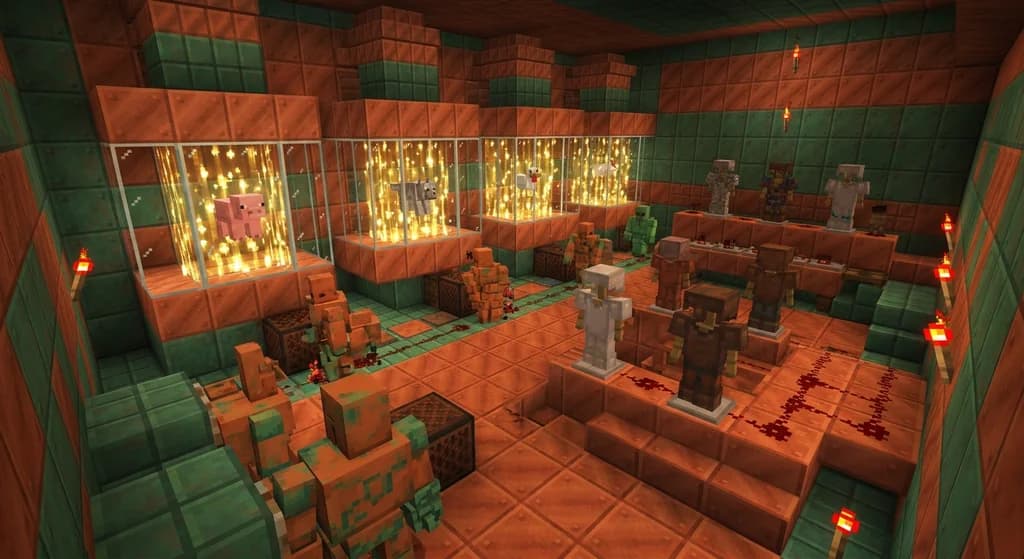
How to Build a Copper Golem Baby Mob Command Center (2026 Guide)
Discover the best minecraft challenge ideas for 2026: build a Copper Golem Baby Mob Command Center using golden dandelion age-locking, oxidized trumpet automation, and mannequin NPC logic gates.
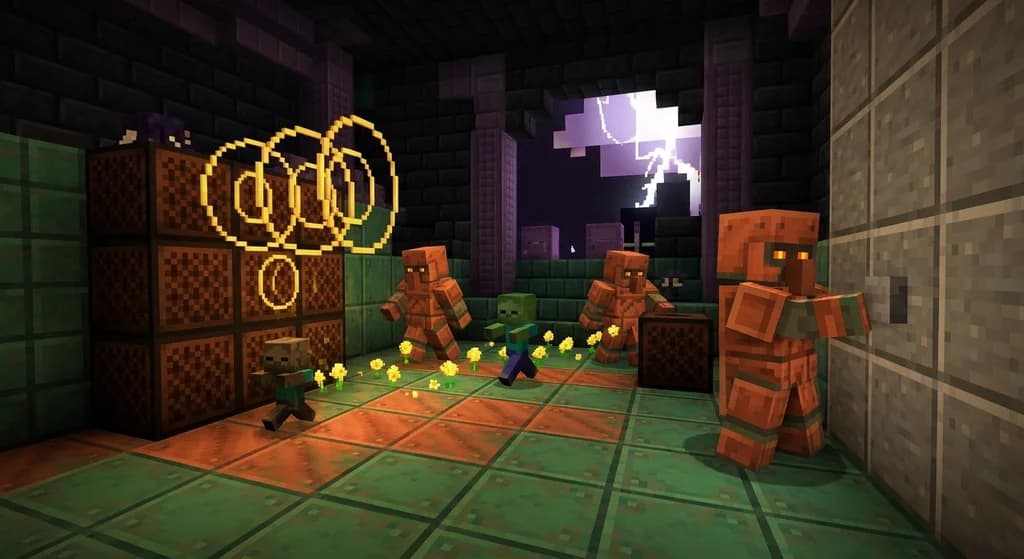
How to Build a Rhythmic Copper Golem Tiny Mob Dungeon 2026
Discover unique Minecraft game ideas 2026: build a Rhythmic Copper Golem Tiny Mob Dungeon using trumpet pitch oxidation, Golden Dandelion stasis, and End flashing skylight cues.
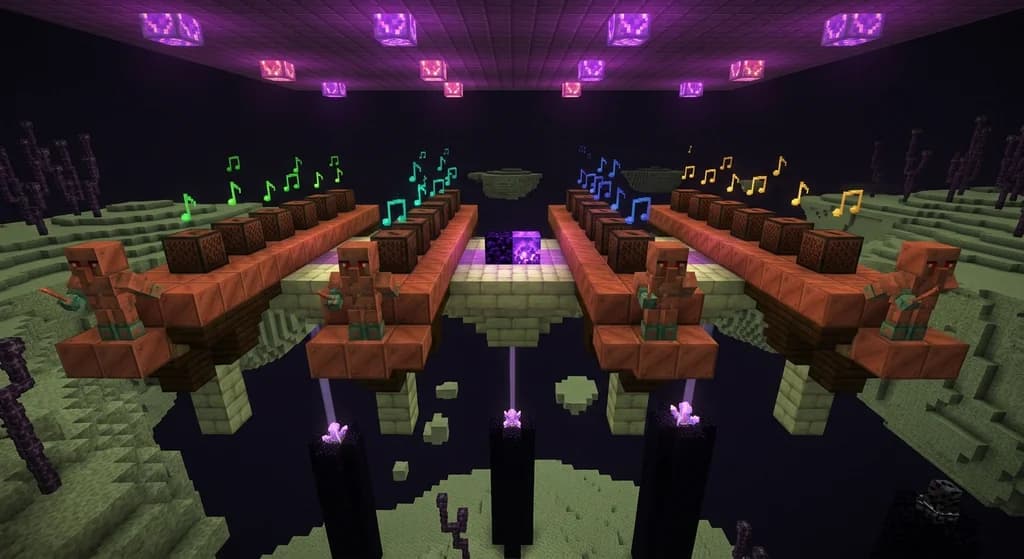
How to Build a Flash-Sync Copper Trumpet Rhythm Trial 2026
Master minecraft redstone challenges 2026: build a Flash-Sync Copper Trumpet Rhythm Trial using copper trumpet pitch oxidation and The End's flashing skylight.
Build an Eternal Baby Mob Menagerie With Copper Golems 2026
Bored in Minecraft? Build an Eternal Baby Mob Menagerie using Golden Dandelion age-locking, Copper Golem automation, and oxidation trumpet signals. New challenge for 2026.
Have a question or another approach?
Compare notes with other readers. Include your edition and version when discussing mechanics.