How to Automate Crop Farming in Minecraft with Villagers (2026 Guide)
Filed under Minecraft Tips & Tricks · How we create content
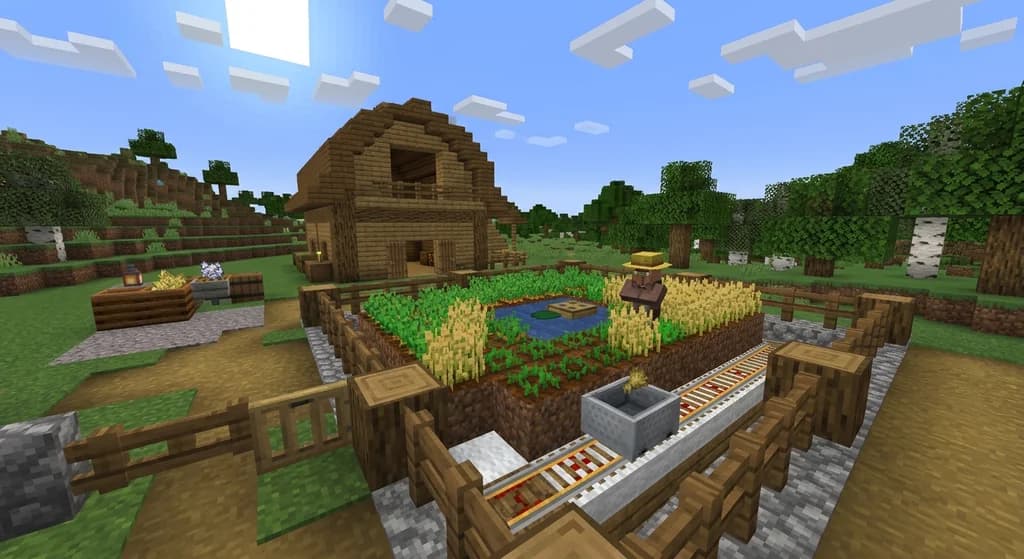
Key Takeaways
| Point | Details |
|---|---|
| Villager mechanics are key | Farmer villagers harvest crops and share food, but you must empty their inventory for continuous automation. |
| Design matters most | A 9x9 farm with a central water source and a minecart hopper collection system is the gold standard for efficiency. |
| Secure your villagers | Always build a roof or wall to protect your farmer from zombie sieges, pillager patrols, and lightning strikes. |
| Trading amplifies profit | Cured farmers offer massive discounts, turning your automated carrots and potatoes into a limitless emerald engine. |
| Use on Gaia Legends | Supply the custom player-driven economy with bulk wheat and golden carrots to earn in-game currency and rare items. |
Table of Contents
- What Is an Automatic Villager Crop Farm?
- Why Automate Crop Farming with Villagers?
- How to Build a Villager Crop Farm
- How Do Villager Crop Farms Actually Work?
- Best Crops for Villager Automation
- How to Secure and Expand Your Farm
- How to Put This Into Practice on Gaia Legends
- Frequently Asked Questions
- Recommended
You can spend hours replanting wheat and carrots, or you can build one machine and let a villager do it forever. Learning how to automate crop farming in Minecraft with villagers transforms survival gameplay. It turns a tedious daily chore into a background process that churns out food and emeralds while you're mining for diamonds. This guide covers the mechanics, the best farm designs, and how to scale your production into a full-blown economic engine.
What Is an Automatic Villager Crop Farm?
An automatic villager crop farm is a redstone-free build that uses a farmer villager's AI to plant, harvest, and share crops, which are then collected by a minecart hopper system underneath the farmland.
An automatic villager crop farm is a self-sustaining food production loop. Unlike piston-harvested farms that require bone meal or massive redstone clocks, a villager-based farm relies entirely on the mob's own behavior. A farmer villager scans for mature crops, breaks them, picks up the drops, and then replants seeds from its inventory. The automation part comes from intercepting the food the villager tries to share with others. A minecart hopper running beneath the dirt captures the thrown items, funneling them into a central chest. It is one of the most lag-friendly and resource-efficient farms in the game.
Why Automate Crop Farming with Villagers?
Automating crop farming with villagers eliminates manual replanting, generates passive emeralds through trading, and scales easily to support massive builds or server economies with minimal lag.
- Passive food generation: Once built, the farm runs while you work on other projects. You'll never need to craft bread or golden carrots manually again.
- Emerald engine: Farmers buy wheat, potatoes, carrots, and beetroot. A cured zombie villager buys 1 carrot for 1 emerald—a single 9x9 field can produce a stack of emeralds per hour.
- Server economy integration: On multiplayer servers like Gaia Legends, bulk crops are always in demand for trading, event hosting, and community builds.
- Lag efficiency: Unlike massive piston farms, villager farms use no redstone dust, no observers, and no hopper clocks. The server tick impact is negligible, which is critical for large SMPs.
Pro Tip: Build your first villager crop farm near your base's chunk-loading boundary. It will continue producing crops even when you're just close enough to keep the chunks loaded but far enough to reduce entity lag.
How to Build a Villager Crop Farm
A basic automatic villager crop farm requires a 9x9 tilled field, a central water source, a farmer villager, a composter workstation, a second villager to receive food, and a minecart hopper collection line beneath the dirt.
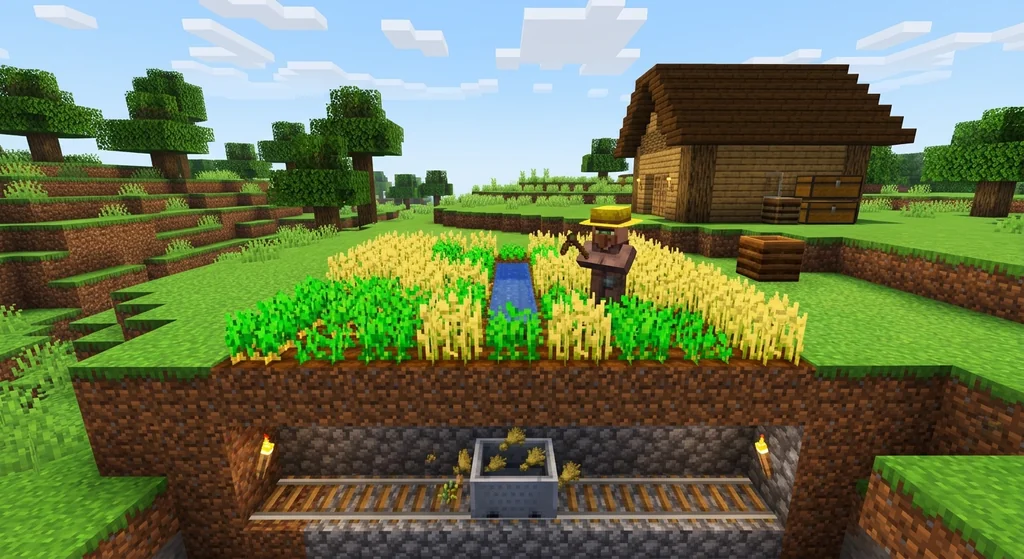
Step-by-Step Construction
- Dig a 9x9 pit one block deep. This will hold the water and collection system.
- Place a water source in the dead center. It hydrates farmland up to 4 blocks in every direction.
- Run a powered rail line around the perimeter of the pit floor. Place hopper minecarts on the rails. These will collect items thrown by the farmer.
- Cover the pit with dirt blocks. The dirt must be supported by the rails underneath. Till all the dirt with a hoe.
- Build a glass or fence wall around the farm. Leave a 2-block-high interior so the villagers cannot escape. Add a roof or slab the top to prevent lightning strikes.
- Place a composter inside the farm. This assigns the farmer profession and allows the villager to claim the crops.
- Introduce one farmer villager and one "receiver" villager. The receiver stands in a 1x1 space separated by a gap the farmer can pathfind to but not enter.
- Plant your initial seeds. The farmer will do the rest.
Warning: Never place more than one farmer villager in the same 9x9 field. Multiple farmers will compete for the same crops, break each other's pathfinding, and drastically reduce output.
Collection System Details
The minecart hopper track should connect to a single unloading station. Use an unpowered rail over a regular hopper that feeds into a double chest. Every time the minecart passes over the hopper, items are extracted. According to community testing, a single hopper minecart can collect up to 1,500 items per hour from a well-tuned farm (via Minecraft Wiki).
How Do Villager Crop Farms Actually Work?
Farmer villagers scan for fully grown crops, harvest them with bone-meal-free AI, pick up the drops, craft them into bread if necessary, and then throw the excess food to nearby villagers when their inventory fills.
The villager's inventory has 8 slots. When a farmer harvests a crop, the item goes into an empty slot. Seeds are replanted first. Once all slots contain at least one stack of food or seeds, the villager attempts to throw stacks of food at other villagers. The key to automation is ensuring the thrown items never reach the receiver. By separating the receiver behind a trapdoor gap or a half-slab barrier, the food lands on the ground and falls through the dirt into the minecart hopper below. This mechanic is the foundation of every automatic villager crop farm.
Note: Farmers will not harvest crops if
mobGriefingis set tofalseon your server or world. This game rule prevents villagers from breaking crop blocks, completely disabling the farm.
Best Crops for Villager Automation
Carrots and potatoes are the most efficient crops for villager automation because they require no crafting step, trade at high value, and produce multiple items per harvest.
| Crop | Average Yield per Harvest | Farmer Trade (1 emerald) | Automation Efficiency |
|---|---|---|---|
| Carrot | 2-5 carrots | 22 carrots | Excellent — no crafting needed |
| Potato | 1-4 potatoes | 26 potatoes | Excellent — no crafting needed |
| Wheat | 1 wheat + 0-3 seeds | 20 wheat | Good — villager crafts bread, slowing output slightly |
| Beetroot | 1 beetroot + 0-3 seeds | 15 beetroot | Moderate — lower yield per harvest |
Carrots and potatoes are the top performers. A farmer with a full 9x9 carrot field can generate roughly 1,300 carrots per hour in ideal conditions (via Minecraft Wiki). Wheat farms are slightly slower because the farmer spends time crafting bread, but they are still viable for passive bread production. Beetroot is the weakest option, but it is useful if you need red dye or want to complete a buried treasure map that requires specific items.
Golden Carrots and Trading
Golden carrots are the best food in the game for saturation. An automated carrot farm feeds directly into a golden carrot production line. Trade the excess carrots to farmer villagers for emeralds, then use those emeralds to buy golden carrots from master-level farmers. On a server with a strong economy, this loop generates infinite top-tier food and currency. You can even use the profits to purchase Minecraft armor trims from other players.
How to Secure and Expand Your Farm
Protecting your farmer villager from zombies, pillagers, and lightning is non-negotiable—a single zombie siege can wipe out weeks of breeding and trading progress in seconds.
Security Checklist
- Lighting: Place torches or glowstone inside the farm and on the roof. Light level must be 8 or higher to prevent hostile mob spawns.
- Walls: Use glass, fences, or solid blocks at least 2 blocks high. Glass lets you monitor the farm without entering.
- Roof: A full-block roof prevents lightning from turning your villager into a witch. Slabs or stairs also work.
- Iron Golems: Place one iron golem near the farm entrance. It will engage any zombies or pillagers that get too close.
- Name Tags: Always name your farmer and receiver villagers. Named villagers never despawn, even if you travel far away.
Scaling Up
To scale production, build multiple 9x9 modules side by side. Each module needs its own farmer, composter, and receiver. Connect all the minecart hopper lines to a central sorting system. A four-module carrot farm can produce over 5,000 carrots per hour, enough to supply a horse breeding operation with golden carrots indefinitely.
How to Put This Into Practice on Gaia Legends
On Gaia Legends, automated villager crop farms are the backbone of the player-driven economy. The server's custom trading system lets you sell bulk wheat, carrots, and potatoes for in-game currency, which you can then spend on rare items, elytra flight courses, or exclusive cosmetic perks. Build a multi-module carrot farm and become the server's primary food supplier—players will seek you out for golden carrots before big events and boss fights.
Gaia Legends is free to join, non-pay-to-win, and supports Java + Bedrock crossplay. The community is friendly, the economy is active, and your automated farm will always have buyers. Whether you are a redstone engineer or a humble farmer, your crops have real value here.
Join at gaialegends.pro and start your legend today.
Frequently Asked Questions
Recommended
- How to Create Minecraft Trading Cards for Your Server Economy in 2026 | Gaia Legends
- How to Find Nether Fortresses Fast in Minecraft Speedruns (2026) | Gaia Legends
- How to Beat Minecraft Hardcore Mode Without Totems of Undying (2026) | Gaia Legends
- How to Transfer Minecraft Items Between Servers Without Losing Enchants 2026 | Gaia Legends
Ready to play? Join Gaia Legends today — no pay-to-win, Java + Bedrock crossplay.
- Java:
join.gaialegends.pro - Bedrock:
join.gaialegends.pro— Port19132
Frequently Asked Questions
How do I automate crop farming in Minecraft with villagers?
Build a 9x9 tilled field with a central water source, place a composter inside to assign a farmer villager, and add a second villager nearby as a food receiver. Run a minecart hopper underneath the dirt to collect the crops the farmer throws. The farmer harvests and replants automatically, creating a fully hands-off food and emerald farm.
Why won't my farmer villager harvest crops?
Check that `mobGriefing` is set to `true`—farmers cannot break crop blocks without it. Also, ensure the villager has a composter workstation and that its inventory is not completely full. If the farmer has no empty slots and no villager to throw food to, it will stop harvesting entirely.
What is the best crop for an automatic villager farm?
Carrots are the best crop for automation. They require no crafting step, yield 2-5 carrots per harvest, and trade at 22 carrots per emerald. Potatoes are a close second. Wheat is slightly slower because the villager stops to craft bread, but it is still excellent for passive food production.
Can I use multiple farmer villagers in one farm?
No, you should never place more than one farmer in a single 9x9 field. Multiple farmers compete for the same crops, break each other's pathfinding, and drastically reduce efficiency. Build separate modules for each farmer and connect them with a shared collection system.
How do I protect my villager crop farm from zombies?
Surround the farm with a 2-block-high wall and a full-block roof to block line-of-sight and lightning. Place torches everywhere to keep light levels above 8. Add an iron golem near the entrance for extra protection, and always name-tag your villagers so they never despawn.
Why does my villager crop farm stop working at night?
Villagers do not harvest crops at night or during rain because they seek shelter. To keep the farm running 24/7, place a bed inside the farm and ensure the villager can pathfind to it. The villager will sleep, wake up, and immediately resume farming at dawn.
Related guides
How to Use the Observer Block: 7 Simple Redstone Tricks
Learn how to use the observer block in Minecraft with 7 simple redstone tricks. From auto-farms to hidden doors, master observer mechanics and upgrade...

7 Cauldron Tricks in Minecraft Most Players Miss (2026)
Discover 7 clever minecraft cauldron tricks for dyeing leather, brewing potions, redstone, and more. Make your Minecraft life easier with these overlooked...

Top 7 Best Minecraft Guide Books Every Player Needs in 2026
Discover the 7 best Minecraft guide books for 2026. From official survival handbooks to redstone bibles, find the perfect book to level up your gameplay fast.

How to Brew Potions in Minecraft: Complete Beginner's Guide
Learn how to brew potions in Minecraft with this complete beginner's guide. Covers brewing stand setup, ingredients, recipes, splash and lingering potions.
Have a question or another approach?
Compare notes with other readers. Include your edition and version when discussing mechanics.