How to Build a Sentient Copper Golem Jazz Club (2026 Guide)
Filed under Minecraft Gameplay Remix · How we create content
The Moment You Realize Minecraft Is Boring Again
You know the feeling. You've mined the diamonds. You've killed the dragon. You've built the mega-base. You're standing in your perfectly lit storage room at 11 PM wondering why you even launched the game.
Here's the thing: you're not bored of Minecraft. You're bored of playing it the same way.
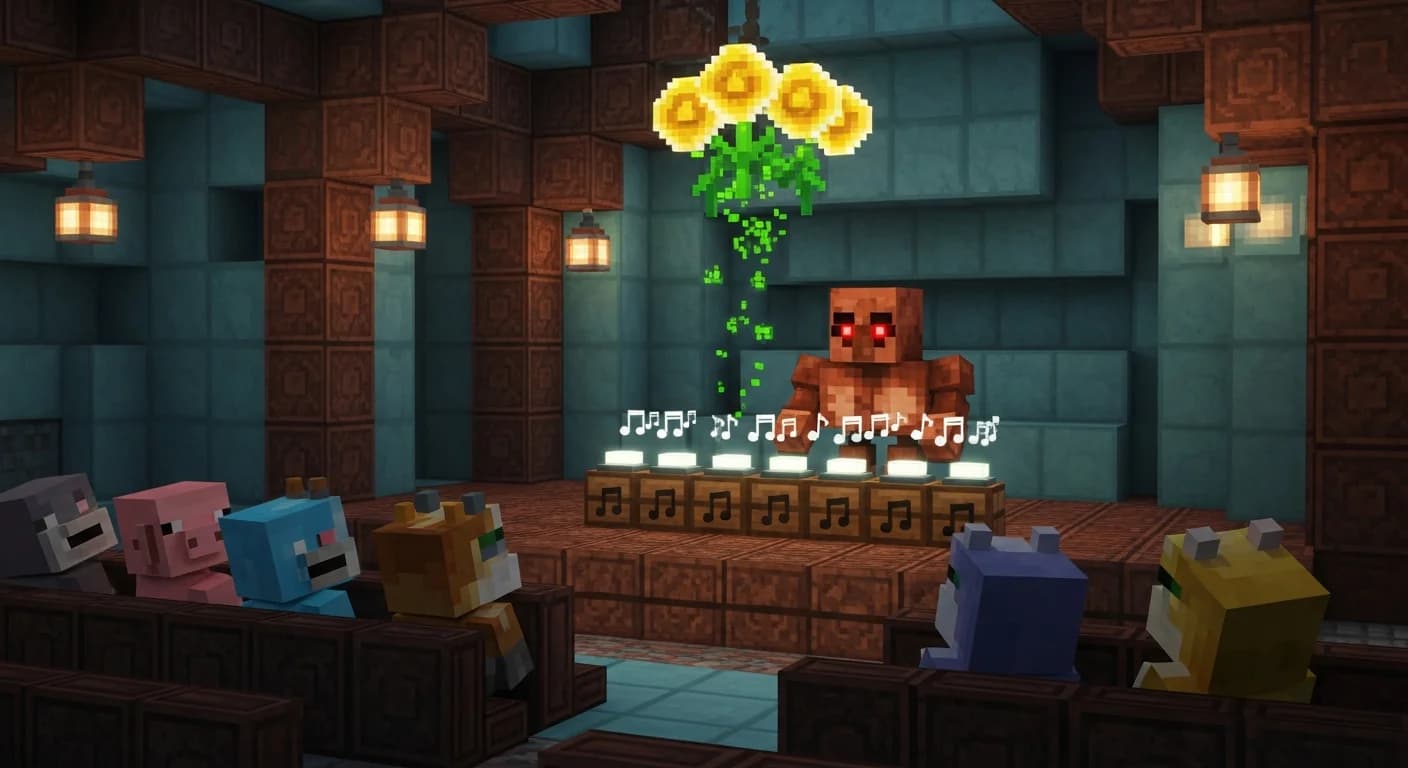
The 2026 update cycle has quietly handed us three mechanics that, combined, create something nobody has officially named yet — a self-performing, living jazz club that runs without you touching a single button. Copper Golems press the keys. Oxidized copper blocks shift the pitch. Frozen baby mobs provide the ambiance. And the whole thing grooves on its own, forever.
This is not a decoration build. This is a generative music machine dressed up as the coolest speakeasy in your world. Let's build it.
What Is the Sentient Copper Golem Jazz Club?
The Sentient Copper Golem Jazz Club is a unique Minecraft build challenge that fuses three distinct 2026 mechanics into a single, self-sustaining performance space: Copper Golem button randomization drives the melody, Trumpet Note Blocks tuned by copper oxidation state provide the harmonic palette, and Golden Dandelion-stasised baby mobs fill the audience and vocal sections with their new, never-aging sound variants.
The result is a build that plays itself — a procedurally generated jazz performance running 24/7 in your world, with no player input required after construction.
This sits firmly in the category of unique Minecraft build challenges 2026 players are hunting for, because it requires:
- Deep knowledge of Copper Golem behavior
- Deliberate acoustic design using oxidation levels
- Mob management with the Golden Dandelion
- Redstone routing that keeps everything in sync
It's part build challenge, part generative art installation, part technical redstone puzzle. And it sounds incredible when it works.
How to Build Your Jazz Club: Step-by-Step Setup
Materials You'll Need
Gather these before you break ground:
- Copper Blocks (at least 64, in all four oxidation stages: fresh, exposed, weathered, oxidized)
- Copper Golems (minimum 3 — one per "instrument section")
- Note Blocks (32+, to be placed on top of copper blocks for trumpet sound)
- Buttons (Stone or wooden — Copper Golems will press any button they can reach)
- Golden Dandelions (one per baby mob you want to freeze permanently)
- Name Tags (to keep your baby mob vocalists from despawning)
- Leads and Fences (to position your audience)
- Lanterns and Candles (for that smoky jazz-club atmosphere)
- Copper Chests (for backstage storage — they oxidize beautifully as set dressing)
Note: Copper Golems will wander and press buttons autonomously — you don't need to wire the buttons to anything for the music to trigger. The golem is the randomization engine.
World and Server Settings
- Play on Java Edition 26.1 or later to access Golden Dandelions, baby mob sound variants, and Trumpet Note Blocks.
- Set the world to Normal or Hard difficulty so Copper Golems remain active.
- Disable mob griefing only if you want to prevent Golems from wandering out of their stage zones — otherwise, let them roam freely within a fenced performance area.
- On a server, ensure entity tick rates are healthy. Complex multi-golem setups with simultaneous Note Block triggers can stress underpowered servers (more on Gaia's solution below).
The Three Sections of the Club
Structure your build around three distinct zones:
1. The Stage
Build a raised platform from weathered copper blocks (the green-teal middle stage of oxidation). Place Note Blocks directly on top of copper blocks — this is what triggers the trumpet instrument added in 26.1. The oxidation level of the copper block underneath determines the pitch character of the trumpet sound, giving each Note Block a slightly different tonal quality.
Arrange your Note Blocks in a horseshoe around a central button panel. Place buttons on the front face of blocks at Golem-height. Your Copper Golems will wander the stage, pressing buttons at random — which triggers Note Blocks, which plays trumpet sounds. That's your melody section, and it costs zero redstone.
2. The Pit Orchestra
Below the stage, dig out a sunken area and line it with freshly placed copper blocks (unoxidized, orange). These produce a brighter, crisper trumpet tone — your "lead horn" section. Place a second Copper Golem here with a denser button arrangement for faster, more chaotic note triggering.
Over time, if you don't wax these copper blocks, they'll oxidize naturally — and your pit orchestra's sound will literally change as weeks pass in-game. The club ages. The music deepens. That's emergent storytelling through oxidation.
3. The Audience and Vocal Section
This is where the Golden Dandelion mechanic becomes pure theater.
Spawn baby mobs — Pigs, Cats, Wolves, Chickens, and Horses all received new baby sounds in the 26.1 Tiny Takeover update. Each animal also has randomized adult sound variants assigned at spawn, meaning no two baby Pigs sound exactly alike. Collect a diverse cast.
Use a Golden Dandelion on each baby mob: right-click while holding one, and green particles will drift downward from the mob, confirming it has been permanently frozen in its baby state. It will never age. Name-tag every frozen baby so they don't despawn.
Pen them in tiered seating made from slabs and stairs. Your audience is now permanent, adorable, and — because Minecraft simulates ambient mob sounds continuously — they will chirp, squeal, and meow throughout every performance. They are your vocalists. They are your crowd noise. They are, in a very real sense, the soul of the club.
Pro Tip: Breed multiple Pigs before freezing to maximize sound variant diversity. Since each animal gets a randomly assigned sound variant from the new pool, you might get two Pigs that sound completely different — one classic oink, one new variant. A diverse audience sounds like a real crowd.
The Rules of the Challenge
To make this a proper build challenge rather than a freeform build, impose these constraints on yourself:
- No manual Note Block tuning — you cannot right-click Note Blocks to set their pitch. Oxidation level is your only pitch control.
- No powered rails or pistons to move Golems — they must navigate autonomously.
- The club must be fully enclosed — no open-air venues. Jazz clubs are underground.
- All baby mobs must be named — no unnamed vocalists. Give them jazz names. Miles. Ella. Coltrane.
- The build must run for 10 in-game days without player intervention before it counts as complete.
Best Strategies for the Jazz Club Challenge
Difficulty Tiers
| Tier | Rules | Goal |
|---|---|---|
| Casual | Any oxidation levels, 1 Golem, 3+ baby mobs | Get the club running and sounding good |
| Hardcore | No waxing allowed — full natural oxidation arc | Complete the 10-day challenge before copper fully oxidizes |
| Insane | 3 Golems, 10+ named baby mobs, no lanterns (candles only) | Build a multi-section club that sounds harmonically intentional |
| Legendary | All of the above + underground in a survival world, no creative mode | Survive, gather materials, and open the club before Day 30 |
Multiplayer Variations
With friends, split roles:
- The Architect designs the physical space and acoustic layout
- The Breeder is responsible for sourcing, freezing, and naming all baby mob vocalists
- The Golem Wrangler manages Copper Golem placement, button positioning, and stage routing
- The Sound Director controls oxidation — deciding which copper blocks to wax (locking their sound) and which to leave aging
In multiplayer, you can also run competing jazz clubs in the same world and hold a listener vote after 10 days. Whoever's club gets the most "applause" (a stack of wool thrown onto the stage by audience members) wins.
Scoring and Progression
Award yourself points for:
- +10 per unique baby mob sound variant in your audience
- +15 per oxidation stage represented in your Note Block layout (max 4 stages = +60)
- +25 if your club runs 10 full in-game days without you touching anything
- +50 if a friend listens to your club and says "wait, that actually sounds like music"
- -20 if a Copper Golem escapes the stage area
Why the Sentient Jazz Club Works
The Game Design Behind the Magic
Three mechanics that were designed independently happen to be perfectly complementary here.
Copper Golems were built to be unpredictable. Their button-pressing behavior is intentionally random — Mojang designed them as "lively mechanical companions," not deterministic machines. That randomness, which would be a bug in a precision redstone build, is the feature in a jazz context. Jazz is improvisation. A Golem that wanders and presses buttons at will is, functionally, improvising.
Trumpet Note Blocks have 4 distinct tonal variations based on oxidation level — fresh copper, exposed, weathered, and oxidized each produce a different trumpet character. That's a four-note harmonic palette built into the environment itself, requiring zero redstone pitch-tuning. The acoustic design is baked into the block's physical state.
Golden Dandelion stasis means your baby mob vocalists are permanently frozen — they produce their new Tiny Takeover sounds indefinitely without growing into adults. Since each animal has a randomly assigned sound variant, your audience's sonic texture is unique to your specific world seed. No two jazz clubs will ever sound the same.
These three systems weren't designed to work together. That's what makes combining them feel like a discovery.
What Makes It Replayable
- Oxidation is a timer. Unwaxed copper will continue aging, shifting your club's sound over weeks of play. Revisiting your club after a long absence means hearing a different instrument palette.
- Golem behavior is non-deterministic. Every session, the melody is different. You can't predict what the Golems will play.
- Baby mob sound variants are seed-specific. Starting a new world means a new cast of vocalists with a new sonic fingerprint.
How to Put This Into Practice on Gaia Legends
Everything described in this guide is fully playable on Gaia Legends right now — and the server's custom features push the concept even further.
Gaia runs on an optimized server core that ensures complex rhythm-based redstone and multi-mob audio setups never experience the desync or lag spikes that plague standard servers. When you have three Copper Golems firing Note Blocks simultaneously across multiple oxidation stages, timing matters. On Gaia, it holds.
Beyond performance, Gaia's world design gives your jazz club a home. Build it in the depths of the Wilderness zone, where custom terrain generation creates natural cave systems that double as atmospheric underground venues. The cave acoustics (visually, at least) sell the speakeasy vibe harder than any surface build could.
Gaia also supports Java + Bedrock crossplay, meaning your friends on any platform can come listen to the show. Show them your frozen baby Coltrane the Pig. Let them watch a Copper Golem stumble into a button and accidentally play something beautiful.
Gaia Legends is free to join, non-pay-to-win, and supports Java + Bedrock crossplay.
Join at gaialegends.pro and remix your Minecraft experience today.
Conclusion: Open the Club Tonight
The Sentient Copper Golem Jazz Club isn't just a build. It's a proof of concept that Minecraft in 2026 has more creative depth than most players have even scratched.
Here are your three takeaways:
- Copper Golem randomization + Trumpet Note Blocks + Golden Dandelion stasis = a self-playing music machine that requires no player input after construction
- Oxidation is a slow-burn mechanic — your club's sound will evolve over weeks, making every return visit feel different
- Baby mob sound variants are world-seed-unique, meaning your jazz club's "house band" can never be exactly replicated anywhere else
Try the Sentient Copper Golem Jazz Club tonight. Name your first frozen baby mob. Let a Golem press its first button. Then sit back, listen, and remember why you fell in love with this game.
Share your club screenshots with #GaiaJazzClub — we want to hear what your Golems are playing.
Frequently Asked Questions
What makes the Copper Golem Jazz Club one of the best unique Minecraft build challenges 2026 has introduced?
It combines three mechanics from the 2026 update cycle — Copper Golem button randomization, Trumpet Note Blocks with oxidation-based pitch variation, and Golden Dandelion-frozen baby mob vocalists — into a self-playing generative music machine. No two clubs sound alike, and the build evolves over time as copper oxidizes, making it endlessly replayable and genuinely novel among Minecraft challenges.
What should I do when bored in Minecraft and tired of normal builds?
Impose creative constraints that force you to use mechanics in unexpected ways. The Jazz Club challenge is a perfect example: you can't manually tune Note Blocks, Golems must navigate autonomously, and all baby mobs must be named. These rules transform familiar blocks into a design puzzle. Other great options include automation challenges, mob-behavior art installations, or oxidation-timer builds where the passage of time changes the structure.
How does the Trumpet Note Block work, and what controls its pitch in this build?
In Java Edition 26.1, placing a Note Block on top of a Copper Block produces a trumpet instrument sound. The oxidation level of the copper block underneath changes the tonal character of the trumpet — fresh copper, exposed, weathered, and oxidized each produce a distinct variation. In the Jazz Club build, you use all four oxidation stages across different sections of the venue to create a natural harmonic palette without any manual Note Block tuning.
How do Golden Dandelions keep baby mobs permanently young?
Introduced in Java Edition 26.1's Tiny Takeover update, the Golden Dandelion is a flower that stops baby mobs from aging when you right-click a baby mob while holding one. Green particles drifting downward confirm the effect is active. The mob stays in its baby state indefinitely. Right-clicking again with a Golden Dandelion reverses the effect. Always pair this with a Name Tag to prevent your frozen vocalists from despawning.
Do I need a special server to run a multi-Golem jazz club without lag?
Standard servers often struggle with simultaneous Copper Golem entity ticking and Note Block audio triggering in the same chunk, causing desync where notes fire late or mob sounds cut out. Gaia Legends is optimized specifically to handle these complex setups. Its server core keeps rhythm-based redstone and multi-mob audio in sync, so your jazz club performs cleanly even with three Golems and a full audience of baby mobs running simultaneously.
Can I play the Copper Golem Jazz Club challenge in multiplayer, and how does it work?
Absolutely — multiplayer actually enhances the challenge. Split your group into roles: an Architect, a Breeder who sources and freezes baby mobs, a Golem Wrangler who manages stage layout, and a Sound Director who decides which copper blocks to wax versus leave aging. You can also run competing jazz clubs in the same world and hold a listener vote after 10 in-game days to crown the best venue.
Related guides
How to Beat the Ultimate Copper Age Baby Mob Challenge 2026
Master the best minecraft challenge ideas of 2026: beat the Copper Age Baby Mob Challenge using golden dandelion age-locking, copper golem redstone, and oxidation trumpet puzzles.
How to Create an Interactive Baby Mob Museum: 2026 Guide
Bored in Minecraft? Build an interactive baby mob museum using Golden Dandelion age-locking, Copper Golem automation, and Mannequin NPC labels in 2026.
How to Build a Copper Golem Flash-Stealth Trial in Minecraft 2026
Bored in Minecraft? Build a Copper Golem Flash-Stealth Trial using The End's flashing skylight, Golden Dandelion obstacles, and randomized redstone traps. Fresh 2026 gameplay ideas inside.
How to Build an End-Flash Copper Weeping Angel Maze (2026)
Bored in Minecraft? Build an End-Flash Copper Weeping Angel Maze using flashing skylights, Copper Golem Statues, and Golden Dandelion freeze mechanics for pure survival horror.
Have a question or another approach?
Compare notes with other readers. Include your edition and version when discussing mechanics.