Build an Automated Copper Golem Jazz Orchestra: 2026 Guide
Filed under Minecraft Gameplay Remix · How we create content
TL;DR
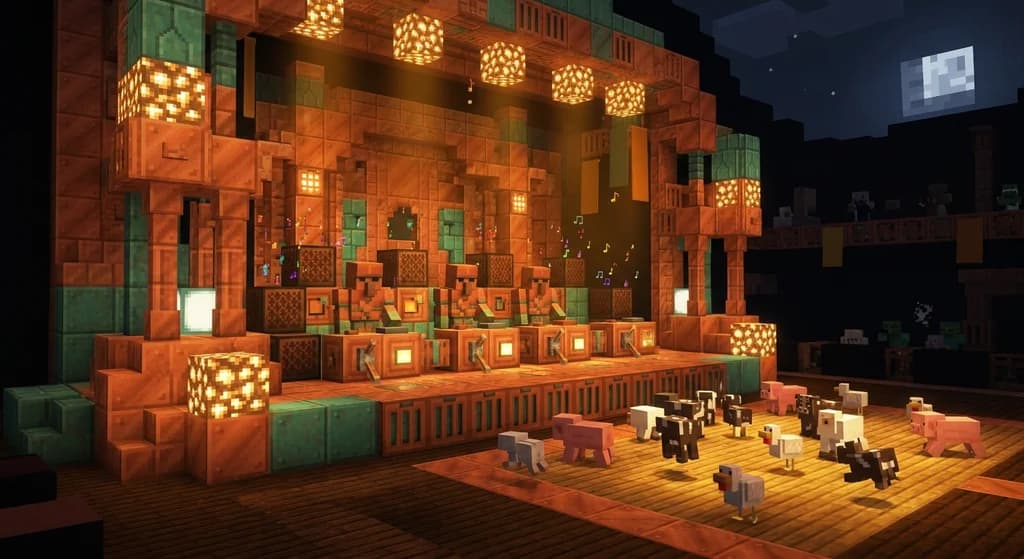
Bored in Minecraft? Here's how to build a fully automated Jazz Orchestra using Copper Golem randomized button-pressing, oxidation-tuned Trumpet Note Blocks, and Golden Dandelion-frozen baby mobs as a permanent choir section. After reading, you'll have a working musical machine that composes itself — and sounds genuinely incredible.
Table of Contents
- What is the Copper Golem Jazz Orchestra?
- How to Set Up Your Automated Jazz Orchestra
- Best Strategies for Your Jazz Orchestra Build
- Why This Concept Works
- How to Put This Into Practice on Gaia Legends
- Conclusion
- FAQ
What is the Copper Golem Jazz Orchestra?
You know that creeping feeling — you log into Minecraft, stare at your base, and realize you've built everything you wanted to build. The diamonds are mined, the Nether fortress is looted, and the Ender Dragon is a distant memory. What now?
Here's what: you build something that plays music at you while you wander your world.
The Copper Golem Jazz Orchestra is a technical automation challenge that combines three of the most exciting mechanics from the 2025–2026 update era into a single, self-playing musical installation. It's one of the most creative Minecraft gameplay ideas to emerge from the Copper Age drop, and it rewards both redstone nerds and aesthetic builders equally.
Copper Golem Jazz Orchestra is a player-designed automated music system in which Copper Golems randomly activate Trumpet Note Blocks placed on Copper Blocks at varying oxidation levels, producing emergent jazz-style melodies, while Golden Dandelion-frozen baby mobs serve as a permanent ambient choir whose new sound variants add harmonic texture to the composition.
This isn't just a "cool redstone thing." It's a living, breathing musical machine that generates different music every time it runs — because the Copper Golem's button-pressing behavior is intentionally random, and oxidation states create a natural pitch ladder across your instrument array.
The Three Pillars of the Build
Every great Minecraft automation challenge has a mechanical spine. This one has three vertebrae:
- Copper Golems — Introduced in Java Edition 1.21.9, these mechanical companions wander and randomly press nearby buttons. Their unpredictability is the "jazz" in your jazz orchestra.
- Trumpet Note Blocks — Also from 1.21.9, a Note Block placed on a Copper Block produces a trumpet sound. Critically, the pitch character shifts based on the oxidation level of the Copper Block beneath it — fresh copper, exposed copper, weathered copper, and oxidized copper each yield a distinct tonal quality.
- Golden Dandelion Baby Mob Choir — Added in Java Edition 26.1, the Golden Dandelion permanently stops baby mobs from aging when you interact with them while holding one. Baby wolves, cats, pigs, horses, and chickens all received new sound variants in 26.1, and each animal is randomly assigned one of these variants. A choir of age-locked babies with randomized sound variants creates a genuinely unpredictable ambient vocal layer.
Put these three pillars together and you have something no other Minecraft challenge idea quite replicates: a generative music machine.
How to Set Up Your Automated Jazz Orchestra
Materials Checklist
Before you lay a single block, gather everything on this list:
For the Trumpet Section (Note Block Array):
- 32+ Copper Blocks in mixed oxidation states (fresh, exposed, weathered, oxidized — at least 8 of each)
- 32+ Note Blocks
- Copper Golem Spawn Eggs or Copper Golem Statue Blocks (at least 4–8 golems for a full orchestra)
- Buttons (stone or wooden — Copper Golems can press both)
- Redstone Dust and Repeaters for signal routing
For the Baby Mob Choir:
- Golden Dandelions (at least one per baby mob you want to freeze)
- A selection of baby mobs: wolves, cats, pigs, horses, and chickens all have new sound variants in 26.1
- Name Tags (optional but highly recommended — named mobs don't despawn, protecting your choir investment)
- Leads and Fences to pen your choir in place
For the Stage Itself:
- Copper Decorations (slabs, stairs, chiseled variants from 1.21.9)
- Copper Chests for prop storage
- Shelves (also from 1.21.9) for aesthetic instrument storage displays
- Lighting of your choice — sea lanterns and soul lanterns work beautifully against oxidized copper's teal tones
World Settings
This build works in Survival or Creative. For Survival, consider:
- Difficulty: Normal — you want the Copper Golems active and wandering, not frozen
- Mob Griefing: ON — Copper Golems need to press buttons
- Cheats or a Gaia server command for oxidation control (more on this in the Gaia section)
Note: Copper Golems only press buttons — they do NOT activate pressure plates or tripwires. Make sure every instrument trigger in your array uses a button, not a plate. This is the single most common setup mistake.
Step-by-Step Build Guide
Follow these steps in order. Skipping ahead causes timing headaches later.
-
Lay your Copper Block grid. Arrange your 32 Copper Blocks in a 4×8 grid (or any shape you like). Group them by oxidation stage: one quadrant of fresh copper, one of exposed, one of weathered, one of oxidized. This creates four distinct "sections" of your orchestra — think brass, mid-brass, mellow brass, and muted brass.
-
Place Note Blocks on top of every Copper Block. Each Note Block now produces a trumpet sound. Right-click each one to tune it to your desired pitch within that section. You have 25 pitch steps per Note Block, so you can create full scales across your oxidation quadrants.
-
Attach a button to the side of each Note Block. Wire each button to a short redstone circuit that also fires the Note Block directly, so the Golem's press triggers sound immediately with no lag.
-
Place your Copper Golems. Spawn or construct 4–8 Copper Golems across the grid. They will wander and press buttons at random. More golems = denser, busier jazz. Fewer golems = sparse, contemplative ambient music. Start with 4 and adjust to taste.
-
Build your choir pen. Choose a raised platform or curved amphitheater area adjacent to the main stage. Pen your baby mobs here using fences and leads. Aim for at least 2–3 babies per species for rich harmonic layering, since each animal has a randomly assigned sound variant — you have a 1-in-3 chance (or better) of getting a unique vocal color per mob.
-
Apply Golden Dandelions. Hold a Golden Dandelion and interact with each baby mob. You'll see green particles moving downwards — this confirms aging has been stopped. These babies are now permanent choir members. They will never grow up, never change their sound variant, and never stop contributing to your ambient soundscape.
-
Name every choir mob. Use Name Tags to lock them to your world. Unnamed mobs can despawn even when age-locked.
-
Test the full system. Stand at the center of your stage and listen. The Copper Golems should be pressing buttons, the Trumpet Note Blocks firing across four tonal zones, and your baby choir providing a soft ambient underscore. If it sounds chaotic — perfect. That's jazz.
Pro Tip: Place a Copper Golem Statue Block at each corner of your stage as decorative sentinels. They look incredible against oxidized copper walls and signal to any visitor exactly what kind of build they've walked into.
Best Strategies for Your Jazz Orchestra Build
Difficulty Tiers
Not everyone wants to commit to a 32-instrument build on day one. Here's how to scale the challenge:
| Tier | Golem Count | Note Block Count | Choir Size | Oxidation Control |
|---|---|---|---|---|
| Casual Quartet | 2 Golems | 8 Note Blocks | 4 baby mobs | Natural oxidation only |
| Full Big Band | 6 Golems | 32 Note Blocks | 12 baby mobs | Manually scraped sections |
| Legendary Orchestra | 12 Golems | 64 Note Blocks | 20+ baby mobs | Precisely tuned per section |
| Gaia Insane Mode | 12 Golems | 64 Note Blocks | 20+ baby mobs | /oxidize command per block |
The "Oxidation Ladder" Tuning Strategy
Here's the advanced technique that separates a good orchestra from a legendary one: treat your four oxidation stages as four instrument sections, each with a different tonal character.
- Fresh Copper → Bright, punchy trumpet hits. Tune these Note Blocks to high pitches (steps 18–25). This is your lead melody section.
- Exposed Copper → Slightly warmer tone. Tune to mid-high pitches (steps 13–17). This is your counter-melody section.
- Weathered Copper → Mellow, rounded sound. Tune to mid-low pitches (steps 7–12). This is your harmonic fill section.
- Oxidized Copper → Deep, muted trumpet. Tune to low pitches (steps 1–6). This is your bass line section.
With this layout, even fully random Golem button-pressing tends to sound musical, because the pitch relationships within each section are harmonically coherent.
Multiplayer Variations
Playing on a server? The Jazz Orchestra becomes a collaborative composition challenge:
- Conductor Role: One player manages oxidation states, scraping or waxing Copper Blocks to shift the orchestra's tonal character in real time during a performance.
- Golem Wrangler Role: One player herds and repositions Copper Golems to bias which sections get activated most.
- Choir Master Role: One player manages the baby mob choir — adding new species, applying Golden Dandelions to fresh babies, and curating the ambient vocal layer.
- Audience Role: Honestly, just standing in the center and listening is its own reward.
The "Slow Oxidation" Composition Technique
Here's a long-game idea that turns this into one of the most unique Minecraft challenges available: let your orchestra age in real time.
Build your entire array using fresh copper at the start. Every Golem press fires a bright, punchy high note. Over the following in-game weeks, the copper naturally oxidizes — first to exposed, then weathered, then fully oxidized. As it does, the tonal character of each section gradually deepens and mellows. The orchestra literally evolves over time without you touching a thing.
Document the sound at Week 1, Week 4, and Week 8. You'll have three completely different musical moods from the same physical build.
Why This Concept Works
The Design Logic
The reason this Minecraft gameplay idea is so compelling comes down to one word: emergence. No single mechanic here is doing all the work. The Copper Golem's randomness, the oxidation pitch ladder, and the baby mob choir's sound variants each contribute a layer of unpredictability — and when you stack three unpredictable systems, you get something that feels genuinely alive.
Copper Golems press buttons at random intervals with no fixed pattern. This means your orchestra never plays the same sequence twice. It's procedural music generation built entirely from vanilla mechanics.
The Note Block trumpet sound has 4 distinct tonal characters based on oxidation level. That's not just cosmetic variety — it's a genuine four-register instrument array, equivalent to having soprano, alto, tenor, and bass brass sections.
Baby mobs in Java 26.1 each have a randomly assigned sound variant from a pool that includes the classic sound plus new variants. With wolves, cats, pigs, horses, and chickens all in play, your choir can have up to 10 distinct vocal timbres active simultaneously. Age-lock them with Golden Dandelions and that choir is permanent.
What Makes It Replayable
- Every world seed generates a different choir. Because sound variants are randomly assigned at spawn, your baby mob choir on one world will sound different from another player's choir on a different seed.
- Oxidation is irreversible without scraping. This means your artistic decisions about which sections to wax (freeze in time) and which to let age are genuinely permanent in Survival mode — adding real stakes to your composition choices.
- Copper Golems can be repositioned. Moving a Golem from the high-pitch fresh copper section to the low-pitch oxidized section completely changes the character of your music. The same build can produce wildly different results just by rearranging your performers.
How Recent Updates Make It Possible
This build literally could not have existed before 1.21.9. The Copper Golem as a mechanical companion, the Trumpet Note Block instrument, and the oxidation-based pitch variation are all from that drop. The Golden Dandelion age-locking mechanic and the new baby mob sound variants are from 26.1. Stack both updates and you have a build that sits at the absolute frontier of what Minecraft's vanilla systems can do in 2026.
How to Put This Into Practice on Gaia Legends
Everything described above works in vanilla Minecraft — but Gaia Legends takes the Copper Golem Jazz Orchestra from impressive to extraordinary.
Gaia's custom Mechanical Master rank unlocks the /oxidize command, which lets you instantly set the oxidation level of any Copper Block to a precise stage. In vanilla, reaching fully oxidized copper takes real-world weeks. On Gaia, a Mechanical Master can tune an entire 64-block orchestra array in under five minutes — setting each block to its exact desired oxidation stage for perfect tonal control.
This transforms the "Slow Oxidation Composition Technique" from a months-long passive project into an active, real-time performance tool. During a live server concert, a Mechanical Master Conductor can /oxidize blocks on the fly, shifting the orchestra's register mid-performance the way a real conductor modulates dynamics.
Gaia also supports Java + Bedrock crossplay, so your orchestra can have an audience from both platforms. There's no pay-to-win pressure — every mechanical feature is earnable through gameplay.
Gaia Legends is free to join, non-pay-to-win, and supports Java + Bedrock crossplay. Join at gaialegends.pro and remix your Minecraft experience today.
Conclusion
The Copper Golem Jazz Orchestra is proof that Minecraft in 2026 has more creative depth than ever — you just need to know where to look. Here are the three things to take away:
- Copper Golems are random by design — lean into that randomness instead of fighting it, and you get generative music for free
- Oxidation is a four-stage pitch ladder — treat each stage as an instrument section and your Note Block array gains instant musical coherence
- Golden Dandelion baby mobs are permanent choir members — age-lock your best-sounding babies and they'll sing in your orchestra forever
Try building the Casual Quartet tier tonight — just 2 Copper Golems, 8 Note Blocks, and 4 age-locked baby mobs. Give it ten minutes to run and share what you hear. You'll be planning the Legendary Orchestra before the night is over.
FAQ
What is Minecraft copper golem automation and how does it work in a Jazz Orchestra build?
Minecraft copper golem automation refers to using the Copper Golem's built-in random button-pressing behavior as a mechanical trigger for redstone and Note Block systems. In a Jazz Orchestra build, you arrange Copper Golems across a grid of Trumpet Note Blocks placed on Copper Blocks at varying oxidation levels. Each Golem wanders independently and presses buttons at random, firing notes unpredictably — creating emergent, jazz-style musical sequences without any player input.
What to do when bored in Minecraft in 2026?
When boredom hits, the best cure is a creative constraint. Instead of open-ended building, give yourself a specific mechanical challenge — like constructing an automated Jazz Orchestra using Copper Golems, oxidizing Trumpet Note Blocks, and a Golden Dandelion-frozen baby mob choir. The combination of randomness, long-term oxidation progression, and aesthetic design gives you goals at every skill level, from a quick Casual Quartet to a full Legendary Orchestra.
How does the Golden Dandelion work for the baby mob choir section?
The Golden Dandelion, added in Java Edition 26.1, stops baby mobs from aging when you interact with them while holding one. Green particles moving downward confirm the effect. For the choir, you apply it to baby wolves, cats, pigs, horses, and chickens — each of which has a randomly assigned sound variant from the new variants added in 26.1. Age-locked babies keep their assigned variant permanently, giving you a stable, unique choir. Use Name Tags too, since unnamed mobs can still despawn.
How does Trumpet Note Block tuning work with different oxidation levels?
A Note Block placed on a Copper Block produces a trumpet instrument sound, introduced in Java Edition 1.21.9. The tonal character of that trumpet sound changes depending on the oxidation level of the Copper Block beneath it — fresh copper gives a bright, punchy tone while fully oxidized copper produces a deep, muted sound. You can still tune the pitch of each Note Block across 25 steps independently of the oxidation effect, giving you both tonal color and precise pitch control.
Do I need redstone experience to build a Copper Golem Jazz Orchestra?
You need basic redstone knowledge — specifically how to connect a button to a Note Block with a short wire and use repeaters to avoid signal bleed between adjacent instruments. You do NOT need advanced redstone skills like piston doors or flying machines. The Copper Golem handles all the "automation" for you by pressing buttons on its own. If you can build a simple doorbell circuit, you have enough redstone knowledge to build the Casual Quartet tier.
Can I build the Jazz Orchestra on a multiplayer server?
Absolutely — multiplayer actually enhances the build significantly. You can split into roles: a Conductor who manages oxidation states in real time, a Golem Wrangler who repositions Copper Golems to bias which sections play most, and a Choir Master who curates the baby mob vocal section. On a server like Gaia Legends, the Mechanical Master rank's /oxidize command lets the Conductor shift tonal registers instantly during a live performance, making multiplayer orchestra sessions genuinely theatrical.
Recommended
Frequently Asked Questions
What is Minecraft copper golem automation and how does it work in a Jazz Orchestra build?
Minecraft copper golem automation refers to using the Copper Golem's built-in random button-pressing behavior as a mechanical trigger for redstone and Note Block systems. In a Jazz Orchestra build, you arrange Copper Golems across a grid of Trumpet Note Blocks placed on Copper Blocks at varying oxidation levels. Each Golem wanders independently and presses buttons at random, firing notes unpredictably — creating emergent, jazz-style musical sequences without any player input.
What to do when bored in Minecraft in 2026?
When boredom hits, the best cure is a creative constraint. Instead of open-ended building, give yourself a specific mechanical challenge — like constructing an automated Jazz Orchestra using Copper Golems, oxidizing Trumpet Note Blocks, and a Golden Dandelion-frozen baby mob choir. The combination of randomness, long-term oxidation progression, and aesthetic design gives you goals at every skill level, from a quick Casual Quartet to a full Legendary Orchestra.
How does the Golden Dandelion work for the baby mob choir section?
The Golden Dandelion, added in Java Edition 26.1, stops baby mobs from aging when you interact with them while holding one. Green particles moving downward confirm the effect. For the choir, you apply it to baby wolves, cats, pigs, horses, and chickens — each with a randomly assigned sound variant. Age-locked babies keep their assigned variant permanently, giving you a stable, unique choir. Use Name Tags too, since unnamed mobs can still despawn even when age-locked.
How does Trumpet Note Block tuning work with different oxidation levels?
A Note Block placed on a Copper Block produces a trumpet instrument sound, introduced in Java Edition 1.21.9. The tonal character changes depending on the oxidation level of the Copper Block beneath it — fresh copper gives a bright, punchy tone while fully oxidized copper produces a deep, muted sound. You can still tune the pitch of each Note Block across 25 steps independently of the oxidation effect, giving you both tonal color and precise pitch control in the same build.
Do I need redstone experience to build a Copper Golem Jazz Orchestra?
You need only basic redstone knowledge — specifically how to connect a button to a Note Block with a short wire and use repeaters to avoid signal bleed between adjacent instruments. You do NOT need advanced redstone skills. The Copper Golem handles all the automation by pressing buttons on its own. If you can build a simple doorbell circuit, you have enough redstone knowledge to build the Casual Quartet tier and expand from there.
Can I build the Jazz Orchestra on a multiplayer server?
Absolutely — multiplayer enhances the build significantly. You can split into roles: a Conductor who manages oxidation states in real time, a Golem Wrangler who repositions Copper Golems to bias which sections play most, and a Choir Master who curates the baby mob vocal section. On Gaia Legends, the Mechanical Master rank's /oxidize command lets the Conductor shift tonal registers instantly during a live performance, making multiplayer orchestra sessions genuinely theatrical.
Related guides
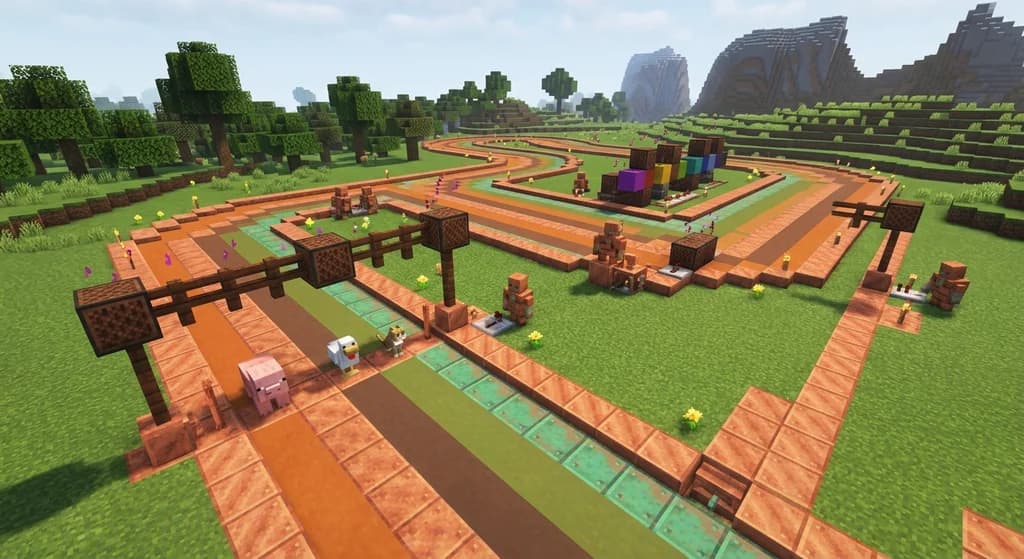
How to Build a Copper Golem Baby Mob Racing Circuit 2026 Guide
Build a Copper Golem baby mob racing circuit in Minecraft 2026. Use Golden Dandelion age-locking, oxidation trumpet lap timers & Gaia Legends betting arenas.
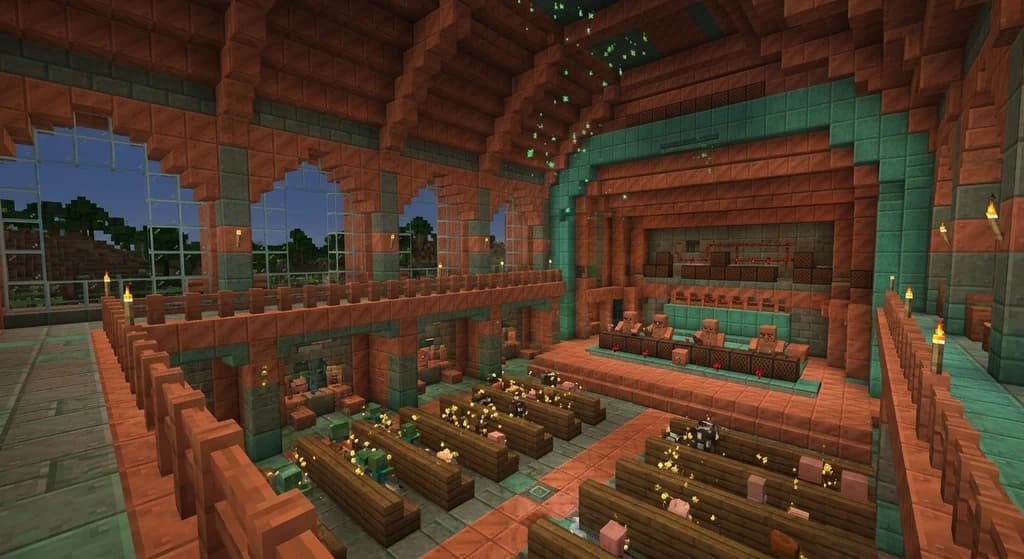
How to Master the Perpetual Tiny Mob Copper Orchestra 2026
Discover the ultimate Minecraft gameplay challenge for bored players: build a Perpetual Tiny Mob Copper Orchestra using Golden Dandelions, Copper Golems, and Oxidized Trumpets in 2026.
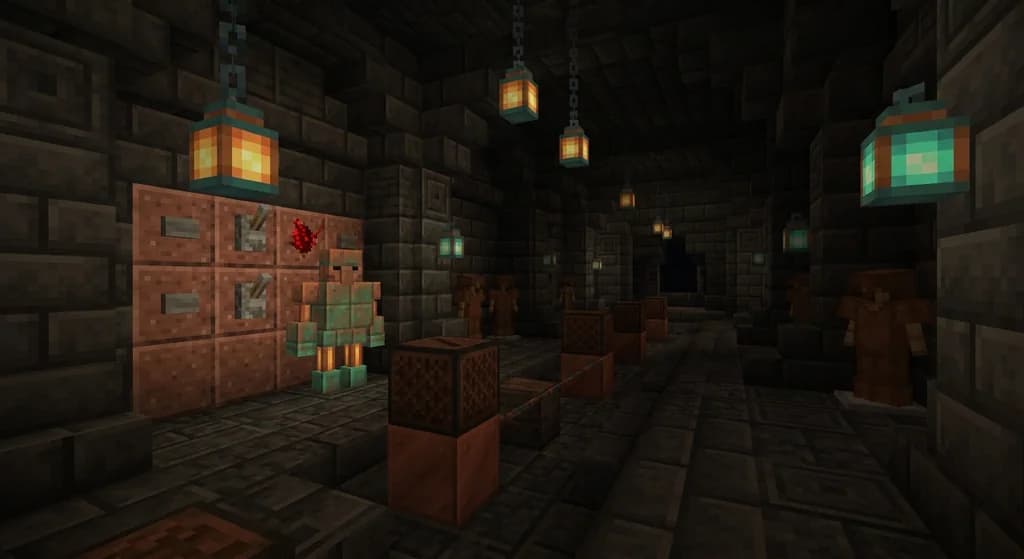
How to Build a Copper Trumpet Stealth Heist Course 2026
Discover fun things to build in Minecraft when bored 2026: a Copper Trumpet Stealth Heist Course using oxidation-based pitch alarms, Copper Golem guards, and Mannequin decoys.
How to Build a Copper Golem Flash-Stealth Trial in Minecraft 2026
Bored in Minecraft? Build a Copper Golem Flash-Stealth Trial using The End's flashing skylight, Golden Dandelion obstacles, and randomized redstone traps. Fresh 2026 gameplay ideas inside.
Have a question or another approach?
Compare notes with other readers. Include your edition and version when discussing mechanics.